
 Image 1 of 2
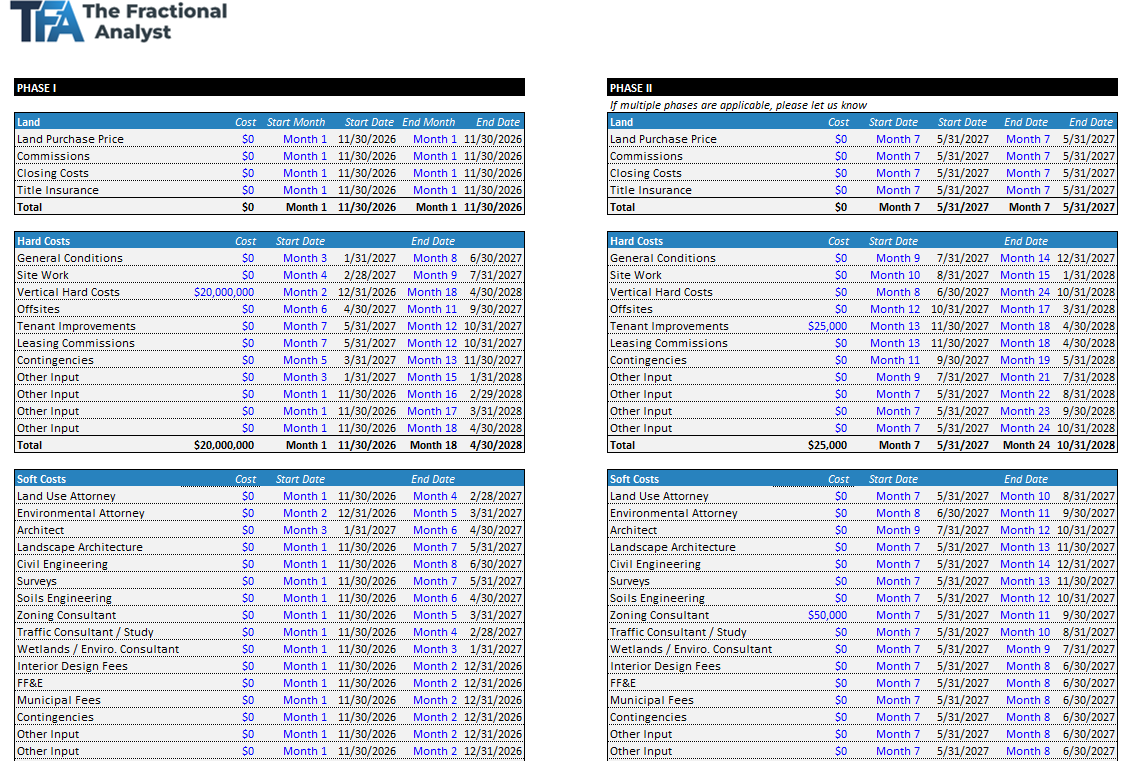 Image 2 of 2
This free file download comes with two checklists for residential development: for-sale & for-rent.
The operating standard for disciplined deal sourcing and competitive analysis
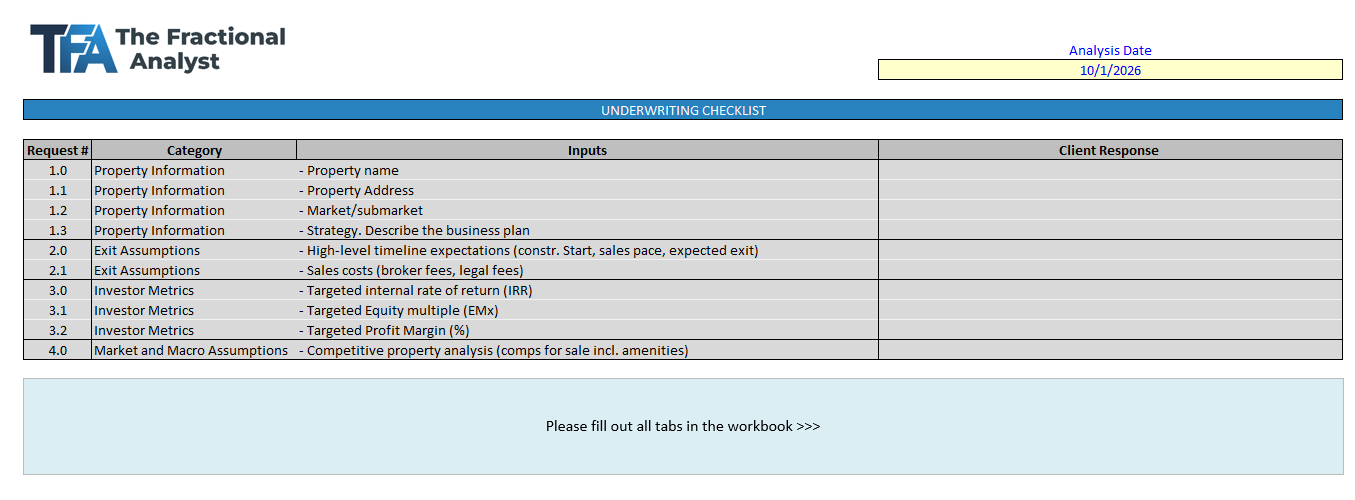
The residential for-sale underwriting checklist is a systematic data capture framework built to eliminate blind spots in early-stage deal evaluation. It operationalizes the diligence workflow by organizing requests into five core categories, each tied to a specific decision gate in the underwriting process.
What the checklist covers:
Property Fundamentals — Asset name, location, market positioning, and business plan articulation. This is the filter: if the strategy isn't clear, nothing downstream works.
Exit Structure — Realistic timeline assumptions (construction start, sales pace, exit date) and hard costs (broker fees, legal) that directly move the needle on return sensitivity.
Investor Metrics — Target IRR, equity multiple, and profit margin expectations established upfront so there's no debate later about whether a deal hit its marks.
Market Context — Competitive set analysis (comparable for-sale assets, amenity benchmarks) that grounds pricing and absorption assumptions in reality, not fantasy.
Project Economics — A complete cost model, capturing land acquisition, hard costs (from general conditions through vertical construction), soft costs (professional fees, permitting, design), and financing costs.
Why it matters:
Most deals blow up because missing data creates hidden assumptions. Your contractors think they know comps; your lender assumes rents; your investor guesses at hold times. This checklist forces those assumptions into daylight early, while you can still back out without losing $50k in due diligence spend.
Each data point requested is tied to a return driver or risk variable. There's no make-work here. Fill it in completely before you move to model build.
This free file download comes with two checklists for residential development: for-sale & for-rent.
The operating standard for disciplined deal sourcing and competitive analysis
The residential for-sale underwriting checklist is a systematic data capture framework built to eliminate blind spots in early-stage deal evaluation. It operationalizes the diligence workflow by organizing requests into five core categories, each tied to a specific decision gate in the underwriting process.
What the checklist covers:
Property Fundamentals — Asset name, location, market positioning, and business plan articulation. This is the filter: if the strategy isn't clear, nothing downstream works.
Exit Structure — Realistic timeline assumptions (construction start, sales pace, exit date) and hard costs (broker fees, legal) that directly move the needle on return sensitivity.
Investor Metrics — Target IRR, equity multiple, and profit margin expectations established upfront so there's no debate later about whether a deal hit its marks.
Market Context — Competitive set analysis (comparable for-sale assets, amenity benchmarks) that grounds pricing and absorption assumptions in reality, not fantasy.
Project Economics — A complete cost model, capturing land acquisition, hard costs (from general conditions through vertical construction), soft costs (professional fees, permitting, design), and financing costs.
Why it matters:
Most deals blow up because missing data creates hidden assumptions. Your contractors think they know comps; your lender assumes rents; your investor guesses at hold times. This checklist forces those assumptions into daylight early, while you can still back out without losing $50k in due diligence spend.
Each data point requested is tied to a return driver or risk variable. There's no make-work here. Fill it in completely before you move to model build.