
State of the Class B/C Multifamily Market in Central Florida
Focus geography: Orlando–Kissimmee–Sanford MSA / core Central Florida submarkets in Orange, Seminole, Osceola and Lake counties
Executive Summary
The Central Florida Class B/C apartment story is still attractive, but it is no longer a pure growth story. Over the last decade, the market benefited from strong in-migration, job growth, renter household formation and a widening affordability gap versus homeownership. That supported occupancy and rents across all vintages, with Class B/C generally outperforming Class A on occupancy because workforce renters had fewer alternatives.
The current market is in a late-supply-cycle reset. New deliveries have weighed on metro-wide occupancy and rent growth since 2023, especially in Class A lease-up product. Class B/C has held up better because it remains the relative-affordability option, but its cash flow is being pressured by three expense line items: insurance, property taxes and capital expenditures.
For the next 2–3 years, the setup looks better than the last 24 months. Construction starts are slowing, absorption is improving, and the market appears to be moving from oversupply toward balance. That should help stabilize Class B/C occupancy and return modest asking-rent growth. The main underwriting risk is not demand; it is expense growth and the ability to maintain collections from renters who are still highly payment-sensitive.
What "Class B/C" means in this market
In Central Florida, Class B/C usually means 1980s–2000s vintage garden product and older suburban assets serving workforce renters. These properties tend to compete on:
monthly affordability versus new Class A product
location near jobs, schools and transportation corridors
unit functionality rather than luxury amenity packages
operational execution, safety, cleanliness and resident service
This segment has been more resilient on occupancy than luxury product, but it also faces the heaviest burden from:
older roofs, plumbing, electrical and HVAC systems
rising insurance deductibles and tighter underwriting
reassessments after cap-rate compression and value growth
deferred maintenance and code/life-safety upgrades
Decade in review: 2015 to 2025
1) Occupancy
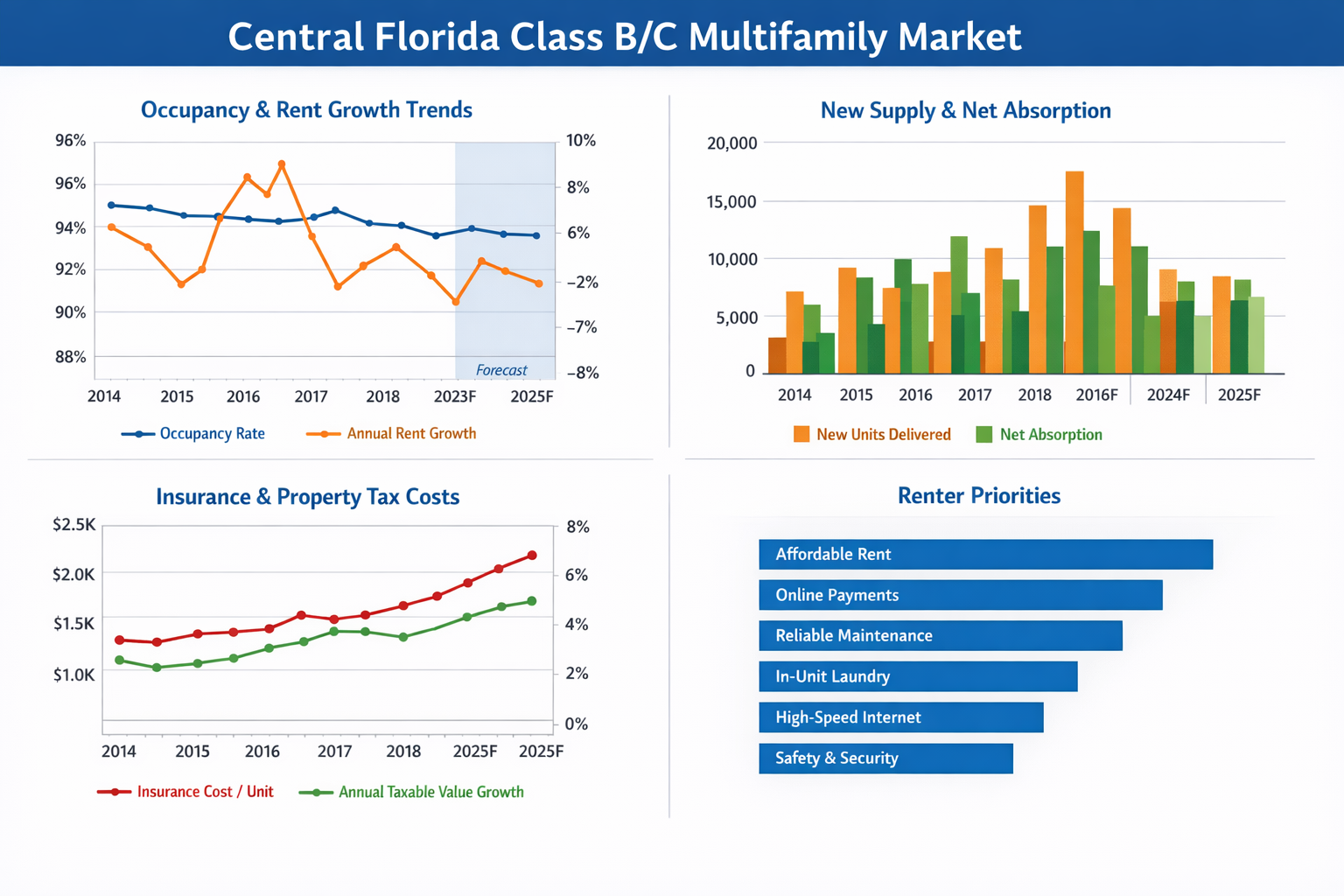
Over most of the last decade, Central Florida multifamily occupancy was healthy by national standards. The strongest period was the post-pandemic run-up in 2021–2022, when migration, wage growth and limited for-sale affordability tightened apartment demand.
The reset began in 2023 and continued through 2025 as a large wave of completions hit the Orlando metro. Metro-wide stabilized occupancy fell to the low-92% to low-93% range in 2025, the softest reading in years.
Important for Class B/C: lower-tier product still outperformed luxury. One useful benchmark from Berkadia: over the last 10 years, average Orlando Class C occupancy ran about 170 basis points above Class A. That is the core B/C thesis in Central Florida: when affordability is strained, older workforce product stays fuller.
2) Asking rents
The decade can be split into three phases:
2015–2019: steady, fundamentals-driven rent growth
2020–2022: accelerated rent growth during the migration and inflation boom
2023–2025: deceleration to flat or slightly negative growth because of supply pressure
By late 2025, most Orlando metro reports showed advertised/effective rents roughly flat to down modestly year over year. That reflects market-level averages; Class B/C generally held pricing better than top-of-market new product because it remained the affordable substitute.
3) Supply
Supply is the biggest reason fundamentals softened.
Central Florida was one of the nation’s most active multifamily development markets. Orlando ended 2025 with a very large pipeline still under construction, though materially below peak underway counts seen earlier in the cycle. Deliveries outpaced absorption for stretches in 2024–2025, which pushed concessions higher and pressured occupancies.
For B/C owners, the supply issue is indirect as much as direct. New Class A lease-ups often steal the top of the B renter pool through concessions. That creates a chain reaction: Class A competes with B, B competes with C, and operators across the stack become more aggressive on pricing and screening.
4) Absorption
Demand has been better than many feared. Central Florida continues to benefit from population growth, tourism, logistics, healthcare and broad service-sector employment.
Even during the recent soft patch, absorption remained solid enough to prevent a more severe correction. The market’s challenge was that demand was good while supply was extraordinary.
5) Debt terms over the decade
Debt has moved through three eras:
2015–2021: low-rate, high-liquidity period with aggressive leverage available
2022–2024: sharp rate shock, wider spreads, lower proceeds, higher DSCR sensitivity, floating-rate pain
2025–2026: improving but still disciplined lending environment
For B/C assets today, debt is available, but lenders are more conservative on:
insurance assumptions
replacement reserves
roof age and remaining useful life
T12 collections quality
delinquency and bad-debt trends
near-term tax reassessment risk
Current market snapshot: where Central Florida stands now
Occupancy
Central Florida occupancy looks close to a cyclical bottom rather than the start of a deeper deterioration. Market reports through late 2025 and early 2026 point to stabilization around the low-90s, with better performance in affordable/well-located workforce assets than in brand-new luxury product still fighting for lease-up.
B/C read-through: expect stronger physical occupancy than the market average, but often with more management friction, slower turns and tighter resident payment capacity.
Asking rents
Rents have reset from peak-growth years. Owners should not underwrite 2021–2022 style rent growth. The near-term story is stabilization, selective increases on renovated units, and better retention economics than aggressive mark-to-market pushes.
What is working in B/C:
smaller, frequent increases instead of large renewals
preserving occupancy and collections over headline asking-rent gains
using unit upgrades selectively where the rent premium is truly proven
Supply
Supply is still elevated, but the construction pipeline is now moving in the right direction. Starts have slowed because financing, insurance, labor and construction costs remain high. That matters because the market does not need demand to surge; it mainly needs the pipeline to normalize.
Absorption
Absorption should stay positive because Central Florida still attracts households priced out of homeownership and other higher-cost metros. Workforce demand is intact. The key operating issue is not whether there are renters; it is whether they qualify, pay on time and stay.
Forecast: next 2–3 years
Base case: 2026–2028
Occupancy
Likely path: gradual improvement from current levels as the delivery wave fades. Class B/C should continue to outperform Class A on occupancy because affordability remains the market’s defining theme.
Asking rents
Likely path: modest positive growth rather than another boom. Expect low-single-digit rent growth in better-located B product, with C product more dependent on collections discipline and submarket employment conditions.
Supply
Likely path: starts remain muted, completions roll down, lease-up pressure eases by late 2026 into 2027. This is the biggest support for the forecast.
Absorption
Likely path: steady. Migration may moderate from prior extremes, but the region still has enough demographic support to absorb normalized supply.
Debt terms
Likely path: better than 2023–2024, but not loose. More lender appetite should improve execution for agency and bank debt, yet underwriting will stay conservative because insurers and tax burdens remain volatile.
Practical debt expectations for B/C deals today
Typical financing themes for stabilized B/C assets in Florida:
lower leverage than peak-cycle lending
more stress on replacement reserves and capex escrows
stronger preference for fixed-rate agency executions on durable workforce deals
floating-rate debt usually reserved for high-conviction value-add with substantial liquidity support
wider lender differentiation based on roof age, claims history, flood/wind exposure, and sponsor insurance strategy
In plain English: debt is more available than it was in the freeze period, but it rewards clean stories. The clean story is: durable collections, low delinquency, no major deferred maintenance, recent roofs, proven insurance placement, and a credible tax posture.
Insurance market: property-level and portfolio-level
Florida insurance remains one of the biggest reasons Class B/C underwriting feels harder than the topline rent story would suggest.
Property-level insurance
The property-level market has improved from crisis conditions, but it is still expensive and underwriting-heavy. Owners of older Central Florida apartments continue to face scrutiny on:
roof age and type
prior claims history
plumbing and electrical systems
wind mitigation features
flood zone exposure and water intrusion history
update history by building and by line (roof/HVAC/plumbing/electrical)
What has changed: the state insurance market has shown signs of stabilization after reforms, and Citizens is moving back toward being an insurer of last resort rather than the dominant carrier. That is positive.
What has not changed enough: many apartment owners still face high premiums, higher deductibles, layered wind coverage, and greater demand for engineering reports and loss-control documentation.
For Class B/C, the gap between "insurable" and "financeable at acceptable economics" can be meaningful. A property may obtain coverage but at a deductible structure or premium load that destroys debt yield and cash flow.
Portfolio-level insurance
Portfolio strategies can still create value, but only when the schedule is curated.
Portfolio benefits may include:
more negotiating leverage with brokers/carriers
blending of stronger and weaker locations
centralized loss-control and maintenance reporting
captive or high-deductible strategy opportunities for sophisticated owners
Portfolio risks include:
one poor-loss property contaminating the entire schedule
concentration issues in wind-exposed counties
aggregate deductible exposure in storm years
lender-level complexity when different assets have different covenant packages
Insurance conclusions for B/C owners
The best operators in Central Florida are treating insurance as an operating discipline, not a once-a-year procurement event. Winning practices include:
pre-binding engineering and wind-mitigation review
roof replacement planning before renewal crises
standardized incident reporting and claim management
submetering / leak detection / shutoff controls where feasible
broker competition and early marketing of the account
very detailed property-condition records for older assets
Property taxes: trend and outlook
Property taxes have been a major NOI headwind.
The key pattern over the last decade has been:
values rose sharply during the 2021–2023 run-up
assessments followed with a lag
many buyers underwrote based on in-place taxes and then got hit by reset risk after acquisition
even where millage is flat or only modestly changed, taxable value growth still increases tax bills
That dynamic especially hurts B/C acquisitions bought for a value-add business plan, because the buyer can get hit three ways at once:
reassessment after sale
rising insurance
capex to keep the property insurable and competitive
Local tax trends in core Central Florida counties
Recent county-level tax-roll data show that taxable values are still growing in core Central Florida, even as the apartment market has cooled from its peak. Seminole County’s 2025 taxable value, for example, increased meaningfully year over year, and Orange County continues to publish annual tax roll growth and final millage schedules showing how tax burdens can rise even without a dramatic millage jump.
Bottom line: for apartment underwriting, assume tax pressure remains real. The tax issue is less about a sudden spike in nominal millage and more about steadily rising assessed values, especially after sale or major renovation.
What the state and local governments are doing
State of Florida
The state remains active on both insurance and property taxes.
Insurance
The 2022–2025 reform cycle was intended to stabilize Florida’s property insurance market through litigation, reinsurance, claims and Citizens-related changes. The latest official updates continue to frame the market as stabilizing, with Citizens shrinking and private market participation improving.
For apartment owners, that does not mean cheap insurance. It means the market is becoming more functional, but underwriting discipline remains strict.
Property taxes / multifamily-specific exemptions
Florida has expanded and clarified affordable-housing-related ad valorem exemptions for qualifying multifamily projects through Live Local and later bulletins/statutory changes. Those changes matter most for income-restricted or mixed-income deals that can qualify under the applicable affordability rules.
That is a real opportunity for workforce and missing-middle strategies, but it is not a universal solution for conventional B/C owners. Operators need property-tax counsel and appraiser-level review to determine whether any affordability component or land structure qualifies.
Local governments and municipalities
At the local level, Central Florida jurisdictions are mostly focused on:
affordable housing production and preservation
trust funds and local subsidy programs
zoning / land-use flexibility for housing supply
redevelopment in targeted corridors
Examples include Orange County’s Housing for All initiative and local housing action plans in Orlando and surrounding jurisdictions. These efforts are supportive of long-term rental demand and affordable housing production, but they do not remove the current expense pressure on conventional workforce assets.
The average renter in this market and what they want
There is no single renter profile, but the median Central Florida Class B/C renter is generally more payment-sensitive than the renter targeted by new luxury deliveries.
Typical characteristics of the workforce renter pool in this market:
higher sensitivity to total monthly housing cost than to amenity prestige
strong interest in convenience, safety and reliability
willingness to pay for practical features if they clearly improve daily life
less tolerance for surprise fees, poor maintenance response and friction in payments or move-in
The broader Orlando housing market also remains meaningfully cost-burdened, which explains why affordability and payment flexibility matter so much.
What renters say they prefer
Across current renter-preference surveys, the most durable priorities are practical rather than flashy:
in-unit laundry or laundry convenience
air conditioning and reliable HVAC
strong mobile/internet connectivity
transparent fees and pricing
easy online leasing and resident communication
digital rent payment options
secure package handling and access control
well-maintained parking and lighting
responsive maintenance
Surveys also continue to show strong renter interest in flexible payment options and a smoother digital experience.
How owners and developers can attract higher-quality residents and lower collection risk
The strongest playbook for Central Florida B/C is not "amenitize like Class A." It is "remove friction, improve trust, and protect the resident’s budget."
High-ROI resident strategy
1) Win on reliability, not luxury
For workforce renters, clean common areas, safety, HVAC reliability, quick work orders and pest control often matter more than a clubhouse refresh.
2) Keep fee structures simple
Hidden fees damage conversion and renewal. Transparent all-in pricing attracts better applicants and reduces payment disputes.
3) Offer flexible payments carefully
Split-payment options, early engagement before delinquency, and digital autopay tools can reduce collections friction when paired with disciplined underwriting.
4) Tighten screening without becoming too narrow
Best practice is layered screening:
income verification
employment durability
rent-to-income analysis
prior housing behavior
nuanced use of credit rather than blunt score cutoffs alone
5) Invest in resident communication
B/C collections performance improves when management communicates early, clearly and digitally. Missed payments are often preceded by resident disengagement.
6) Focus capex on the daily-use items
The best B/C renovation dollars often go to:
lighting and security cameras
parking and curb appeal
laundry, package and access solutions
kitchen and bath refreshes with durable finishes
low-maintenance flooring
leak detection and water management
7) Protect school and commute convenience
In suburban Central Florida, location near schools, service employment, logistics corridors, healthcare jobs and daily retail matters more than luxury branding.
What owners should do now
For lenders
Underwrite insurance with real quotes, not generic assumptions
Recast taxes to post-sale levels immediately
Stress collections, not just physical occupancy
Differentiate between true workforce assets and "old Class A with deferred maintenance"
Reward sponsors that show documented roof/plumbing/electrical plans
For investors
Prefer submarkets with durable workforce demand and less near-term Class A delivery pressure
Buy collections quality and expense control, not only headline occupancy
Treat insurance engineering and tax appeal work as part of the business plan
Underwrite slower rent growth but better long-run durability in Class B/C than in commodity Class A lease-up competition
For operators
Run renewals to maximize retention and collections, not sticker rent
Use selective upgrades instead of broad luxury repositioning
Rebid insurance early and prepare renewal documentation months ahead
Appeal taxes aggressively where reassessments outpace income reality
Track delinquency, NSF activity, skip risk and service-ticket response times as leading indicators
Overall conclusion
The Central Florida Class B/C multifamily market is not distressed; it is being repriced around a more realistic operating model.
Demand remains real. Occupancy in workforce housing should stay relatively resilient. Supply pressure is fading. Those are positives.
But the winning B/C strategy for the next 2–3 years is operational excellence, not aggressive rent growth. The owners who outperform will be the ones who control insurance, challenge taxes, preserve collections, and deliver a dependable resident experience at a monthly cost that still feels attainable.
That combination should produce better risk-adjusted performance than chasing luxury competition in a market that is still digesting new supply.
Research and articles used for this report
Cushman & Wakefield Orlando Multifamily MarketBeat Q4 2025
https://www.cushmanwakefield.com/en/united-states/insights/us-marketbeats/orlando-marketbeatsOrlando Multifamily MarketBeat PDF Q4 2025
https://assets.cushmanwakefield.com/-/media/cw/marketbeat-pdfs/2025/q4/us-reports/multifamily/orlando_americas_marketbeat_multifamily_q42025.pdfNorthmarq: Orlando Multifamily Transaction Activity Accelerates
https://www.northmarq.com/insights/insights/transaction-activity-accelerates-second-halfMarcus & Millichap / IPA Orlando 1Q 2026 Multifamily Market Report
https://www.institutionalpropertyadvisors.com/research/market-report/multifamily/orlando/orlando-2026-investment-forecast-ipa-multifamily-market-reportYardi Matrix Orlando Multifamily Market Report December 2025
https://www.yardimatrix.com/blog/orlando-multifamily-market-report/MMG Real Estate Advisors 2026 Orlando Forecast
https://mmgrea.com/2026-orlando-forecast/MMG Orlando Q2 2025 Market Report
https://mmgrea.com/orlando-q2-2025-market-report/Berkadia Mid-Year 2024 Orlando Multifamily Report
https://www.berkadia.com/research/berkadia-mid-year-2024-multifamily-report-orlando/HUD Comprehensive Housing Market Analysis: Orlando-Kissimmee-Sanford HMA
https://www.huduser.gov/portal/publications/pdf/OrlandoKissimmeeSanfordFL-CHMA-24.pdfHUD Housing Market Profile: Orlando-Kissimmee-Sanford, July 2024
https://www.huduser.gov/portal/periodicals/USHMC/reg/OrlandoKissimmeeSanfordFL-HMP-July24.pdfFlorida Department of Financial Services: Property Insurance Changes
https://myfloridacfo.com/division/ica/propertyinsurancechangesFlorida Office of Insurance Regulation: Property Insurance Market Update
https://floir.com/docs-sf/property-casualty-libraries/property-insurance-market-overview/insurance-update-may-2024.pdfFlorida Department of Revenue PTO Bulletin 25-13
https://www.floridarevenue.com/TaxLaw/Documents/PTO%20BUL%2025-13%20-%20Exemption%20for%20Affordable%20Housing%20on%20Governmental%20Property.pdfFlorida Department of Revenue PTO Bulletin 25-11
https://floridarevenue.com/TaxLaw/Documents/PTO%20BUL%2025-11%20-%20Affordable%20Housing%20Property%20Exemption%20Land%20Leased%20From%20a%20Housing%20Finance%20Authority%20and%20From%20a%20Nonprofit.pdfFlorida Senate SB 1350 (2026)
https://www.flsenate.gov/Session/Bill/2026/1350/Orange County Property Appraiser Tax Roll & Millage Rates
https://ocpaweb.ocpafl.org/faqcontent/Taxroll_InfoOrange County 2025 Tax Roll Certification
https://ocpaimages.ocpafl.org/api/Content/GetContentDynamicFile?contentFileID=416714Seminole County Property Appraiser Tax Roll Facts
https://www.scpafl.org/information/tax-rollCity of Orlando Budget Documents 2024-2025
https://www.orlando.gov/Our-Government/Records-and-Documents/Financial/Budget-Documents/2024-2025Orange County Housing for All
https://www.orangecountyfl.net/NeighborsHousing/HousingForAll.aspxOrange County Housing Trust Fund Plan 2026-2028
https://www.orangecountyfl.net/Portals/0/Resource%20Library/neighbors%20-%20housing/Housing%20Trust%20Fund%20Plan%202026-2028.pdfCity of Orlando 2025 Annual Action Plan Draft
https://www.orlando.gov/files/sharedassets/public/v/1/departments/housing/draft_city_of_orlando_2025_annual_action_plan.pdfApartments.com renter search survey Q4 2025
https://www.apartments.com/grow/learning-center/renter-search-survey-q4-2025Zillow Consumer Housing Trends Report 2025 – Renters
https://www.zillow.com/research/renters-housing-trends-report-2025-35647/RealPage rental trends and resident experience findings
https://www.realpage.com/news/realpage-releases-new-multifamily-rental-trends/NMHC / Grace Hill Renter Preferences Survey
https://www.nmhc.org/research-insight/research-report/nmhc-grace-hill-renter-preferences-survey-report/MetroPlan Orlando Regional Indicators Report 2025
https://metroplanorlando.gov/wp-content/uploads/CFMPOA-Regional-Indicators-Report-2025.pdfCity of Orlando Annual Action Plan 2023
https://www.orlando.gov/files/sharedassets/public/v/1/departments/housing/2023-annual-action-plan_final.pdf