
Best Practices for Reviewing Title Commitments

A title commitment review should answer one question fast: can this deal close with clean, insurable title? If I were reviewing one today, I’d focus on eight checks: confirm Schedule A, match the legal description to the survey, track title-to-site conflicts, assign every B-I item, read every special exception, tie title issues to deal math, run a closing checklist, and finish with a date-down plus post-closing policy check.
Here’s the short version:
- Schedule A must match the PSA, loan documents, entity records, and survey.
- Legal descriptions should be checked line by line against the survey, plat, and prior deed.
- Schedule B-I items need an owner, a cure document, and a deadline.
- Schedule B-II exceptions should be backed by the recorded documents, not just the short labels in the commitment.
- Survey review matters because field notes can show gaps, overlaps, access problems, and encroachments.
- Title issues can change deal math through added costs, escrow needs, tax shifts, or use limits.
- The last search matters because anything recorded after the commitment date can still hit the deal.
- The final policy should match the marked commitment, loan terms, and recorded closing documents exactly.
A few facts stand out from the article: the commitment is built around 3 main parts; ordering a new ALTA survey may take at least 2 weeks; and even small errors in names, vesting, or legal descriptions can block recording or limit coverage.
If I had to sum up the whole process in one line, it would be this: compare, track, clear, and confirm - before funding and again after recording.
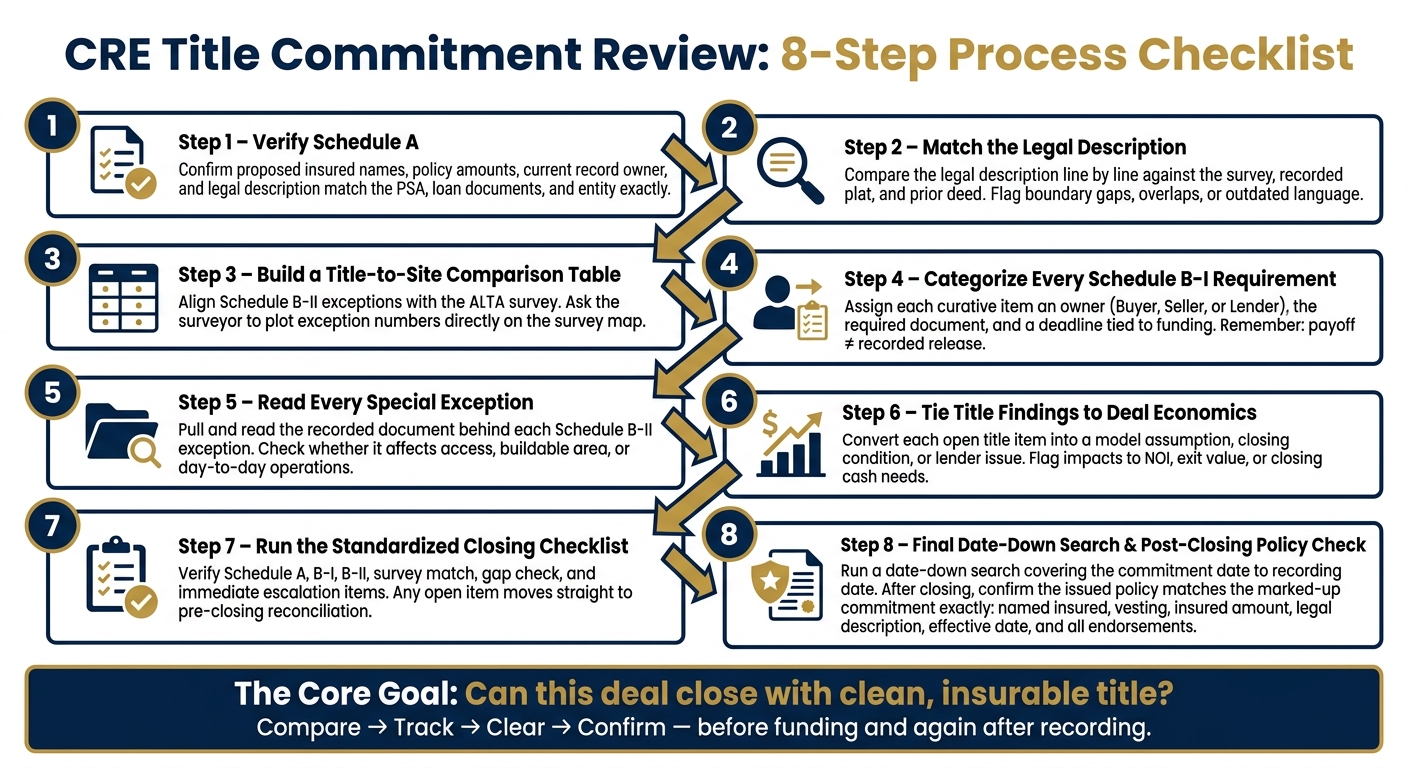
CRE Title Commitment Review: 8-Step Process Checklist
Title Commitment Explained by an Attorney | What to Watch For!
sbb-itb-df8a938
What to Gather Before You Start Reviewing
Before you open the title commitment, get every document tied to the deal in one place. Build the file first. It makes the review far less messy.
The main set should include the latest title commitment, the executed Purchase and Sale Agreement (PSA), a loan term sheet or draft loan documents, and entity formation documents. These papers confirm signing authority and the vesting name. Sort out entity and signing issues before the review begins.
You’ll also want the current ALTA/NSPS survey, recorded plat, site plan, and zoning report. Under 2026 ALTA survey standards, surveyors must flag discrepancies between recorded data and field measurements, which makes the survey a key check for legal description errors.[6] If you need to order a new ALTA survey, give yourself at least two weeks of lead time.[4]
Set up an issues log for each Schedule B-I requirement and Schedule B-II exception, then assign every item to the buyer, seller, or lender. Use standard U.S. formatting throughout, such as MM/DD/YYYY and $1,250,000. Even small mismatches can block recording or void title insurance coverage.[5]
Use this file as your reference set when you move into the Schedule A review. With the documents assembled, start with Schedule A.
1. Verify Schedule A Against the Purchase and Loan Documents
Schedule A lays out the main facts behind the deal: the proposed insureds, the insured interest, the policy amount, and the legal description. If something is off here, that mistake can follow the file all the way to closing and end up in the final policy. That’s why it makes sense to check each line against the PSA, loan documents, and survey before you move any further.
Start with the proposed insured names. They should match the PSA and loan documents exactly, including full entity names, punctuation, and suffixes.[1][7] A small difference in an LLC or trust name can turn into a headache later.
Then check the policy amounts. The Owner's Policy amount should match the purchase price in the contract or final addendum. The Lender's Policy amount should match the actual loan amount.[6][7]
Next, compare the current record owner in Schedule A with the seller listed in the PSA. If the vesting name in Schedule A doesn’t line up with the PSA seller, that can point to a chain-of-title break or a transfer that was never finished.[1]
Also watch the commitment date. Anything recorded after that date sits outside the search period, so you need an updated search before closing. A stale commitment can slow the whole deal down.[6][1]
Once those items check out, turn to the legal description and compare it against the contract, survey, and prior deed.
| Schedule A Item | Compare With | Risk of Mismatch |
|---|---|---|
| Proposed Insured | PSA / Loan Documents | Coverage may fail |
| Policy Amount | Purchase Price / Loan Amount | Under-insurance risk |
| Current Record Owner | PSA (Seller) | Chain-of-title gap |
| Legal Description | Contract / Survey / Prior Deed | Wrong parcel insured |
| Vesting / Entity Format | LLC or Trust Docs | Enforceability issues |
2. Match the Legal Description to the Survey and Recorded Plat
Once Schedule A is set, compare the legal description to the survey and recorded plat to make sure the policy covers the exact parcel being bought or financed. If the description is off, recording can stall, or part of the site may sit outside coverage. The best way to check this is to test the description line by line against the survey and the recorded plat [8].
Do the same line-by-line check against the purchase agreement, loan documents, survey, and recorded plat. Pay close attention to the lot and block references, subdivision name, recording book and page, and any metes and bounds language. Shortened or old wording shows up all the time, and it can hold up recording or even weaken lien priority [5].
The survey notes can also point out problems that don't show up on paper alone. Under the 2026 ALTA survey standards, surveyors must note any differences between recorded information and what they found in the field [6]. If those notes show a boundary shift, overlap, or encroachment, flag it before closing.
If the legal description and survey do not match, keep the standard survey exception in place until the issue is fixed or a survey endorsement is issued [6].
| Discrepancy Type | Risk | Recommended Action |
|---|---|---|
| Boundary gaps or overlaps | Insures the wrong parcel or leaves land uninsured | Request a quiet title action or corrective document |
| Encroachments | Boundary disputes; potential removal of structures | Obtain a survey-related endorsement or resolve with neighbor |
| Easement conflicts with planned use | Limits development or current operations | Review recorded document; seek a zoning or location endorsement |
| No legal access | Renders property unusable or unsaleable | Confirm recorded access agreements or easements |
| Truncated or outdated language | Prevents recording at the county level | Update the legal description to match the most recent recorded plat |
Any mismatch that is still open should move into the title-to-site comparison table for the next review pass.
3. Build a Title-to-Site Comparison Table
Build a title-to-site comparison table to line up Schedule A legal description items and Schedule B-II exceptions with the survey and the recorded plat. Use it after you review the legal description and survey. That way, you can see what still needs work in one place. It gives the team one working view of each open issue.
Ask the surveyor to place the Schedule B-II exception numbers directly on the survey. That makes each item much easier to match at a glance.
Use these fields:
| Table Field | Purpose | Source Document |
|---|---|---|
| Exception/Item # | Identifies the specific item from the commitment | Schedule B-II |
| Type of encumbrance | Describes the encumbrance (for example, a utility easement or setback) | Recorded Document |
| Recording Info | Lists the book/page or instrument number for verification | Schedule B-II |
| Plotted on Survey? | Confirms whether the item is shown on the site map | ALTA/NSPS Survey |
| Survey Note Ref | Points the reviewer to the specific survey note or callout | ALTA/NSPS Survey |
| Recorded vs. measured | Compares recorded plat data with field measurements | Plat vs. Survey |
| Conflict | Flags whether a structure crosses a line or an easement affects improvements | Survey vs. Title |
| Next action | Notes whether the item should be removed, covered by an endorsement, or accepted | Internal Workflow |
The Recorded vs. measured column helps catch boundary shifts and acreage gaps. The Next action column keeps each open item moving toward a clear step, whether that means asking for removal, seeking an endorsement, or accepting the exception as-is.
Use the table to track exceptions outside the site boundary and back up removal or endorsement requests. Then move any unresolved items into the B-I requirement log.
4. Categorize Every Schedule B-I Requirement by Owner and Deadline
Once your title-to-site comparison table is done, shift to Schedule B-I. This section lists the items that must be cleared before the title policy can be issued. At that point, every open item should become a tracked closing condition.
Build that tracker as soon as the commitment comes in. Give each item:
- an owner
- the document needed to clear it
- a deadline tied to funding
In most deals, the Seller handles payoffs, lien releases, and other cure items. The Buyer and Seller usually provide entity authority documents. The Buyer signs the mortgage or deed of trust. The Lender delivers loan documents and, when needed, subordination agreements.
One point matters more than it may seem: payoff and release are not the same thing. A payoff clears the debt. A recorded release clears title. If you mix those up, you can think an item is done when it isn't. Don't mark anything complete until the title company confirms the item is cleared.
Use the tracker below to keep the owner, required document, and deadline in one place.
| Requirement Category | Responsible Party | Document Needed | Closing Risk if Unresolved |
|---|---|---|---|
| Existing Mortgages | Seller | Payoff statement and recorded release | Loss of lien priority; refusal to insure |
| Entity Authority | Buyer / Seller | Operating Agreement, Resolutions, Incumbency Certificate | Unauthorized signatures; potential buy-back risk |
| Taxes / Assessments | Seller | Paid tax receipts or escrowed funds | Superior lien attachment; buy-back risk |
| Judgments / Liens | Seller | Satisfaction of Judgment or Lien Release | Clouded title; inability to convey clear fee interest |
| Mechanics' Lien Waivers | Seller / Contractor | Final lien waivers and affidavits | Lender loses first-priority lien position |
| Standard Items | Buyer / Lender | Executed Deed/Mortgage, Premium Payment | Policy cannot be issued; deal stalls |
If closing gets pushed, order a bringdown before funding. That helps catch new liens, tax changes, or bankruptcy filings that showed up after the first title review. Once the bringdown comes back clean, move the file to final pre-closing reconciliation.
5. Read Every Special Exception and Pull the Recorded Documents
Once curative items are logged, turn to the exceptions still listed on the policy. Schedule B-II shows the property-specific risks that are excluded from coverage.[10][6] These are not standard boilerplate exceptions. Each one is tied to the deal in front of you.
As soon as the commitment comes in, request the recorded document behind each special exception. Then pull it and read it closely. You want to see the rights granted, who benefits, and what part of the property is affected.
This is where the survey starts doing real work. Use it to check whether an exception affects access, the building footprint, or day-to-day operations. A blanket easement is much broader than a 10-foot strip easement. A covenant that blocks the planned use can kill the deal. An active right of first refusal can limit a foreclosure sale. And if an exception touches the buildable area, access, or setbacks, it moves out of the “legal detail” bucket and into underwriting.
Check every locatable exception against the survey. Confirm whether it touches the buildable area, access, or setbacks. If the exception can't be removed, decide whether a title endorsement is needed. Any item that still isn't cleared should go into the issue log for underwriting and closing review.
Use the table below to sort out what needs removal, what may call for an endorsement, and what might be accepted. These are the exceptions most likely to affect closing or underwriting.
| Exception Type | Potential Impact | Mitigation Strategy |
|---|---|---|
| Utility Easement | Limits building footprint; may block planned construction | Plot on survey; confirm no-build zone boundaries |
| Restrictive Covenant | May prohibit intended use or require specific setbacks | Review for expiration; consult attorney about amendment options |
| Right of First Refusal | Can block lender's ability to sell after foreclosure | Confirm termination with seller; evaluate foreclosure risk |
| Unreleased Mortgage / Deed of Trust | Prevents clear title; creates lien priority risk | Obtain payoff letter and confirm recorded release |
| Encroachment | Potential forced removal of structures; unmarketable title | Boundary line agreement or title endorsement |
| Mineral Rights | Subsurface extraction rights may disrupt surface use | Surface waiver or specialized title coverage |
6. Tie Title Findings to Underwriting and Deal Economics
Once you've logged special exceptions, the next step is simple: turn each open item into a model assumption, a closing condition, or a lender issue. Title findings don't just sit in a legal file. They can hit NOI, exit value, and the cash you need at closing.
Start with operating expenses. Recorded maintenance agreements tied to shared easements or stormwater declarations can add recurring property costs.[4] If the title commitment shows a maintenance obligation, pull the recorded document and make sure that cost shows up in your pro forma NOI.
If the property has a TIF or tax abatement, check whether a sale or change of control can trigger recapture. Then model any reassessment at exit into taxes, value, and returns.
Unresolved mechanic's liens and unreleased mortgages can also turn into an immediate cash need at closing. If the seller can't clear them, you're likely looking at either a price cut discussion or an escrow holdback at closing.
Here's a clean way to tie each title item to underwriting:
| Title Issue | Underwriting Impact | Financial Effect |
|---|---|---|
| Maintenance Agreements | NOI | Increases operating expenses for shared infrastructure [4] |
| Tax Abatement Recapture | NOI / Exit Value | Triggers higher future tax expense or immediate liability at sale [9] |
| Mechanic's Liens | Capex | Closing cash need [9] |
| Restrictive Covenants | Lease-up | Limits tenant pool; may increase vacancy or lower rents [4] |
| Severed Mineral Rights | Exit Value | Increases risk profile; may require non-disturbance agreements [11] |
| Nonconforming Use | Exit Value | Limits rebuilding rights after casualty or future expansion [9] |
If a title issue affects buildable area, permitted use, or lien priority, put it in the investment memo with a specific dollar effect or a clear closing condition. Don't leave it sitting there as a legal item to deal with later.
Then carry those dollar impacts into the review checklist so every title item stays linked to a condition, an owner, and a deadline.
7. Use a Standardized CRE Title Review Checklist
Use the checklist to turn earlier title findings into a repeatable, close-ready workflow. A checklist won’t fix weak judgment on its own. But it will make reviews more consistent and help your team avoid missed items when closing gets hectic.
Treat the title commitment like a working review document, not a box to check. That’s where the payoff is. It pushes every finding into a clear action bucket: either something you can cure before closing or something that needs immediate escalation. A set review order also makes handoffs smoother across analysts, attorneys, and paralegals.
Here’s a clean breakdown of what a CRE title review checklist should cover at a minimum:
| Checklist Category | Key Items to Verify | Risk Managed |
|---|---|---|
| Schedule A | Names, vesting, legal description, amounts, effective date | Errors in ownership or the insured parcel |
| Schedule B-I | Mortgage payoffs, lien releases, entity authority documents | Failure to satisfy conditions before policy issuance |
| Schedule B-II | Easements, CC&Rs, encroachments, ROFRs | Post-closing surprises that limit property use |
| Survey Match | ALTA survey vs. Schedule B-II exceptions | Unrecorded or misplaced encumbrances |
| Immediate Escalation | Lis pendens, unreleased ancient mortgages, chain of title gaps, unresolved probate | Potential deal-killers requiring immediate escalation |
| Gap Check | Last-minute title search before recording | New liens filed between the effective date and closing |
Any open item should move into the pre-closing reconciliation right away.
Make the gap check the last step before recording. It helps catch liens filed after the commitment date. If anything is still open after the checklist review, move it straight into final pre-closing reconciliation.
8. Complete a Final Pre-Closing Reconciliation and Post-Closing Policy Check
Once the checklist is done, there’s one last gap to close: the space between the commitment and what actually gets recorded. Run a date-down search for the period between the commitment date and the closing or recording date. Why does that matter? Because anything recorded during that window falls outside the first search and can create a coverage problem.
At this stage, confirm that recorded mortgage releases, cleared tax liens, and completed lien releases have been handled for every open item that’s still left [6]. If the deal has subordinate debt, review the subordination agreement with care. It needs to name the right lender, match the loan terms, and be properly notarized [3]. If that agreement is wrong, the senior lender can end up sitting in second position, which can make the loan non-saleable [3].
You’ll also want to make sure standard exceptions that need to be cleared, or backed up by an affidavit or survey, have been dealt with [6]. For recent construction, check mechanic's lien waivers and owner affidavits directly. This isn’t the moment to assume anything got done just because it was expected.
"Funding without satisfying commitment conditions can result in limited or denied coverage." - Orchestrate Mortgage and Title Solutions [5]
After those items clear, line up the issued policy against the closing package. Then, after closing, compare the issued policy to the marked-up commitment. The details need to match the recorded documents exactly:
Then review each negotiated endorsement, including zoning, access, and contiguity, and make sure each one is attached and reflects the property details the right way [6][2]. Before moving to the next step in the workflow, confirm county recording.
How Title Review Connects to CRE Analysis and Closing Workflows
Once you clear the Schedule B items, turn each one into a model assumption or a closing condition. Title review isn't just a legal box to check. It feeds straight into underwriting and closing.
Every open exception in Schedule B-II or unresolved item in Schedule B-I can lead to a financial hit or an operating problem. That might mean access limits, utility conflicts, use limits, or a delayed closing. So each finding should tie back to one of three things:
- a reserve update
- a pro forma adjustment
- a tracked closing condition
| Title Finding | Underwriting Impact |
|---|---|
| Restrictive Covenants (CC&Rs) | Limits tenant types, use, and redevelopment density |
| Utility / Access Easements | Can block building footprints, parking layouts, or required site access |
| Maintenance Agreements | Increase operating expenses and capital reserve requirements |
| Rights of First Refusal (ROFR) | Complicate exit strategy and can delay or prevent a sale |
| Tax Abatements / PILOTs | Change monthly cash flow and NOI projections |
| Mechanics' Liens | Require immediate capital to clear at closing or threaten lien priority |
Use these outputs to update the underwriting model, issues log, and closing checklist at the same time. Then map each issue to the right owner, deadline, and closing action.
Two Tables to Support Your Title Review
Once you've logged the exceptions, the next step is simple: figure out what each title item means for the deal and decide what to do with it. These two tables help you move from spotting an issue to assigning a clear disposition without wasting time.
Table 1: Title-Survey Alignment
Use this table to confirm each title item against the right source documents.
| Title Item | Where Confirmed | Impact |
|---|---|---|
| Legal Description | Schedule A, Survey, Recorded Plat | Errors can cause the policy to insure the wrong parcel or delay recording. |
| Ownership/Vesting | Schedule A, Vesting Deed, Entity Docs | Unauthorized signers can invalidate the lien or delay closing. |
| Easements | Schedule B-II, Survey (Plotted) | Can block planned construction or limit parking layouts. |
| Encroachments | Survey, Adjoining Property Records | May render title unmarketable or require removal of improvements. |
| Access Rights | Survey, Schedule B-II | Lack of legal access can render a commercial property unusable. |
| Lien Priority | Schedule B-I, Payoff Statements | Unreleased prior liens can jump ahead of the new mortgage. |
Table 2: Exception Strategy
For every Schedule B-II exception, apply a clear Accept / Modify / Delete call. That's the fastest way to sort routine items from deal problems that need a closer look.
| Exception | Action | Reason | Deal Impact |
|---|---|---|---|
| General Survey Exception | Delete | Current ALTA survey required. | Required by most commercial lenders for funding. |
| Gap Exception | Delete | Clear the search-to-recording gap. | Protects buyer and lender from last-minute liens. |
| Mortgages and Other Liens | Delete | Seller records releases at or before closing. | Essential for clean title and lender lien priority. |
| Utility Easement (Perimeter) | Accept | Fine if it stays outside improvements. | Minimal impact if it doesn't interfere with the building footprint or planned improvements. |
| Taxes (General) | Modify | Limit to taxes not yet due and payable. | Ensures seller covers all accrued taxes through closing. |
| CC&Rs / Use Restrictions | Accept / Modify | Review for use limits. | Can be a deal-breaker if the intended use is restricted. |
| Right of First Refusal | Delete | Must be terminated or waived before closing. | Prevents future sale or complicates lender foreclosure. |
| Mechanic's Liens | Delete | Require lien waivers and owner's affidavit. | Protects against super-priority claims over the new mortgage. |
Use Table 1 to find the issue. Then use Table 2 to assign the fix. If an item still isn't resolved after that, move it into the escalation review.
When to Escalate a Title Issue
Escalate any title issue that can't be fixed through standard review, payoff, release, or endorsement. If a Schedule B item still doesn't have a clean cure after the checklist review, send it to the right person based on the issue type.
Move fast when the insurer won't cover the defect. Lenders usually won't finance a title problem that isn't insurable[11]. The same goes for conservation or agricultural easements with non-impairment clauses or development bans. Those can stop a deal cold, so they should go straight to real estate counsel[11].
Some issues also need a specialist instead of a routine fix:
- Ground leases, air rights, and mineral reservations should go to counsel for review of the recorded documents and the buyer's planned use.
- Cross-access agreements and shared parking rights need both survey and legal review. First, plot the easement. Then read the full agreement. If the easement is drafted poorly, it can interfere with lease terms or future site use[4].
- Major encroachments that affect the building footprint or violate an easement need survey and legal review to confirm scope and marketability.
- Unresolved liens should go to the seller and title officer for payoff statements, release documents, or escrowed funds[6][5].
- Signing-authority gaps belong with the borrower and attorney; the table below shows the routing[3][5].
Use the table below to route each issue to the right specialist and gather the documents they need.
| Issue Type | Escalation Path | Required Documents |
|---|---|---|
| Ground Lease / Air Rights / Mineral Reservations | Real Estate Attorney | Underlying recorded documents, severance deeds, buyer's intended use plans |
| Cross-Access / Shared Parking | Attorney + Surveyor | Plotted survey, full easement agreement text |
| Major Encroachments | Surveyor + Attorney | Title commitment and survey review |
| Unresolved Liens / Judgments | Seller / Title Officer | Payoff statements, release documents, or escrowed funds |
| Signing Authority Gaps | Borrower / Attorney | LLC operating agreement or trust agreement |
| Uninsurable Defects | Real Estate Attorney | Full title commitment and all underlying recorded documents |
Conclusion
Title review isn't just paperwork. It's the last checkpoint before closing, and any title issue that slips through can turn into a deal issue.
The closing comes down to four things: a clean Schedule A, a survey that matches, cleared B-I items, and B-II exceptions that have been reviewed. When those boxes are checked, the file should be ready for funding.
The last risk window sits between the commitment and recording. Run the final date-down search before funding. Then, after recording, compare the issued policy to the marked-up commitment. Make sure the effective date is correct, the endorsements are included, and the policy amount matches the final loan amount.
Title review helps stop delays. The final date-down search covers the last gap before funding. And when the policy lines up with the commitment and the loan terms, the deal closes on solid ground.
FAQs
What is a title commitment?
A title commitment is a contract from a title insurance company that says it will issue an owner’s or lender’s title insurance policy at closing, as long as certain conditions are met. It lays out what must happen before closing and what limits or claims may affect ownership and lien position.
It usually includes:
- Schedule A: the insured party, policy amount, and legal description
- Schedule B-I: closing requirements
- Schedule B-II: exceptions or encumbrances the policy won’t cover
Who should clear Schedule B-I items?
Each Schedule B-I requirement should be assigned to the party responsible for handling it - usually the seller, buyer, or lender, depending on the item.
In commercial deals, the seller often clears these items before closing unless a given item is assigned to the buyer. Review them early, confirm the status of each one, and check with your real estate attorney or title officer if needed.
When should I order a date-down search?
Order a date-down search when the initial commitment’s effective date is stale, especially if closing gets pushed back.
A title commitment only shows records through its effective date. That means later liens, tax updates, bankruptcy filings, or recording gaps won’t show up.
If the file has been sitting for several weeks without a check, update it before funding. That helps confirm the requirements and property details are still correct.