
Lender's Title Insurance: Key Role in Loan Security

If a lender’s lien is flawed, the loan is at risk - even when the property looks fine.
I’d sum up the article like this: lender’s title insurance protects the loan’s lien position, not the building’s value. It is usually paid one time at closing, the coverage amount is usually tied to the loan balance, and the policy helps if an older title problem hurts the lender’s right to enforce the mortgage or keep first-lien status.
Here’s the short version:
- What it covers: title defects, hidden liens, and other recorded issues that can hurt validity, enforceability, or priority of the mortgage lien
- What it does not cover by default: zoning issues, contamination cleanup, survey issues, and many post-closing matters
- Who it protects: the lender, not the borrower’s ownership interest
- How gaps are handled: with ALTA endorsements, plus survey, zoning, and site review
- Why it matters in CRE: a title problem can delay foreclosure, cut recovery, and create legal costs
A few points stand out:
- The premium is generally a one-time closing cost
- The policy amount usually starts at the original loan amount
- Coverage usually drops as the loan is paid down
- The policy usually stays in place until payoff, foreclosure, or the end of the lender’s secured interest
Title Insurance Explained in 5 Minutes
sbb-itb-df8a938
Quick comparison
| Topic | Lender’s title insurance |
|---|---|
| Main purpose | Protects the lender’s lien |
| Protected party | Lender / mortgagee |
| Focus | Debt security, not property value |
| Payment | One-time premium at closing |
| Coverage period | Usually until payoff or loss of secured interest |
| Main gaps | Zoning, survey, contamination, post-policy matters |
| Common add-ons | ALTA 3.1, 8.2, 9, 13.1, 17, 19, 25 |
I’d read the article as a guide to one main idea: title insurance is only one part of loan protection. The lender still needs a clean title commitment, a matching legal description, the right endorsements, and support from survey, zoning, access, and site-review work before closing.
Lender's Title Insurance in Commercial Real Estate Financing
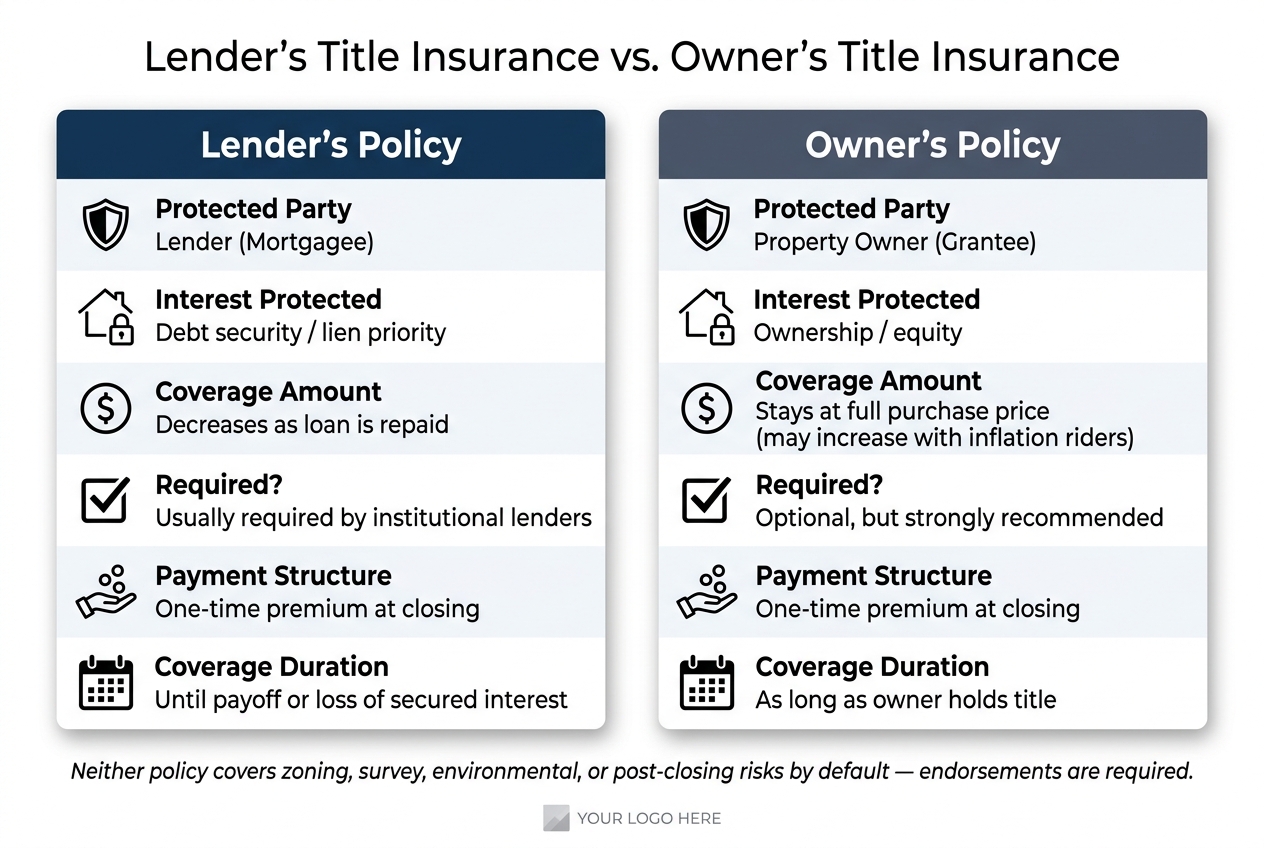
Lender's vs. Owner's Title Insurance: Key Differences at a Glance
This is the policy lenders rely on to keep lien priority in place if title defects show up after closing. It insures the lender's mortgage lien or deed of trust against covered title issues that can hurt priority or enforceability.
Definition, Insured Interest, and Policy Duration
Coverage matches the original insured loan amount, then drops as the principal balance is paid down. This is indemnity coverage tied to the loan, not the property's market value. Coverage stays in place as long as the lender keeps a secured interest, which usually means until payoff or foreclosure. The policy is bought one time at closing and remains in force while that secured interest continues.
How the Lender's Policy Differs from the Owner's Policy
The two policies protect different parties and different interests. Here's the key difference at a glance:
| Feature | Lender's Policy | Owner's Policy |
|---|---|---|
| Protected Party | Lender (mortgagee) | Property owner (grantee) |
| Interest Protected | Debt security / lien priority | Ownership / equity |
| Coverage Amount | Decreases as loan is repaid | Stays at full purchase price (or increases with inflation riders) |
| Required? | Usually required by institutional lenders | Optional, but strongly recommended |
A lender's policy does not protect the borrower's equity. For that, the borrower needs an owner's policy. It's a simple split: one policy protects the loan, the other protects ownership. That difference shapes how lenders set coverage and handle closing protection.
U.S. Closing Practice and Cost Structure
In the United States, lender's title insurance is bought with a one-time premium paid at closing. After that, there are no monthly or annual charges. Endorsements can expand standard coverage for certain risks, and they add to the base premium. Those endorsement fees vary by state, loan amount, and title company. Pricing also changes based on the state, deal size, and the endorsement package. Local rate schedules differ from one market to another. From there, the next step is deciding which endorsements make sense for the deal.
What the Policy Covers, Excludes, and How It Protects the Loan
Standard coverage sets the starting point. The exclusions and endorsements show how much protection the lender actually has.
A lender's title policy protects the mortgage lien's validity, enforceability, and priority. Coverage applies to title defects that existed on or before the policy date.
Standard Covered Risks That Support Lien Priority
The policy protects the lender against title defects and liens that could weaken lien priority or cut into foreclosure recovery. If a covered defect clouds title, creates a competing claim, or puts the lender's right to enforce its mortgage in doubt, the policy can step in.
That matters because these defects can slow down foreclosure and shrink what the lender recovers. The catch? The policy's reach depends heavily on what it leaves out.
Common Exclusions and Limits Lenders Must Manage Outside the Policy
Title insurance does not cover everything, and some of the biggest risks sit outside the standard form.
Standard policies often exclude governmental actions such as eminent domain or the exercise of police powers unless notice of that action appears in the public records on the policy date. Zoning, land use, contamination, boundary matters that a survey would show, and legal access issues also call for separate diligence or endorsements.
| Risk Type | Typical Policy Treatment | Loan Security Impact | Separate Mitigation Method |
|---|---|---|---|
| Zoning/Land Use | Excluded in standard policy; covered by ALTA 3 series | Prevents intended use or triggers structure removal | Zoning letters, legal opinions, and PZR reports |
| Environmental | Only covers recorded liens (ALTA 8.1/8.2) | Remediation costs can exceed collateral value | Phase I/II Environmental Site Assessments (ESA) |
| Boundary/Survey | Standard exception for "matters a survey would show" | Encroachments impair marketability and foreclosure | ALTA/NSPS Land Title Survey |
| Legal Access | Insures legal access, not physical or practical access | Property may be unreachable for development or use | Review of access easements and municipal records |
| Post-Policy Risks | Excluded - coverage stops at the policy date | New liens or transfers can threaten priority | Date-down endorsements and post-closing audits |
Environmental risk sits outside standard title coverage. A standard policy covers only recorded environmental liens, so Phase I and Phase II ESAs still matter. In plain English, title insurance may help with a recorded lien tied to contamination, but it won't pay to figure out whether the dirt itself is a problem.
When a covered defect comes up, the claims process decides what happens next.
Claims, Defense, and Loss Payment Mechanics
The lender notifies the insurer, and the insurer cures, defends, or pays. That process helps protect the lender's collateral position and foreclosure recovery when title problems threaten lien priority.
Key ALTA Endorsements for Commercial Lender Protection
Endorsements plug holes in standard title coverage by insuring specific risks that can weaken lien priority, limit access, throw off survey data, or restrict how the collateral can be used. In plain English: they turn common title and survey worries into named insurance protections.
The endorsements lenders ask for most often deal with zoning, environmental liens, access, contiguity, survey accuracy, and leasehold collateral.
Commercial Endorsements Lenders Most Often Require
The ALTA 3 series deals with zoning risk. ALTA 3.1, which is used on improved properties, protects the lender if a court orders a building to be changed or removed because it violates setbacks, height limits, floor space rules, or parking rules. That means the lender can make a claim under the policy instead of leaning only on a zoning opinion.
ALTA 8.2 covers recorded environmental protection liens and state-statute liens that are in effect on the policy date. It matters most for industrial sites and mixed-use properties.
ALTA 9 covers covenant violations, existing encroachments, and damage tied to mineral-rights activity. ALTA 17 confirms legal access to a public right-of-way, which matters when the collateral depends on easement-based access. ALTA 19 applies when the collateral includes more than one parcel and confirms that the property forms one continuous tract. ALTA 25 confirms that the insured legal description matches the survey, which cuts the risk of a mismatch between the policy and the property being financed. ALTA 13.1 is used when the loan is secured by a leasehold interest, including tenant improvements and relocation costs.
How Lenders Build an Endorsement Package by Deal Type
No two deals need the same endorsement stack. Lenders should match endorsements to the deal structure and risk profile instead of treating the list like a box-checking exercise.
State rules can limit which endorsements and forms are available. Before the commitment is finalized, lenders need to confirm which endorsements can actually be issued in the state where the property sits.
The right package should line up with the collateral structure, property use, and parcel layout. The goal is simple: cover the gaps left open by standard title insurance.
| Endorsement | Primary Risk Addressed | Typical CRE Use Case | Why It Matters for Loan Security |
|---|---|---|---|
| ALTA 3.1 | Zoning non-compliance | Improved commercial property | Prevents value loss from forced building changes |
| ALTA 8.2 | Environmental protection liens | Industrial or mixed-use sites | Protects against cleanup liens that can prime the mortgage |
| ALTA 9 | CC&Rs, encroachments, minerals | Complex developments | Protects against hidden encumbrances |
| ALTA 13.1 | Leasehold eviction and valuation | Ground leases and tenant financing | Preserves collateral value under a ground lease |
| ALTA 17 | Lack of legal access | Easement-dependent or landlocked sites | Confirms access to the site |
| ALTA 19 | Contiguity | Multi-parcel collateral packages | Confirms the parcels form one continuous collateral package |
| ALTA 25 | Survey discrepancies | Multi-parcel or irregular lots | Matches the policy description to the surveyed land |
Send the endorsement list during due diligence so title issues come to light before closing. That gives the title company time to clear problems before the deal gets to the finish line.
How Title Insurance Fits into CRE Due Diligence, Underwriting, and Closing
Title insurance protects the lender’s security interest, but it doesn’t work alone. It needs to line up with title review, survey, zoning, and environmental diligence before closing. If those pieces don’t match, small errors can turn into lien priority problems, enforceability issues, or plain old closing delays.
From Title Commitment to Final Policy at Closing
After endorsements are chosen, the next job is to clear title exceptions and make sure the policy matches the loan file.
The process starts with the title commitment. It has two parts that matter most here. Schedule A lists the insured amount, the proposed insured, and the legal description. Schedule B lists the exceptions, meaning the items the policy will not cover. Any exception that stays unresolved can threaten lien priority or enforceability.
Work with the title company early to deal with exceptions and ask for draft endorsement language before closing. That gives the lender time to review the file instead of scrambling at the eleventh hour. Once the exceptions are cleared and the endorsements are settled, the final loan policy is issued at closing and protects the lender’s lien position.
One detail deserves extra attention: the legal description. Check it against the commitment, the survey, and the endorsements. If those documents don’t match, the result can be litigation risk that the policy may not cover.
How Title Insurance Works with Survey, Zoning, and Environmental Diligence
Title insurance covers only part of the risk. That’s why lenders pair it with survey, zoning, and environmental review.
An ALTA survey confirms physical boundaries and supports the ALTA 25 endorsement. A zoning report or zoning letter supports the ALTA 3 series endorsement. A Phase I/II ESA informs the ALTA 8.2 endorsement for recorded environmental liens.
The table below shows how each diligence item supports the policy and underwriting.
| Due-Diligence Item | Related Title Policy Component | Risk Mitigated | Loan Impact |
|---|---|---|---|
| ALTA Survey | ALTA 25 (survey/legal description match) | Boundary discrepancies and encroachments | Confirms collateral physical limits match legal description |
| Zoning Report or Letter | ALTA 3 Series | Zoning violations | Confirms property can be used as planned |
| Phase I/II ESA | ALTA 8.2 (recorded environmental liens) | Recorded environmental liens | Mitigates risk of cleanup liens against the collateral |
| Easement/Access Agreements | ALTA 17 (Access) | Lack of legal access to public right-of-way | Essential for property utility and marketability |
| CC&R Review | ALTA 9 (restrictions, encroachments, minerals) | Covenant violations and mineral rights | Protects against third-party claims that could impair use |
It helps to order surveys and zoning materials early. If those reports come in late, they can push the closing date and even affect loan terms.
Underwriting and Portfolio Considerations for CRE Teams
When title issues stay unresolved, they often spill into underwriting. That can affect pricing, reserves, and credit structure.
For portfolio lenders, title quality isn’t a one-off issue tied to a single asset. It shows up again and again across the book. A standard process for title review, exception tracking, and complete diligence files helps cut closing risk across portfolios.
Conclusion: The Core Role of Lender's Title Insurance in Loan Security
In practice, lender's title insurance matters most when the closing file and diligence work point in the same direction. It protects lien priority and enforceability when title defects put recovery at risk.
But the policy can't do everything on its own. Standard coverage leaves out zoning, survey, environmental, and leasehold title defects. Those issues need separate diligence and the right endorsements.
The endorsement package should fit the collateral, the property's use, and the title risks the diligence process turns up. By the time the deal closes, the file should show the same risk view developed during underwriting. That means matching the legal description across the commitment, survey, and deed, clearing up discrepancies before closing, and documenting endorsement decisions.
Done right, those steps help protect lien priority and make title insurance more than a funding formality. They make it part of the legal backbone of loan enforceability and lien priority.
FAQs
Do I need both lender’s and owner’s title insurance?
Yes, in most cases.
Lender’s title insurance covers the lender’s mortgage interest. Owner’s title insurance covers your equity and your ownership rights for as long as you own the property.
They do two different jobs, so one doesn’t replace the other. And if you buy both at the same time, you may get a discount on closing costs.
Can lender’s title insurance cover title problems after closing?
Yes. Lender’s title insurance protects the lender if title problems show up after closing. That includes fraud, forgery, hidden liens, and rival ownership claims.
Most known issues get dealt with before the loan closes. But this policy still works as a backstop for the lender’s financial stake for as long as the mortgage is in place.
Which endorsements matter most for a CRE loan?
For commercial real estate loans, the endorsements that matter most are the ones tied to the property's risk profile and the lender's loan terms.
Common examples include ALTA 3 (zoning), ALTA 17 (legal access), ALTA 25 (survey match), and ALTA 9 (restrictions, encroachments, and mineral rights).
Some deals call for more specialized coverage, such as ALTA 8.2, 13.1, and 19. The right mix depends on the property, the loan, and the issues that show up during due diligence, so check with your lender and legal counsel for deal-specific coverage.