
How Title Insurance Limits Affect CRE Deals
Title insurance does not cover every title risk in a CRE deal. In most cases, the lender is covered up to the unpaid loan balance, while the owner takes the loss above that amount.
If I had to boil this down, I’d say this article makes five main points:
- Policy limits matter as much as the policy itself. An owner’s policy usually matches the purchase price. A loan policy usually matches the original loan amount.
- Risk shifts across the capital stack. As debt pays down, the lender’s exposure drops. But the owner can still have equity, added project cost, and upside at risk.
- Schedule B exceptions and missing endorsements can leave big holes. If access, zoning, parcel fit, or survey issues are not insured, the insurer may not pay.
- Some deal types are hit harder than others. Construction loans, site assemblages, access-heavy assets, and zoning-driven deals tend to face the most trouble.
- Early review helps avoid loss and delay. I’d check the commitment, survey, legal description, and endorsement list before closing - not at the last minute.
A few facts stand out:
- CRE deals often use 2 separate policies: one for the owner and one for the lender.
- The lender’s policy limit usually declines with principal paydown.
- In a construction deal, a missing future-advance or mechanics’ lien piece can stop draws.
- In a multi-parcel deal, missing ALTA 19 can lead to a quiet title suit or extra land cost.
- Missing ALTA 17, 19, 3.1/3.2, or 25 can affect access, parcel fit, zoning use, or survey match.
| Issue | What it can do |
|---|---|
| Low owner coverage limit | Leaves equity above the insured amount exposed |
| Missing future-advance coverage | Puts lender lien priority at risk between draws |
| Missing access coverage | Cuts site utility and property value |
| Missing contiguity coverage | Breaks a planned assemblage |
| Missing zoning coverage | Can trigger loss of use or forced physical changes |
Put simply: title insurance is a risk-allocation tool, not a blanket shield. If the limit, exceptions, and endorsements do not match the deal, the lender may protect the debt while the sponsor absorbs the rest.
Commercial Real Estate Title: Risks & Protection in Michigan and Ohio
sbb-itb-df8a938
How coverage limits shift risk across the capital stack
Once coverage limits meet the capital stack, the issue gets pretty simple: who takes the hit above the loan amount? Title insurance protects the lender's debt recovery first. Any loss above the loan balance usually lands on the equity side. If a title problem shows up after closing, the lender's insured loss is usually capped at the unpaid principal balance, while the sponsor absorbs anything above that mark.
Where owner and lender interests diverge
In a typical acquisition or recapitalization, the lender's insured exposure gets smaller as the loan amortizes. The owner's risk works differently. It includes not just equity, but also the value created by the business plan. That split becomes more pronounced in leveraged deals, where senior debt is covered but the equity and mezzanine layers are left exposed.
How exclusions and exceptions create uncovered loss
Coverage gaps can get expensive fast when title issues affect access, zoning, or redevelopment rights. If the policy does not specifically cover the affected item, the insurer may not pay for the loss that follows. In that situation, the lender stays focused on lien priority and loan recovery, while the sponsor is left dealing with equity loss and less future upside. Those uncovered losses tend to show up most clearly in construction, assemblage, and access-sensitive assets.
CRE deal situations where title insurance limits become a problem
Some deal structures carry far more title risk than others. And the trouble usually shows up at the worst time: in the middle of construction or during a site assemblage.
That matters because a title gap doesn't just sit quietly in the background. It can stall loan draws, push back a closing, or leave equity exposed above the insured amount.
Construction loans, future-advance coverage, and mechanics' lien exposure
Construction lending is where title limits can hit lenders the hardest and the fastest.
Why? Because every draw can reopen lien-priority risk. If the policy doesn't include the right future-advance coverage, mechanics' liens filed between draws may jump ahead of the lender's lien position. Once that happens, lender confidence can drop in a hurry. The result is often a funding freeze or a lower loan-to-cost structure.
The same issue can show up when a project depends on multiple parcels or fixed legal access. If those pieces don't line up on paper, the deal can start to wobble even if the site looked fine at first glance.
Assemblages, access-dependent sites, and zoning-sensitive assets
Multi-parcel assemblages create a different problem. When a development site is pieced together from separate parcels, gaps or intervening parcels can stop the property from working as one developable unit. Without ALTA 19, the sponsor may be forced into a quiet title action or may need to buy extra land just to make the site work.
Access-dependent properties have their own version of this risk. A retail center, medical office, or hospitality asset may depend on a specific curb cut or a shared driveway easement. If that access isn't legally backed up in the policy, value can drop fast. In practice, the property can behave like it's landlocked, which can cut NOI and push valuation down.
When that happens, title risk turns into financing risk and valuation risk very fast.
Zoning-sensitive assets can run into the same kind of pain. If a structure has a setback, height, or parking violation that isn't covered, the fix may be harsh. A court-ordered correction can mean demolition or the loss of a permitted use.
Scenario table: limitation, deal impact, and financial consequence
| CRE Scenario | Limitation | Deal Impact | Financial Consequence |
|---|---|---|---|
| Construction/Phased Funding | Missing future-advance/mechanics' lien coverage | Intervening liens take priority over lender | Draws halted; LTC reduced |
| Multi-Parcel Assemblage | Missing ALTA 19 (Contiguity) | Gaps between parcels prevent unified development | Quiet title action or extra land acquisition required |
| Access-Dependent Site | Missing ALTA 17 (Access) | Property functions as landlocked; curb-cut access lost | NOI impairment and lower valuation |
| Zoning-Sensitive Asset | Missing ALTA 3.1/3.2 (Zoning) | Court-ordered correction for setback, height, or parking violations | Forced demolition or loss of permitted use |
These gaps close only when endorsements and policy limits line up with the way the deal is actually built.
How to reduce title risk with endorsements and better coverage design
You reduce title risk by lining up endorsements, policy limits, and due diligence with the actual risk in the deal. If coverage is too thin, the lender, the sponsor, or both end up eating the loss.
ALTA endorsements that matter most in CRE
The goal is simple: match the endorsement to the exact gap. That could be access, contiguity, zoning, or survey risk.
ALTA 3-series endorsements deal with zoning and permitted use. ALTA 3.1 is especially important because it protects against court orders that force removal or changes to structures due to violations involving setbacks, height, or parking rules. ALTA 17-series endorsements confirm legal access to a public street. ALTA 19-series endorsements confirm contiguity across assembled parcels. ALTA 25 ties the policy to the survey.
Share the required endorsement list with the title insurer early in due diligence. Zoning letters, current surveys, and other backup documents often take time to collect.
How to size coverage to the business plan
Coverage should match the real exposure, not just the purchase price. In value-add or construction deals, the limit should line up with the business plan and the funding structure.
The loan policy protects the debt. The owner's policy needs to protect the equity sitting above that debt. If the asset includes major planned tenant improvements, the policy limit should reflect the improvement value, not just the land or shell value. The owner and lender policies should work together so each layer of the capital stack has protection.
Comparison table: key endorsements and the gap each one addresses
Use the table below to match each endorsement to the risk it removes.
| ALTA Endorsement | Gap Addressed | Most Useful In |
|---|---|---|
| 3.1-06 (Zoning) | Loss from zoning violations: setbacks, height, parking, and permitted use | Zoning-sensitive assets; adaptive reuse; mixed-use |
| 17-06 (Access) | Legal access to a public street or right-of-way | Retail, hospitality, medical office; access-dependent sites |
| 19-06 (Contiguity) | No gaps or strips between parcels in a multi-parcel assemblage | Development assemblages; land banking |
| 25-06 (Survey) | Policy description matches physical survey boundaries | Any deal with survey-sensitive boundaries |
Review the title commitment, survey, and endorsements together before closing.
Conclusion: Build title limit review into underwriting and asset management
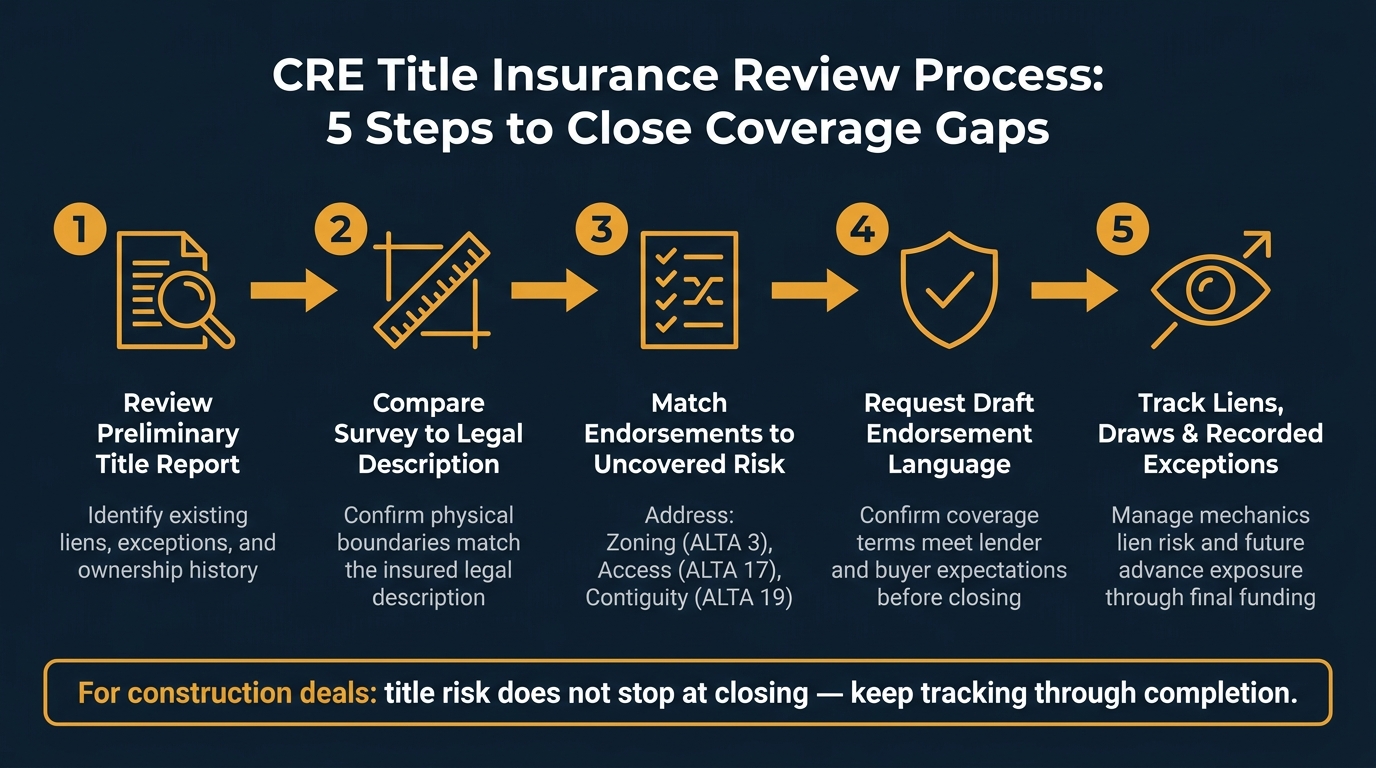
CRE Title Insurance Review Process: 5 Steps to Close Coverage Gaps
Title insurance limits are a risk allocation tool. They shape how much of a loss gets covered, how much risk each party in the capital stack keeps, and whether the business plan can absorb a defect.
That’s why policy review shouldn’t sit at the very end of the deal as one more closing task. If you wait until the last few days before closing, you can miss gaps that should have been flagged during due diligence. Review the owner’s policy, loan policy, and endorsement package early, while there’s still time to fix problems.
A practical review process for deals
Use the same risk lens you use in underwriting - debt, equity, access, zoning, and survey - to handle the final title review. The easiest way to spot gaps is to use a simple process every time.
| Step | Action Item | Objective |
|---|---|---|
| 1. Screening | Review the preliminary title report | Identify existing liens, exceptions, and ownership history |
| 2. Survey Review | Compare survey to legal description | Confirm physical boundaries match the insured legal description |
| 3. Gap Analysis | Match endorsements to the uncovered risk | Address specific exposures: zoning (ALTA 3), access (ALTA 17), contiguity (ALTA 19) |
| 4. Validation | Request draft endorsement language | Confirm coverage terms meet lender and buyer expectations before closing |
| 5. Monitoring | Track lien waivers, draws, and recorded exceptions through final funding | Manage mechanics' lien risk and future advance exposure for construction deals |
For construction deals, keep tracking liens and draws through completion. That extra follow-through matters because title risk doesn’t stop the day the deal closes.
How The Fractional Analyst can support title risk underwriting

Title coverage gaps should be tested during underwriting against realistic downside cases - closing risk, draw risk, and equity loss - using a financial model that measures those outcomes against the capital stack.
The Fractional Analyst supports CRE underwriting, asset management, and lender reporting through direct analyst services and CoreCast.
FAQs
Do I need both owner’s and lender’s title policies?
Yes, in most cases.
A lender’s policy is usually required when you finance a home. It protects the lender’s mortgage interest only, and that protection lasts until the loan is paid off.
An owner’s policy protects your equity and ownership rights for as long as you own the property. It also helps cover pre-existing title problems.
Since the two policies protect different interests, they’re often bought together. In some cases, buying both at the same time may qualify for a simultaneous issue discount.
How do I know if my title policy limit is high enough?
For an owner's title insurance policy, the limit usually matches the property's purchase price. For a lender's policy, it should match the original mortgage amount.
Check that those numbers line up with your transaction documents. The Fractional Analyst can help you review whether your coverage makes sense for the risks and financial size of your commercial real estate deal.
Which ALTA endorsements matter most for my deal?
The right endorsements depend on your deal type and your lender’s requirements. In commercial deals, the most common options include:
- Zoning (ALTA 3 series)
- Access (ALTA 17)
- Same as Survey (ALTA 25)
- ALTA 9 series for restrictions, encroachments, and mineral rights
For leasehold deals, ALTA 13 and 13.1 are often used. ALTA 6 may apply to variable-rate loans, while ALTA 32/33 can apply to construction loans.
The short version? The right mix depends on the loan, the property, and what the lender wants covered. Consult your lender and counsel to confirm the best coverage.