
Tax Rules for Real Estate Funds: LP vs. Series Fund

If you want the short answer, here it is: most real estate sponsors should start with an LP, and use a series fund only when they need separate deal silos.
I’d boil the choice down to four tax points:
- An LP is usually simpler. One Form 1065, one set of Schedule K-1s, and one pooled tax-reporting system.
- A series fund can mean multiple tax files. Each series may need its own Form 1065, its own K-1s, and its own tax elections.
- There is no built-in federal tax win. Both setups usually use pass-through tax treatment. The main difference is how much reporting work you create.
- State tax can change the math. California may require a separate Form 568 plus annual LLC tax and fee for each qualifying series, and Delaware charges $75 per registered series on top of the master entity charge.
If I were sizing this up before a fund launch, I’d focus on:
- how many K-1s each investor may get,
- whether foreign investors trigger FIRPTA or Section 1446 withholding,
- whether tax-exempt investors may face UBTI,
- and whether separate series are worth the extra state filings, bookkeeping, and bank accounts.
5 Real Estate Syndication Tax Questions Every LP Should Know
sbb-itb-df8a938
Quick Comparison
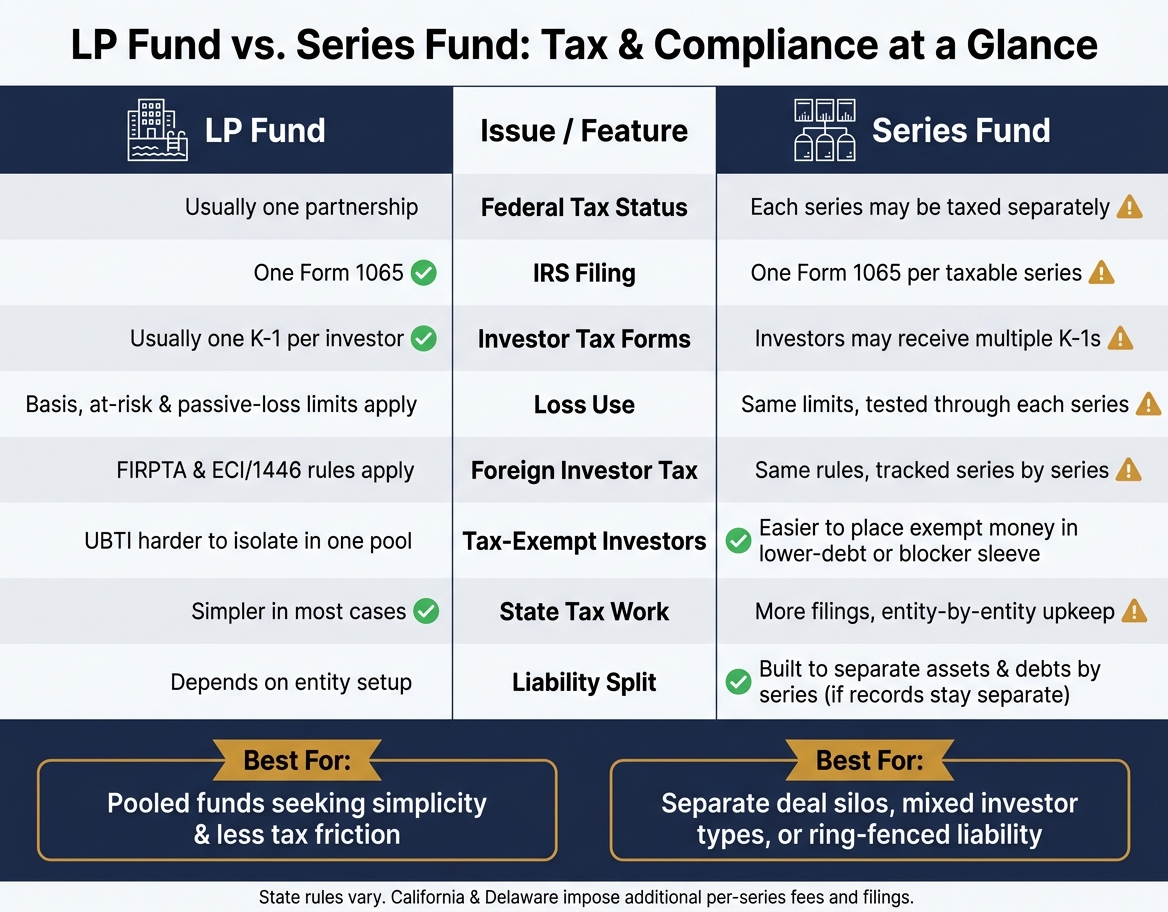
LP Fund vs. Series Fund: Tax & Compliance Comparison for Real Estate Sponsors
| Issue | LP Fund | Series Fund |
|---|---|---|
| Federal tax status | Usually one partnership | Each series may be taxed separately |
| IRS filing | One Form 1065 | One per taxable series in many cases |
| Investor tax forms | Usually one K-1 per investor | Investors may get multiple K-1s |
| Loss use | Basis, at-risk, and passive-loss limits still apply | Same limits apply, but tested through each series structure |
| Foreign investor tax | FIRPTA and ECI/1446 rules may apply | Same rules, but tracked series by series |
| Tax-exempt investor issues | UBTI can be harder to isolate in one pool | Easier to place exempt money in a lower-debt or blocker sleeve |
| State tax work | Simpler in most cases | More filings and more entity-by-entity upkeep |
| Liability split | Depends on entity setup | Built to separate assets and debts by series, if records stay separate |
Bottom line: I’d use an LP when I want one pooled fund with less tax friction. I’d look at a series fund only when separate assets, investor groups, or risk buckets justify the extra filing burden.
The rest of the article breaks down those tradeoffs in plain English.
How US Tax Rules Apply to LP Real Estate Funds
An LP taxed under Subchapter K doesn't pay federal income tax at the entity level. Instead, the fund passes income, gains, losses, depreciation, and credits through to the partners based on the partnership agreement. That setup is what drives the loss limits and withholding rules below.
Pass-Through Treatment, Form 1065, and Schedule K-1s
Each year, the fund files Form 1065 and sends a Schedule K-1 to each investor. Rental activity runs through Form 8825, then to Schedule K and Box 2 of the K-1.[6][18]
Since 2020, the IRS has required partnerships to report capital accounts using the tax-basis method. So each K-1 shows the investor's allocated share using tax-basis capital, not book or GAAP capital.[10][11] That matters because tax-basis capital, along with the investor's share of partnership liabilities, helps determine outside basis. And outside basis affects how much loss an investor can deduct.
Sponsors usually try to deliver K-1s by March 15 for calendar-year funds.[1][9] In practice, that date can be tough to hit. Funds with cost segregation studies or properties in several states often run late, which leaves investors with less time to work through basis and passive-loss limits.
Losses, Basis, At-Risk Rules, and Passive Activity Limits
Once the K-1s go out, a paper loss doesn't always mean a current-year tax deduction. Three separate limits work together to decide whether an LP investor can use a depreciation-heavy loss in that year.
| Rule | What It Limits | Key Form |
|---|---|---|
| Section 704(d) basis limitation | Losses deductible only up to outside basis | Schedule K-1 / basis worksheet |
| Section 465 at-risk rules | Losses limited to amounts economically at risk; qualified nonrecourse real estate debt can count | Form 6198 |
| Section 469 passive activity rules | Passive losses offset only passive income; excess is suspended until sale or sufficient passive income | Form 8582 |
Limited partners are usually treated as passive under Section 469. So depreciation that comes through from the fund usually can't offset W-2 wages or active business income.[19] Those unused losses are suspended and carried forward, and they can often be used later, often when the property is sold. Real estate professionals may be able to treat those losses as nonpassive, but only if they meet the material participation tests.
Carried Interest, FIRPTA, ECI, and Withholding
Carried interest is usually set up as a profits interest. Under Section 1061, gains can be recharacterized as short-term unless the holding period runs longer than three years.[12][13][16] That's why sponsors and tax counsel pay close attention to holding periods. A missed detail here can change the tax result in a big way.
For non-US investors, FIRPTA can trigger withholding on sales of U.S. real property interests. That can also include certain sales of partnership interests if the fund is treated as a U.S. real property holding company.[4][8] On top of that, Section 1446 requires quarterly withholding on each non-US partner's share of ECI at 37% for individuals and 21% for corporations.[14][15][17]
That can create a cash-flow mismatch. The fund may hold back cash for reserves or reinvestment, while the tax rules still require withholding. And when a fund uses separate series, tracking all of this can get messy fast.
How a Series Fund Changes the Tax Analysis
Compared with the LP setup above, a series fund changes the tax picture in a pretty direct way: instead of one pooled return, you move to separate reporting at the series level. So rather than one umbrella vehicle filing a single Form 1065, each series may have its own tax classification, filing duties, and compliance workflow.
Per-Series Tax Classification and Separate Reporting
For federal tax purposes, each series is usually taxed separately when state law treats it as a separate entity.[23][24][27] A single-owner series is usually disregarded, which means its income and loss are reported on the owner's return. If a series has two or more owners, it is generally treated as a partnership that files Form 1065 and issues Schedule K-1s, unless it elects C corporation or S corporation status.[22][2][25][27]
That has a practical effect at tax time: an investor who owns interests in more than one series could receive multiple K-1s.[20][22][26][28] Each series can also make its own tax elections, including a Section 754 election.[23][27] Bonus depreciation treatment and interest-limitation positions may also vary from one series to another.[22][28]
Asset and Liability Separation Versus Added Administration
The big draw of a series structure is ring-fencing. If one series holds a high-leverage development project and another holds a stabilized core portfolio, the idea is that claims and liabilities stay inside each silo.[21][26][24]
But that protection is not automatic. Each series has to operate like its own standalone entity. In day-to-day terms, that means separate bank accounts, separate books, clear allocation policies, and solid records for shared expenses and inter-series transactions.[26][28][35] Contracts should also name the correct series as the actual party to the deal. If those lines blur, the liability shield gets weaker, and the tax separation is harder to support.[24][28]
LP Fund vs. Series Fund: Side-by-Side Comparison
| Feature | LP Fund | Series Fund |
|---|---|---|
| Entity classification | Usually one partnership for federal tax purposes | Each series may be classified separately as a disregarded entity or partnership[29][30][31] |
| Tax filings | One Form 1065 and one set of K-1s | Potentially separate Form 1065 filings and K-1s for each series[29][30][20][32] |
| Liability segregation | Depends on the underlying structure | Designed to ring-fence assets and liabilities by series, but only if records and statutory requirements are respected[33][35][36][37] |
| Administration | Simpler consolidated books and reporting | Requires separate books, accounts, allocations, and often separate EINs[33][34][35][36] |
| State-law recognition | Generally familiar and widely recognized | Only some states and jurisdictions recognize series structures[39] |
The state-law gap can become a real issue. California, for example, does not permit formation of a domestic series LLC, though it may recognize a foreign series LLC doing business there.[38][27] For a multi-state real estate portfolio, that mismatch can lead to filing duties you did not expect, uneven liability protection, and apportionment disputes.[21][24][27]
Those reporting differences also shape who the structure works for and how state filings play out, which the next section covers.
How Structure Affects Capital Raising, Investor Fit, and State Tax Compliance
Pooled Fund Economics vs. Series-by-Series Fundraising
Those reporting differences don’t stop at accounting. They shape fundraising, investor fit, and state tax work too.
A standard LP fund brings capital into one vehicle with one fund-wide waterfall. That usually means return of capital first, then an 8% preferred return, then a GP catch-up, and then an 80/20 LP/GP split above the hurdle.[49][50][52][53] Everyone sits in the same pool, follows the same waterfall, and gets one K-1. That setup tends to work well for institutions and family offices that want diversification without having to track each deal on its own.
A series fund works very differently. Capital is raised one series at a time, often around a specific asset, market, or strategy. Each series can have its own leverage profile, hold period, and promote structure.[26][5][48][51] That gives sponsors more room to match a deal to the right investor group.
There’s a tradeoff, though. Investors who buy into more than one series should expect multiple K-1s, separate state allocations for each series, and a more involved personal tax filing process. In plain English: more paperwork. But the upside is control. Each series can be shaped around the needs of a given investor base instead of forcing everyone into one shared structure.
The next issue is where the money comes from and what filings each structure creates.
Multi-State Filings, Tax-Exempt Investors, and Non-US Investors
When a fund owns property in more than one state, each state may require its own partnership return and nonresident investor filings.[54][55][56][57][58] In a pooled LP, that often leads to one set of state-by-state K-1 data across the full portfolio. In a series fund, each series that owns out-of-state property may bring its own filing duties. That flows from series-level ownership.
Some sponsors use composite returns to cut down on that burden. With a composite return, the fund pays state tax at the entity level for nonresident individual partners. That can make life easier on the filing side, but it comes with a catch: composite returns often apply the highest marginal state tax rate and usually don’t allow personal deductions or loss carryforwards.[54][55][57][20]
Tax-exempt investors add another layer. This group includes pension funds, university endowments, and foundations. Leveraged real estate often creates unrelated business taxable income, or UBTI, which can trigger a Form 990-T filing and reduce after-tax returns.[40][41][42]
A series fund gives sponsors a cleaner way to deal with that issue. Tax-exempt capital can be placed into lower-leverage series or sent through a C-corporation blocker. That blocker absorbs UBTI at the entity level and passes dividends back to the exempt investor, and those dividends generally are not treated as UBTI.[45][46][47] In a pooled LP, all tax-exempt investors share the same leverage profile, so it’s harder to fine-tune that answer unless you add a separate feeder structure.
Non-US investors have their own tax issues. They may face FIRPTA withholding and possible ECI exposure, which can require U.S. tax filings.[43][44][7][3] A series fund lets sponsors separate foreign capital into dedicated series with their own withholding steps or blocker structures, while domestic investors stay in other series.
Before first close, model UBTI, ECI, and FIRPTA.
Conclusion: When to Use an LP and When a Series Fund May Be Worth the Added Complexity
The decision is pretty simple: does the extra complexity earn its keep? Once you factor in the federal, state, and investor-reporting tradeoffs covered above, that’s the core issue.
For most sponsors, an LP is the default move. You get one Form 1065 and one set of K-1s.
A series fund makes sense only when separate strategies or deal-specific investor sleeves call for segregation.[59][60]
And that extra admin work can end up costing more than it gives back.
Key Points for Fund Structuring Discussions
A series fund gives you more flexibility, but not a tax edge. The main differences show up in reporting volume, state compliance, and investor administration, not in the basic tax treatment.
Before picking one structure over the other, sponsors should pressure-test the economics. That means modeling pooled versus series-level waterfalls, estimating how many K-1s each investor is likely to get, and mapping state filing duties in each property state as the portfolio grows.
The structure should follow the strategy, not the other way around. Use an LP when simplicity is the goal. Choose a series fund only when segregation is worth the extra reporting and state work.
FAQs
When does a series fund justify the extra tax work?
A series fund makes sense when the legal and day-to-day gains from isolating assets are worth the extra tax work.
In plain English, it’s usually used to ring-fence liabilities or to offer different investment terms for separate asset pools under one legal entity. That setup can mean more tax filings and more compliance work, yes. But it also gives you cleaner risk separation and more tailored financial reporting for each series.
So while the structure is more complex, it can be a smart fit when each asset pool needs its own terms, reporting, and liability boundaries.
How many K-1s might investors receive in each structure?
In a standard limited partnership (LP), an investor will usually get one K-1 per entity for each tax year.
With a series fund, that number can change based on how the series are set up for tax purposes. If each series is treated as a separate tax entity, an investor may get a separate K-1 for each series they own.
How should sponsors handle tax-exempt and foreign investors?
Sponsors should account for the different tax situations of tax-exempt and foreign investors when they set up the deal and prepare investor documents.
For tax-exempt investors, sponsors often use C corporation blockers to help reduce exposure to unrelated business taxable income and to deal with limits on using interest tax shields. For foreign investors, sponsors should handle tax reporting needs and make required forms, such as W-8BEN, available through secure investor portals.