
The Fed Held Rates. Your Cost of Capital Went Up Anyway.

On July 29, the FOMC voted 9–3 to leave the federal funds target range at 3.50% to 3.75%. That's the fifth straight hold. If you only read the headline, you'd conclude nothing happened.
Something did happen. It just didn't happen where most people were looking.
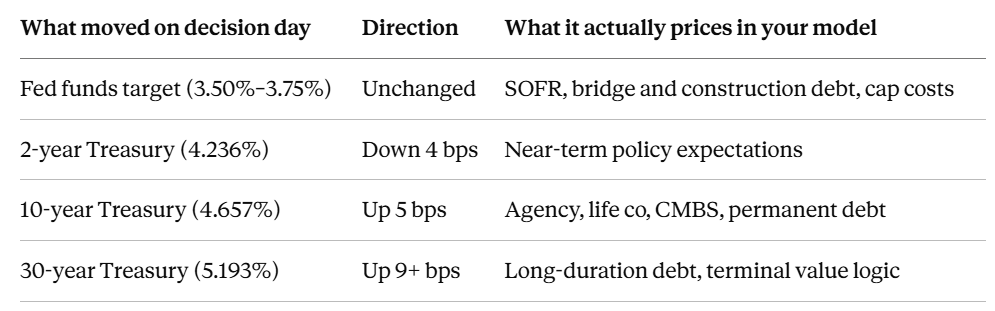
By the close that afternoon, the 10-year Treasury was up 5 basis points to 4.657% and the 30-year was up more than 9 basis points to 5.193%, while the 2-year fell 4 basis points to 4.236%. The Fed held the short end still and the long end walked away in the other direction. As of this week the 10-year sits near 4.69%, backing off an 18-month high, with the 2s10s spread around 47 bps.
For a CRE sponsor, that is not a nothing day. That's the day your permanent takeout got more expensive while your bridge loan stayed exactly where it was.
The fed funds rate is not your cost of capital
I bring this up constantly with clients, so I'll say it plainly here.
Two different curves price your capital stack, and they don't have to move together:
Floating-rate debt — bridge, construction, most value-add — prices off SOFR, which tracks the fed funds rate closely. When the Fed holds, this leg holds.
Fixed-rate debt — agency, life co, CMBS, most permanent takeouts — prices off the 10-year Treasury plus a spread. The Fed doesn't set this. The bond market does.
July 29 was a clean demonstration. The Committee didn't move, so the floating leg didn't move. But long-term yields rose because the bond market wasn't reassured about inflation, and that leg got more expensive.
If your model has one input cell labeled "interest rate" and everything keys off it, this is the week to go fix that.
Move each curve independently and watch what happens to your coupon, your coverage, and how much loan you can actually refinance into.
—
Built by The Fractional Analyst.
Three dissents is the real signal
Here's the part I'd pay more attention to than the decision itself.
Beth Hammack, Neel Kashkari, and Lorie Logan all voted against the hold, and all three wanted a quarter-point hike. That's the first time since September 2016 that three policymakers dissented in the same direction. Inflation has now run above the Fed's 2% target for more than five years, and the July statement flagged supply shocks — energy in particular — as part of the reason.
Meanwhile, markets are pricing roughly a 63% to 65% chance of a 25 bp hike in September, down from about 80% before the meeting. The next decision lands September 16.
Put those together and you get a market where the next move is more likely up than down. I don't know a lot of CRE models built that way.
Warsh isn't going to tell you what's next
Chair Warsh gave no forward guidance, and he's been explicit that he doesn't intend to. He's said he wanted a "family fight" on the Committee and got one. Statements under him are shorter than they were under Powell, and the July statement said nothing about the path ahead.
For underwriting, that changes the exercise. You can't lift a consensus path out of the Fed's own language anymore, because the language isn't there. That leaves two options: model the range, or pretend you know. Only one of those survives an IC meeting.
What I'd actually change in the model this week
Four things, in the order I'd do them.
Split your rate inputs. One cell for SOFR-linked debt, a separate cell for the 10-year, and a spread assumption on top of each. If a single input drives both your bridge coupon and your refi coupon, your sensitivity table is telling you a story that can't happen.
Build the up case, not just the down case. Most models I review run a base case and a "rates fall" upside. Given three hawkish dissents and roughly two-in-three odds of a September hike, the +25 and +50 bp columns deserve equal billing. Run them on the refinance year specifically — that's where a hike does the most damage.
Re-check your exit cap against the long end. With the 30-year at 5.19%–5.27%, an exit cap in the low 5s implies a spread over the risk-free rate that's hard to defend in writing. If your terminal value only works at a cap rate tighter than entry, you don't have a business plan, you have a bet on the bond market.
Price your cap extension now if you're floating. Rate cap costs move off forward SOFR expectations, and those expectations shifted toward a hike. If you have a cap expiring in the next 12 months, get a fresh quote this month rather than at renewal.
The bigger context
There's roughly $875 billion in commercial mortgage maturities on the 2026 calendar. Most of that debt was written when the long end was materially lower than it is today. Every one of those borrowers refinances off the 10-year, not off the fed funds rate.
That's why "the Fed held steady" is a genuinely misleading summary of last week for our industry. The rate that governs the refinance got worse. The rate that governs your existing floating coupon didn't get better. Both of those are true at once, and only one of them made the headline.
Bottom line
A hold is not stability. It's the Fed staying put while the market repriced around it.
If you take one thing from July 29, make it this: stop underwriting to the fed funds rate. Underwrite to the curve that actually prices your debt, model the hike as a real scenario instead of a footnote, and pressure-test the exit before you present a return.
Rates being "unchanged" is exactly the kind of quiet week that puts a deal underwater eighteen months later.
Working through what the rate environment does to a specific deal? That's the kind of question our analysts handle every week. Get in touch.