
How Crowdfunding Works for Commercial Real Estate

Commercial real estate crowdfunding is simple at its core: a sponsor puts a deal online, investors fund part of it, and returns depend on whether the deal is structured as equity or debt.
If I were sizing up this space fast, I’d focus on four things: who runs the deal, where my money sits in the capital stack, how long cash is locked up, and what the legal documents say about payouts, fees, and exits. In most cases, equity deals run 3 to 10 years with target returns around 10% to 20% IRR, while debt deals tend to run 6 to 24 months with target yields around 7% to 12%.
Here’s the short version:
- Sponsors find the property, line up financing, and run the asset.
- Investors put in capital and usually stay passive.
- Platforms post the deal, handle investor flow, and help with SEC rule compliance.
- Senior lenders often fund about 60% to 70% LTV.
- Returns depend on whether you invest in equity or debt.
- Risk depends a lot on payout priority, leverage, and the sponsor’s track record.
- Paperwork matters: the PPM, operating agreement, and subscription agreement set the rules.
- After closing, reporting, property performance, DSCR, LTV, and the exit plan drive results.
If you want the plain-English takeaway, it’s this: CRE crowdfunding can open the door to deals that used to be harder to access, but you still need to read the structure, the sponsor, and the downside case very closely.
Crowdfunding Real Estate: Risks vs Rewards Explained
sbb-itb-df8a938
Quick Comparison
| Deal Type | What You Get | Typical Hold | Target Return | Payout Priority | Main Tradeoff |
|---|---|---|---|---|---|
| Equity | Ownership stake | 3–10 years | 10%–20% IRR | Paid after debt | More upside, more risk |
| Debt | Loan position | 6–24 months | 7%–12% yield | Paid before equity | Lower upside, more payment protection |
From there, I’d look at the process in order: underwriting, launch, investor funding, and post-close reporting.
How the Crowdfunding Process Works, Step by Step
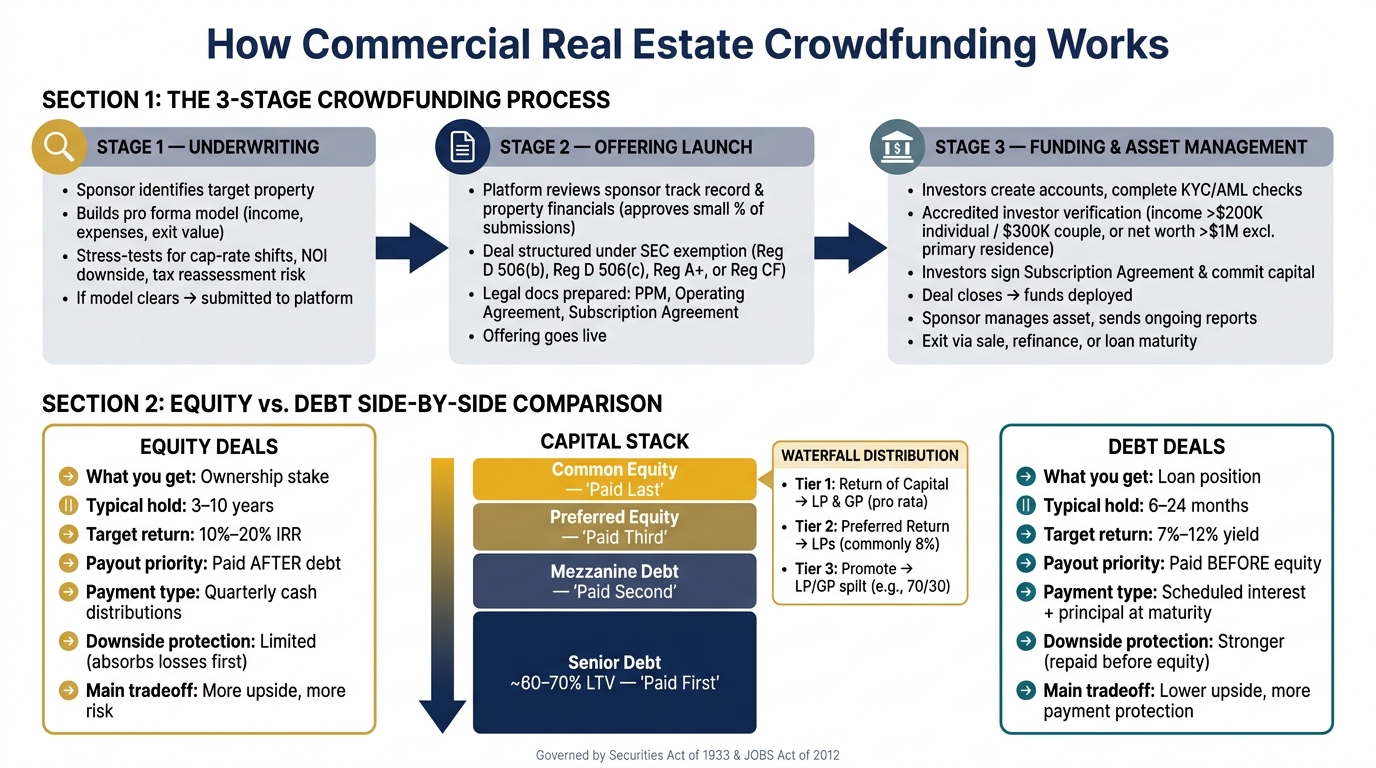
How CRE Crowdfunding Works: Step-by-Step Process & Capital Stack
A CRE crowdfunding deal usually moves through three stages: underwriting, offering launch, and the capital raise followed by asset management. Each stage comes with its own documents, reviews, and go/no-go calls.
1. Sponsor Finds the Property and Builds the Underwriting
The process starts when a sponsor finds a target property and puts together a pro forma model to estimate how the deal might perform. That underwriting usually covers projected income, operating expenses, and the expected exit value.
Sponsors also pressure-test the model for cap-rate shifts, NOI downside, and sale-time tax reassessment risk [5]. In plain English, they’re asking: Does this deal still work if things don’t go as planned? If the numbers still make sense under those stress cases, the sponsor puts the deal package together for the crowdfunding platform.
If the model clears underwriting, the sponsor sends the deal to the platform for review.
2. The Offering Is Reviewed, Structured, and Launched
Platforms approve only a small share of submissions [1]. They look closely at the sponsor’s track record, the property’s financial profile, and whether the deal structure matches the investor group the platform wants to serve.
If the deal gets approved, it is set up under a U.S. securities exemption. Common paths include Regulation D 506(b), Regulation D 506(c), Regulation A+, and Regulation Crowdfunding (Reg CF) [1][2].
| Exemption | Common Use |
|---|---|
| Regulation D 506(b) | Private offering under Regulation D |
| Regulation D 506(c) | Private offering with accredited investor verification |
| Regulation A+ | SEC-regulated offering |
| Regulation Crowdfunding (Reg CF) | SEC-regulated crowdfunding offering |
Next comes the legal paperwork. The legal team prepares the main offering documents: a Private Placement Memorandum (PPM), an Operating Agreement, and a Subscription Agreement [1][2]. These documents give investors the key terms, the deal structure, and the rules that govern how the investment works.
Once that’s done, the platform can launch the offering with the deal details investors need to review.
3. Investors Commit Capital, the Deal Closes, and the Asset Is Managed
After the offering goes live, investors create accounts, complete KYC/AML checks, and verify accredited status for Regulation D 506(c) offerings [1][2]. Accredited investor status generally means annual income above $200,000 for individuals or $300,000 for couples for two straight years, or net worth above $1 million excluding a primary residence [2].
From there, investors sign the Subscription Agreement and commit capital. When the raise hits its target, the deal closes and the funds are deployed into the asset [1][2].
Then the work shifts from fundraising to execution. The sponsor manages the property and sends ongoing reports to investors. The exit usually happens through a sale, refinance, or loan maturity, with proceeds distributed under the Operating Agreement [1].
After closing, the main questions become pretty practical: how returns are paid, what risks are still on the table, and what reporting investors can expect.
How Returns, Risks, and Compliance Work After Funding
How Investors Get Paid
Once a deal closes, your payout comes down to where you sit in the capital stack and what the offering documents say.
Equity investors usually get cash distributions when the property brings in enough net income to cover them. Most platforms pay on a quarterly cycle, although some use monthly distributions to line up with rent collections. When the deal ends - usually through a sale or refinance - the money follows a set waterfall. Debt gets paid first, and then the rest moves through the profit-sharing structure.
| Waterfall Tier | Who Gets Paid | Description |
|---|---|---|
| Tier 1: Return of Capital | LP and GP (pro rata) | Investors get their original capital back first |
| Tier 2: Preferred Return | Limited Partners (LPs) | Preferred return on unreturned capital (commonly 8%) |
| Tier 3: Promote | LP and GP (e.g., 70/30) | Remaining profits split as a performance reward for the sponsor |
Debt investors have a more straightforward setup. They receive scheduled interest payments during the hold period, then get their principal back when the loan matures. Senior debt tends to pay less. Mezzanine debt pays more, but it sits below senior debt and above equity.
One thing to look for in a debt deal is PIK interest. If it's included, that interest builds up until maturity instead of being paid monthly.
The exact payout order always comes back to the operating agreement and the capital stack.
What to Review Before Committing Capital
Before you sign, treat the offering memorandum, operating agreement, and subscription documents as the main source of truth. This is where the deal either holds up or starts to wobble.
Pay close attention to whether the waterfall uses an American (deal-by-deal) or European (whole-of-fund) model [2][4]. That difference matters more than it may seem at first glance. In an American waterfall, the sponsor can start earning promote-level profits once a single asset clears its performance hurdles. In a European waterfall, LPs must get back all contributed capital plus preferred returns across the full portfolio before the sponsor gets any promote.
You should also confirm the sponsor's exit plan. If the deal relies on short-term debt or mezzanine financing, there needs to be a believable route to refinance, sell, or recapitalize the property before maturity. For mezzanine loans, that window is often 1 to 5 years [3].
A few more items deserve a close read:
- Hold periods
- Transfer limits
- Exit fees
Many deals restrict transfers and early exits [1][2].
In the U.S., real estate crowdfunding is usually governed by the Securities Act of 1933 and the JOBS Act of 2012 [2].
And here's the plain truth: nice-looking terms on paper don't mean much if the underwriting behind them is weak.
Equity vs. Debt: Return Profiles, Risks, and Reporting
After closing, the big difference is simple: who gets paid first.
| Feature | Equity Deals | Debt/Mezzanine Deals |
|---|---|---|
| Payment Type | Periodic cash distributions (if supported by cash flow) | Scheduled interest payments |
| Principal Return | Usually at the time of asset sale or refinance | At loan maturity (typically 1–5 years) |
| Capital Stack Priority | Last (Common Equity) or second-to-last (Preferred Equity) | First (Senior Debt) or subordinate (Mezzanine Debt) |
| Downside Protection | Limited - losses are absorbed first | Stronger - debt is repaid before equity |
That priority shapes the return profile and the risk. Equity can have more upside, but it also takes the first hit if things go sideways. Debt has better downside position because it gets repaid before equity, though the return ceiling is usually lower.
Sponsors also have to stay within financial covenants during the hold period. Common examples include a minimum Debt Service Coverage Ratio (DSCR) and a maximum Loan-to-Value (LTV) threshold. Those guardrails add another layer of accountability while the deal is active [3].
After funding, performance usually comes down to three things: the quality of the underwriting, how well the sponsor reports, and how the asset is managed day to day.
How Better Financial Analysis Supports Crowdfunded CRE Deals
This is where stronger analysis and reporting help keep a deal moving in the right direction. After closing, those two things sit at the center of how well a sponsor runs the asset.
Where The Fractional Analyst Fits in the Process
The Fractional Analyst works with sponsors during underwriting and while putting investor materials together. Their team helps build detailed pro formas with realistic rent growth, vacancy assumptions that match the market, and stress-tested cases that show what happens to returns if exit cap rates come in 50–100 basis points higher than expected. That kind of sensitivity work gives investors a much clearer view of downside risk before they put money in.
The same bar applies to investor materials like pitch decks and offering memorandums. The Fractional Analyst also offers free models and templates, including a multifamily acquisition model, a mixed-use development model, and an IRR matrix. Those tools can help with waterfall structures, debt sizing, and sensitivity tables [6].
Direct Servicing and CoreCast for Ongoing Deal Management
Once a deal is funded, the focus shifts. Now it's about reporting, monitoring, and keeping a close eye on the portfolio. The Fractional Analyst handles that through two paths.
Direct servicing gives sponsors access to financial analysts who help with investor and lender reporting packages, asset-level diagnostics, and capital planning decisions. Oakdale Capital, for example, used the direct servicing team to complete more than 50 multifamily underwritings in Q2 and Q3 of 2025, with market research built into each one [6].
CoreCast, their self-service reporting platform, is built for teams that want standardized reporting and monitoring tools. It supports portfolio-wide tracking for occupancy, NOI, and loan covenants, and it can generate standardized investor reports across many assets. In a crowdfunded deal, where there may be dozens or even hundreds of smaller investor positions, that kind of consistency cuts down on friction and helps keep communication clear during the hold period.
| Service Track | Key Applications |
|---|---|
| Direct Servicing | Underwriting, investor/lender reporting, pitch decks, model audits |
| CoreCast (Self-Service) | Portfolio monitoring, standardized reporting, scenario modeling |
That kind of discipline helps keep crowdfunded deals transparent throughout the hold period.
Conclusion: The Core Mechanics of CRE Crowdfunding
CRE crowdfunding works best when underwriting, deal structure, funding, and asset management all stay in sync from the first pass to the final exit.
That’s the basic tradeoff. Investors get access and scale, but their money is tied up, and they don’t control day-to-day operations or when the deal ends. So a lot rides on the sponsor’s judgment from start to finish.
Good underwriting helps get a deal funded. Clear reporting helps keep trust in place all the way through exit.
FAQs
How much money do I need to start?
In commercial real estate crowdfunding, the amount you need to get started depends on the deal. In most cases, investors put in equity that covers 10% to 20% of a project’s total capital needs.
The exact minimum investment comes down to the project sponsor and the crowdfunding platform.
Can I sell my investment early?
Usually, no. Commercial real estate crowdfunding investments are generally illiquid, which means your money is often locked up for the full term of the deal. In most cases, you get your capital back only when the property is sold or refinanced.
It’s worth checking the offering documents for any secondary market options or redemption rights. But in practice, those are uncommon.
What happens if the property underperforms?
If a property underperforms, lenders may ask the owner to put in more equity or route income into lender-controlled reserves. That can tighten cash flow fast.
If the issues are serious enough to trigger a mezzanine debt default, the lender may foreclose on the borrower’s equity interest. In plain English, that can mean losing ownership and control.
Underperformance can also make refinancing at maturity harder. That risk gets worse if net operating income stalls or the property’s value drops.