
Best Practices for Data Integration in CRE Reports

Bad CRE reporting usually starts with bad data flow. If your property, accounting, leasing, debt, and underwriting systems do not line up, your reports slow down, your numbers conflict, and investor trust drops.
I’d boil the fix down to this: map every data source, set one definition for each KPI, use one record for each property and lease, automate ETL with checks, and give each field a clear owner. That is how teams cut manual rework, shorten close cycles, and make reports easier to defend.
A few points stand out fast:
- Conflicting metrics often come from siloed systems and different KPI formulas
- Manual ETL leads to broken links, missing rows, and weak audit trails
- Master data helps keep one ID per property, tenant, and lease
- Centralized reporting layers give teams one place for validation and reporting
- Standard templates and named owners keep review cycles from stalling
- Poor data quality can cost firms $12.9 million to $15 million per year
If I were setting this up, I’d do it in a simple order:
- Inventory every source system
- Map ownership for each data element
- Set KPI rules and master IDs
- Automate high-risk reconciliations first
- Lock report templates and review roles
Here’s the core idea: clean inputs, fixed standards, and clear ownership do more for CRE reporting than adding more spreadsheets or more manual review.
The Main Data Integration Problems in CRE Investor Reporting
Most reporting breakdowns come from three places: fragmented systems, manual ETL, and inconsistent standards.
| Integration Problem | Common Symptoms in Reports | Business Impact |
|---|---|---|
| Fragmented Systems | Mismatched property IDs; conflicting occupancy numbers between leasing and GL | Higher reconciliation costs; conflicting versions of the truth delay decision-making |
| Manual ETL | Typos in tenant names; broken Excel links; missing records in roll-ups | Higher error costs; reduced stakeholder trust |
| Lack of Standards | Inconsistent KPI definitions (e.g., different NOI calculations) | Portfolio performance cannot be compared cleanly; investor Q&A becomes harder to defend |
These issues may look different on the surface. But they lead to the same result: slow, unreliable reporting.
Fragmented Systems and Inconsistent Source Data
Rent rolls, general ledger exports, lease abstracts, debt schedules, and other source files rarely sit in one place. They usually live across different software tools and spreadsheets, each with its own naming rules and ID structure.
That’s when things start to snowball. If a property appears as 123 Main St. in one system and 123 Main Street in another, automated roll-ups can fail. Rent roll balances may not match the numbers in the GL, and each mismatch has to be reviewed before anyone can rely on the output. In practice, that means teams spend time cleaning data by hand before the report is even usable.
Manual ETL, Reconciliation Delays, and Weak Audit Trails
When data pipelines aren’t automated, analysts end up doing the work themselves. Files get emailed across teams, copied into master spreadsheets, and changed with formulas that no one has written down. Every step opens the door to a broken link, a skipped row, or a tab that overwrites the wrong cells without warning.
The bigger issue is figuring out where the error started. Without a documented transformation trail, tying a variance back to a specific invoice or lease becomes extremely hard. That lack of traceability stretches close cycles and leaves analysts defending numbers they can’t fully verify. When the trail is weak, every variance turns into a manual investigation.
No Shared Standards for Metrics and Ownership
Even if data moves cleanly between systems, reporting can still break down when teams define metrics differently. If one asset manager calculates NOI before management fees and another calculates it after, those figures can’t be compared fairly, even within the same fund. The same problem shows up in IRR assumptions and cap rate calculations.
Ownership is another sticking point. If no one has clear approval authority over the final numbers, reports can stall right before delivery. Teams argue over which version of a metric is right, investors ask questions during Q&A that no one can answer with confidence, and the reporting package loses credibility. Standardization is what makes reports comparable and audit-ready.
sbb-itb-df8a938
How to Build a Data Foundation for Reliable CRE Reports
If you want CRE reports people can trust, start where the data starts. That means fixing integration at the source, bringing data into one place, and using the same master records across systems. The first move is simple: map your sources before you build anything.
Map Your Core Data Sources Before Building Pipelines
Before you connect systems or set up pipelines, write down every source that feeds your reports.
For each one, spell out two things: who owns the system and which data elements that system owns. If you skip this step, you're building pipelines on guesswork. That's when teams end up arguing over which system owns a metric, why two numbers don't match, and who needs to fix it.
A source inventory helps stop that mess early. It gives you a clean view of where each record comes from and cuts the back-and-forth before it starts.
Once that ownership is clear, you can pick the architecture that will store and manage those records.
Choose a Centralized Architecture That Supports Governance
Point-to-point integrations may seem like the easy path at first. But as your portfolio grows, they turn into a headache. Every new system adds another direct connection. After a while, you're stuck managing a tangled web of dependencies.
A centralized warehouse or platform works better because it gives you one governed layer for ingestion, validation, and reporting.
| Integration Approach | Scalability | Control | Data Quality | Implementation Effort |
|---|---|---|---|---|
| Point-to-Point | Low | Low | Poor | Low initially; high maintenance |
| Hub-and-Spoke | Moderate | Moderate | Moderate | Medium |
| Centralized Warehouse | High | High | High | High initially; low long-term |
Yes, a centralized warehouse takes more work up front. But the payoff is hard to ignore: fewer reconciliation cycles, cleaner audit trails, and reports you can reproduce without rebuilding the process every time.
After that, the next job is cleaning up duplicate records.
Use Master Data to Create One Record per Property, Tenant, and Lease
Even with a centralized setup, reports fall apart when the same property shows up under three names or a tenant has more than one active lease record across systems.
Master data management (MDM) fixes that by giving each property, tenant, and lease one authoritative record. Then every system points back to that record instead of keeping its own version.
In practice, that usually means:
- Assigning a standard property ID across asset management, accounting, and leasing systems
- Aligning lease and tenant records so roll-ups work without manual cleanup
- Using the same IDs in ETL and reporting templates so results stay consistent
Think of it like giving every asset and lease a single name tag that follows it everywhere. When those IDs match across systems, roll-ups stop breaking for small, annoying reasons.
ETL, Data Quality, and Standardized Reporting: Key Practices
Once source systems and master records are lined up, the next step is making sure those rules show up in every reporting cycle. That’s where ETL and template controls do a lot of the heavy lifting. They cut down reconciliation delays, stop conflicting numbers from popping up, and strengthen the audit trail.
Standardize Schemas and KPI Definitions at Ingestion
Set core KPIs, account mappings, property ID rules, coding rules, and reporting periods in one shared standard. In plain English: lock in a standard chart of accounts and consistent property ID and coding rules before any pipeline starts running.
If one source system uses a different label for the same thing, your team ends up wasting time matching numbers that should already match. That’s the kind of problem that snowballs fast.
Once those definitions are fixed, the ETL process can check data against the same rules every single time.
Automate ETL with Staging, Reconciliation, and Exception Handling
Use a staged ETL flow: extract, validate, transform, reconcile, then publish.
The staging step is where data quality gets checked. Automated tools should flag outliers there, and exceptions should go to the right analyst for review before anything lands in an investor report.
Inaccurate data costs organizations between $12.9 million and $15 million annually [1], so exception handling isn’t just a nice technical feature. It’s a financial control. For most CRE firms, batch processing is a better fit for investor reporting than streaming. Why? Because for a quarterly investor report or lender package, accuracy and reconciliation matter more than speed.
Once the pipeline is steady, assign clear ownership so exceptions move fast and reviews don’t get stuck.
Standardize Investor Templates and Assign Data Ownership
Even clean data can fall apart if the reporting package changes every cycle. Consistent templates make reports faster to produce and easier for investors to follow. At a minimum, the reporting package should use a fixed structure for:
- Financial performance
- Lease reporting
- Business plan updates
Ownership matters just as much as the template. Every data field and every review step needs a named owner. Finance owns KPI calculations. Operations owns source inputs. IT owns audit trails and access controls. Legal owns regulatory review.
Without clear ownership, review cycles drag on and errors slip through without being challenged.
Use CREFC IRP and Annex A as the baseline for field standards across property, loan, and borrower data. Then use role-based access controls to enforce those standards by blocking unauthorized changes to core fields.
Implementation Steps and Conclusion
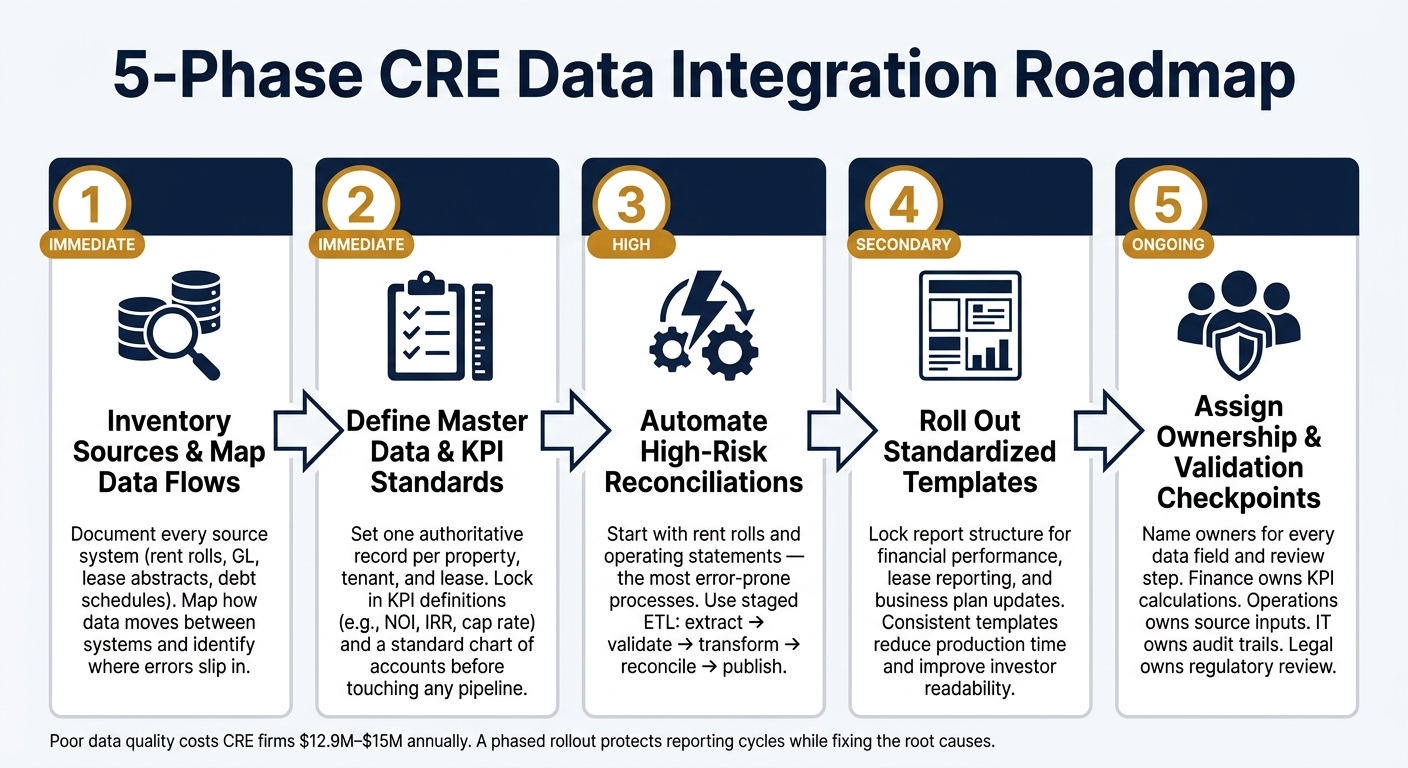
5-Phase CRE Data Integration Roadmap for Reliable Investor Reporting
A Phased Plan for Cleaner Reporting Operations
With source maps, standards, and ETL rules in place, the next step is to roll changes out in phases. That's the safest way to clean up reporting without throwing reporting cycles off track. Trying to rebuild everything at once usually backfires. Teams end up creating the same disruption they were trying to remove.
Start by inventorying every data source and mapping how data moves between systems today. That gives you a clear picture of what feeds what, where handoffs happen, and where errors tend to slip in.
After that, set your master data and KPI standards before you touch any pipeline. If those rules aren't clear up front, automation just moves bad logic faster.
From there, automate the highest-risk reconciliations first. Rent rolls and operating statements tend to be the most error-prone, so they're the right place to begin. Once those processes are stable, roll out standardized templates and put formal ownership and validation checkpoints in place.
| Phase | Action | Priority |
|---|---|---|
| 1 | Inventory sources and map data flows | Immediate |
| 2 | Define master data and KPI standards | Immediate |
| 3 | Automate high-risk reconciliations (rent rolls, operating statements) | High |
| 4 | Roll out standardized templates | Secondary |
| 5 | Assign ownership and validation checkpoints | Ongoing |
How The Fractional Analyst and CoreCast Can Support Execution
If internal teams don't have the bandwidth, outside execution support can help speed up the rollout without changing the reporting design.
For firms that need analyst support, The Fractional Analyst can help with reporting execution. For self-service workflows, CoreCast can automate the ingestion of rent rolls and operating statements and keep reporting data consistent across the portfolio.
Conclusion: Practices That Cut Reporting Friction and Build Investor Trust
Better data integration doesn't require a massive infrastructure rebuild.
The firms that cut reporting friction fastest tend to do a few things well: they unify source systems, standardize master data and KPIs, automate ETL with clear audit trails, and enforce consistent templates with named ownership.
Reporting will always have some complexity. But most of the friction firms deal with today comes from structure problems: fragmented systems, undefined ownership, and inconsistent templates. The good news is that those problems are fixable when teams tackle them in the right order.
Cleaner inputs, clearer ownership, and automated controls reduce friction and build investor trust.
FAQs
How do I know which data source should be the system of record?
Start by giving each data category one home base.
For example:
- Use your accounting software for capital accounts, distributions, and financial statements.
- Use your CRM for investor relationships and profiles.
- Use your document management system for legal agreements and tax forms.
The main goal is simple: each type of data should have one authoritative source. That way, your team knows where to look, which system to update, and which numbers or records to trust.
Clear ownership like this helps protect data integrity and keeps reporting consistent.
What should I automate first in CRE reporting?
Start with automated data collection. Manual entry slows teams down and often leads to transcription mistakes, especially when data is pulled from several property management and accounting systems. That’s where reporting starts to get messy, and reconciliation can turn into a time sink.
After data ingestion is automated, it becomes much easier to standardize report formats and build real-time dashboards. The Fractional Analyst’s CoreCast platform helps automate data collection, improve accuracy, and save time.
Do I need a data warehouse to improve investor reporting?
Not necessarily. Centralized data does matter if you want a reliable single source of truth.
But that doesn't mean you need to rebuild your whole setup from scratch.
You can improve investor reporting with integration platforms that connect straight to your current systems. Tools like CoreCast automate data collection from property management and accounting software. That cuts manual entry, avoids heavy data engineering work, helps standardize reports, and improves data accuracy.