
IRS Forms for Non-U.S. Real Estate Sellers

If you’re a non-U.S. seller of U.S. real estate, the big issue is simple: FIRPTA can withhold 15% of the amount realized at closing, and that is often 15% of the gross sale price. On a $1,000,000 sale, that can mean $150,000 sent to the IRS before your final tax is figured.
I’d boil the process down like this:
- Before closing: I deal with Form 8288-B if I want lower withholding, and Form W-7 if I need an ITIN.
- At closing: the buyer handles Forms 8288 and 8288-A, and the settlement agent usually files Form 1099-S.
- After closing: I file Form 1040-NR if I’m an individual, or Form 1120-F if I’m a foreign corporation, to report the sale and ask for any refund due.
The main point is easy to miss: FIRPTA withholding is a prepayment, not the final tax bill. That means I may still get money back later if the withholding was more than the tax owed.
Quick list of the 7 forms covered:
- Form W-7 - apply for an ITIN
- Form 8288-B - ask for reduced or waived withholding
- Form 8288 - buyer reports and sends FIRPTA withholding
- Form 8288-A - record of how much was withheld
- Form 1099-S - reports gross sale proceeds
- Form 1040-NR - final return for foreign individuals
- Form 1120-F - final return for foreign corporations
FIRPTA Rule 2025: 6 Challenges for Foreign Sellers & IRS Payments
sbb-itb-df8a938
Quick Comparison
| Form | Who files it | When it matters | What it does | Changes cash at closing? |
|---|---|---|---|---|
| W-7 | Seller | Before filing that needs a TIN | Gets an ITIN | No |
| 8288-B | Seller | Before closing | Asks for lower withholding | Yes |
| 8288 | Buyer/withholding agent | After closing | Sends withheld tax to IRS | Yes |
| 8288-A | Buyer/IRS | With Form 8288 | Shows seller and amount withheld | No |
| 1099-S | Closing agent | At closing | Reports sale proceeds | No |
| 1040-NR | Seller (individual) | After sale | Reports sale, claims refund/credit | No |
| 1120-F | Seller (corporation) | After sale | Reports sale, claims refund/credit | No |
So if I want to keep more cash at closing, I focus on the pre-closing forms. If full withholding already happened, I use the final return to sort out the tax and claim any refund.
What Non-U.S. Sellers Need to Know Before Closing
Once the deal reaches the closing table, the paperwork starts to matter fast. This is the point where withholding rules kick in.
In most cases, the buyer or withholding agent sends 15% of the amount realized to the IRS at closing. After that, the seller files a U.S. tax return to sort out the final tax due.
That timing matters. If the seller wants reduced withholding or an exemption, the request has to be filed before closing.
The main parties involved are:
- The foreign seller
- The buyer
- The title company or escrow agent handling settlement
One point trips people up all the time: withholding is based on the amount realized, not the seller’s gain. So if a property sells for $1,000,000, the withholding can be $150,000 even when the taxable gain is much lower. On top of that, some states ask for separate withholding too.
That closing setup determines which forms the buyer, seller, and withholding agent file next.
1. Form 8288
Form 8288 is used to report FIRPTA withholding when a foreign seller sells U.S. real property [1].
After closing, the buyer or withholding agent files Form 8288 and sends the withheld tax to the IRS [1].
It goes with Form 8288-A, which shows the seller’s identity and the amount withheld.
2. Form 8288-A
Form 8288-A goes hand in hand with Form 8288. It's the IRS withholding statement for a non-U.S. seller, and it shows two key things: who the seller is and how much was withheld at closing.
The IRS-stamped copy matters because the seller uses it to back up a credit or refund claim on Form 1040-NR or Form 1120-F.
3. Form 8288-B
Before closing, one form can change how much gets withheld.
Form 8288-B is what a non-U.S. seller files to ask for reduced or waived FIRPTA withholding before closing. The seller files it before closing to request a withholding certificate. If the IRS approves the request, the amount withheld can be reduced or waived. If the IRS denies it, or if the certificate doesn’t arrive in time, the standard withholding rules still apply.
If the seller needs an ITIN to support that filing, Form W-7 comes next.
4. Form W-7
For foreign individual sellers, Form W-7 is the ITIN step. The IRS uses an ITIN to match FIRPTA withholding to the seller. Form W-7 is the application for foreign individuals who can't get a Social Security number. If a foreign seller isn't eligible for a Social Security number, they must file Form W-7 so the IRS can process withholding credits and refund claims.[1]
Timing matters here. If you're filing a Form 8288-B request, submit Form W-7 with Form 8288-B before closing. The IRS needs a valid TIN to process the withholding certificate, so missing identification can slow down the application.
If there isn't a pending Form 8288-B request, file Form W-7 with Form 1040-NR.
Start the W-7 process early. It can help you avoid delays with withholding-certificate processing and refunds.
5. Form 1040-NR
After closing, foreign individual sellers use Form 1040-NR to report the sale and square up the tax that was withheld with the tax they actually owe.
Here’s the key point: FIRPTA withholding is based on the gross sale price, not the seller’s net gain. So the amount withheld is often higher than the final tax bill. Form 1040-NR is the return used to claim a refund for that extra withholding.
To claim the withholding credit, attach stamped Copy B of Form 8288-A. The buyer receives this after sending the withholding to the IRS, and it serves as proof of the amount withheld.
Even if the sale resulted in a loss, file Form 1040-NR if you want to recover the withheld tax.
If the seller is a foreign corporation, the next return is Form 1120-F.
6. Form 1120-F
For foreign corporations, this step shifts from Form 1040-NR to Form 1120-F.
Form 1120-F is the tax return a foreign corporation uses to report a U.S. real estate sale and claim credit for FIRPTA withholding. The key point is simple: corporate tax is based on net gain, not gross proceeds, even though the withholding taken at closing is still 15% of the amount realized [1].
That gap matters. A foreign corporation may have more withheld at closing than it actually owes in U.S. tax. By filing Form 1120-F, the corporation can claim a refund for any excess withholding after its final U.S. tax liability is figured.
To support the withholding credit, attach stamped Copy B of Form 8288-A.
7. Form 1099-S
Along with the FIRPTA withholding forms, the settlement agent also files Form 1099-S to report the sale to the IRS. This is the settlement agent’s information return, and it’s usually filed by the title company or escrow agent - not the seller.
Here’s the key point: Form 1099-S reports the gross proceeds from the sale to the IRS. It helps the IRS match the transaction to the seller’s U.S. tax return. But it does not decide how much tax is owed.
Foreign sellers should ask for a copy of Form 1099-S and use it when preparing their U.S. tax return. That way, they can:
- match the reported proceeds on the return
- check that the TIN on Form 1099-S matches Form 8288-A and the U.S. return
- keep the filing records in sync in case the IRS compares them later
Keep Form 1099-S with your closing records so you can match the IRS filing to your return.
How These Forms Work Together at Closing
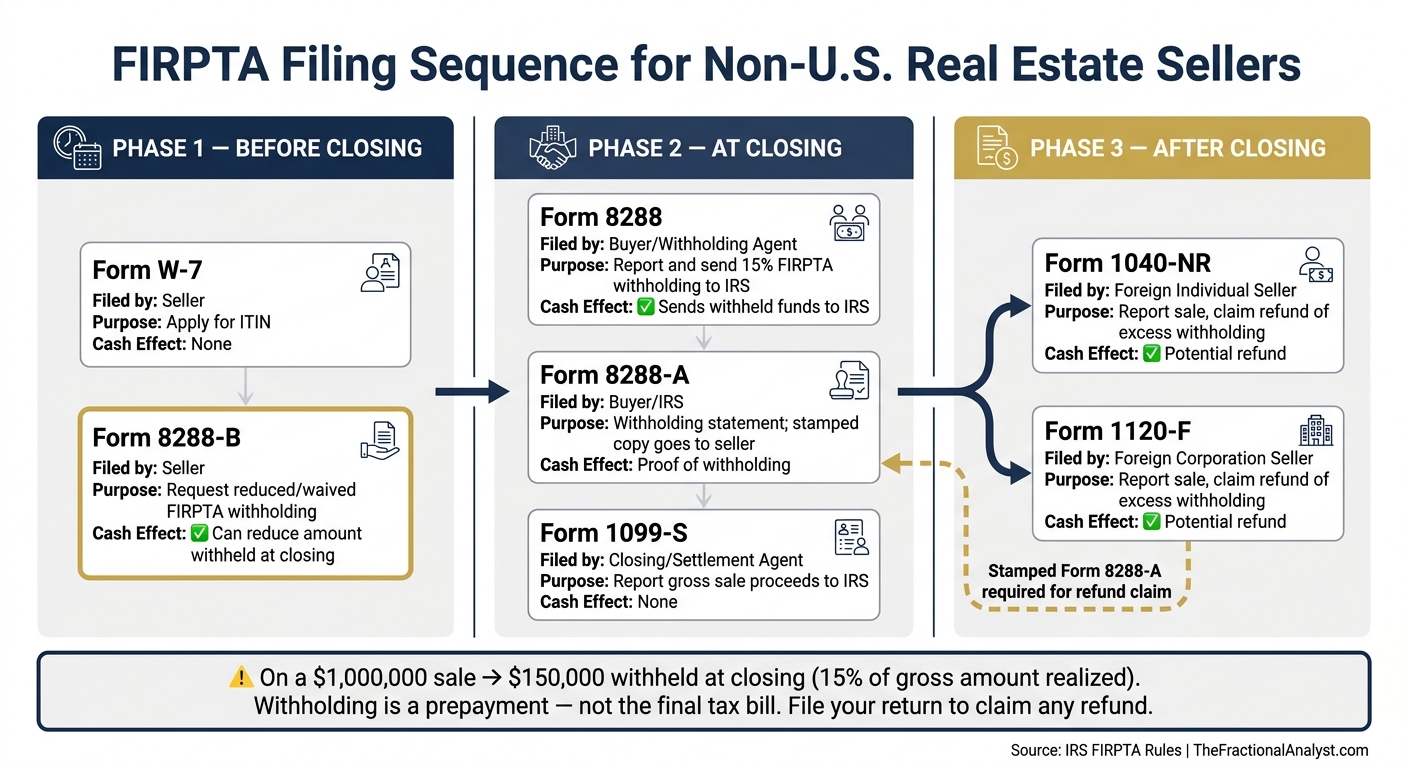
FIRPTA Filing Sequence for Non-U.S. Real Estate Sellers
Now that each form is defined, here’s the filing sequence at closing.
These forms move in a set order, from pre-closing steps to the final tax return. At closing, the buyer files Forms 8288 and 8288-A. The closing agent files Form 1099-S. Later, the seller uses the stamped Form 8288-A to file Form 1040-NR or 1120-F.
| Form | Who's Responsible | Seller Action |
|---|---|---|
| W-7 | Seller | Submit before closing to obtain a U.S. taxpayer identification number |
| 8288-B | Seller | Submit before closing to reduce withholding |
| 8288 | Buyer | Buyer submits withheld funds to IRS |
| 8288-A | Buyer / IRS | Buyer submits; seller receives stamped copy |
| 1099-S | Closing Agent | Agent files; seller receives a copy |
| 1040-NR / 1120-F | Seller | Final return to report sale and claim refund |
Use this sequence as the reference point for the side-by-side comparison that follows.
Side-by-Side Comparison of the 7 Key Forms
This table boils the filing sequence down to three things: who files it, when it gets filed, and whether it changes cash at closing.
| Form | Who Files It | Purpose | Timing | Cash Effect |
|---|---|---|---|---|
| W-7 | Foreign individual seller, if an ITIN is needed | Obtain an ITIN | Before the ITIN-dependent filing | No withholding effect |
| 8288-B | Seller | Request reduced withholding certificate | Before closing | Can reduce the amount withheld at closing |
| 8288 | Buyer or withholding agent | Report and pay withheld FIRPTA tax to the IRS [1] | Shortly after closing | Sends the withheld amount to the IRS |
| 8288-A | Buyer or withholding agent | Withholding statement; IRS-stamped copy goes to the seller | Filed with Form 8288 | Provides proof of withholding |
| 1099-S | Closing agent | Report gross sale proceeds | At closing | Reports the sale only; no withholding |
| 1040-NR | Seller (individual) | Report the sale and claim a refund of excess withholding | After the sale | Refund of excess withholding |
| 1120-F | Seller (foreign corporation) | Report the sale and claim a refund of excess withholding | After the sale | Refund of excess withholding |
The main divide here is timing.
Form 8288-B happens before closing. Forms 8288 and 8288-A come after closing. That sounds simple, but it trips people up all the time. Miss that split, and the filing process can go sideways fast.
That timing difference sets up the mistakes covered next.
Common Filing Mistakes Foreign Sellers Make
Most FIRPTA problems start before closing or show up when the seller files the final return. And the fallout is simple: foreign sellers can lose money or wait much longer for a refund because a few steps were missed.
File Form 8288-B before closing. If it’s filed late, the buyer has to send the full 15% withholding to the IRS, and the seller can only get any extra amount back later by filing a return. [1]
If the seller does not provide the required affidavit or TIN, the buyer must withhold 15% of the amount realized. [1]
Form 8288 is the buyer’s filing, not the seller’s. [1]
Many foreign sellers fail to file Form 1040-NR or Form 1120-F after the sale. That’s a costly slip. The withholding is only a deposit, not the final tax bill. To claim any refund, the seller still needs to file Form 1040-NR or Form 1120-F. [1]
This hits two things that matter most: the seller’s net proceeds and how long it takes to get money back.
How FIRPTA Withholding Affects Your Net Proceeds and Refund Timeline
The biggest surprise here is usually timing, not the tax itself. Once FIRPTA withholding applies, the main issue becomes simple: how much cash leaves the closing table now, and how long it takes to get any extra amount back.
Take a sale where a property was bought for $2,000,000 and sold for $2,500,000. Even then, $375,000 is withheld at closing. That’s because the buyer must withhold 15% of the amount realized and send it to the IRS.
This is where things can sting a bit for sellers with a high cost basis and only a modest gain. FIRPTA withholding does not look at basis or selling expenses when the money is held back. It’s based on the gross amount, not the actual taxable gain. So the amount withheld can end up being more than the final tax bill. When that happens, the IRS keeps the excess until the seller files a tax return and claims a refund or credit.
For commercial real estate dispositions, that directly affects net proceeds planning. A clean way to think about it is this:
| Factor | What It Means at Closing |
|---|---|
| Withholding Base | 15% of the gross sales price (amount realized) [1] |
| Final Tax Base | Net capital gain (sales price minus adjusted basis) |
| Cash Flow Timing | Proceeds are reduced immediately at closing; any refund arrives after filing |
Asset managers and sponsors working with foreign investors should build this "withholding gap" into disposition pro formas and treat the 15% as a Day 1 cash outflow at closing [1]. Investor reporting should also separate net proceeds from net proceeds after FIRPTA. That way, investors can see why the closing distribution is lower and why part of the cash may not come back until later.
Conclusion
Foreign sellers need to handle FIRPTA from the pre-closing stage all the way through the final tax return. Order matters here, because each form has a specific job at a specific point in the process.
Here’s how the seven main forms line up: Form W-7 is used to get an ITIN, Form 8288-B can lower withholding before closing, Forms 8288 and 8288-A deal with the withholding payment and the record of that payment, Form 1099-S reports the sale, and Form 1040-NR or Form 1120-F ties everything together on the final return.
That timeline only works when the right ID and withholding paperwork is handled first. The core dependency is straightforward: Form W-7 supports pre-closing filings, and the stamped Form 8288-A is needed for the final return. Filing in the right order decides whether withholding gets reduced, credited, or refunded.
Build the FIRPTA timeline into disposition planning as early as you can. When you plan ahead, the withholding, return, and refund steps are far more likely to happen in the right sequence. The Fractional Analyst supports FIRPTA-aware underwriting, reporting, and disposition analysis.
FAQs
Do I always have to pay the full 15% at closing?
No. Under federal FIRPTA rules, the 15% withholding for foreign sellers is separate from your final tax bill.
If the amount withheld is more than you end up owing, you can claim a refund by filing a U.S. tax return. In some cases, you can also apply for an IRS withholding certificate before the sale closes to cut or remove the withholding.
What if I do not have an ITIN before the sale?
If you don’t have an ITIN before closing, you can still move forward with the sale. But in most cases, you can’t count on withholding exemption forms submitted at closing.
For nonresident sellers, avoiding state withholding usually comes down to one thing: filing the right exemption forms at the closing table. If those forms aren’t ready by closing, withholding is usually taken out, and you’d get that money back later through tax filing or other tax reporting.
How long does it take to get a FIRPTA refund?
The search results don’t give a set timeline for getting a FIRPTA refund.
If the amount withheld is higher than your actual tax bill, you’ll need to file a U.S. tax return to claim the extra amount back as a refund.