
Common Easement Types in CRE Transactions
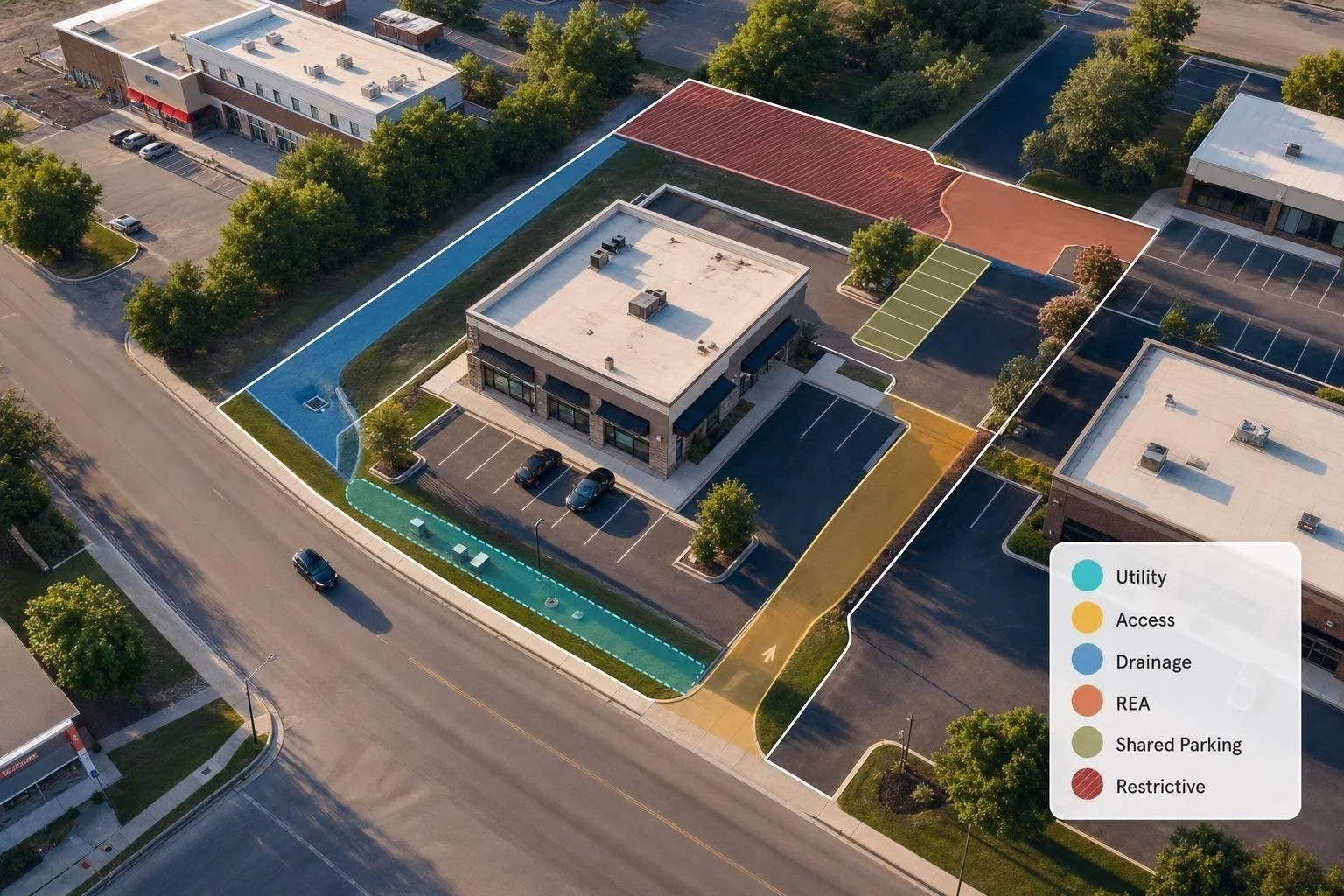
A single easement can shrink a building pad, block truck access, cut parking, or slow a closing. If I’m reviewing a CRE deal, I want four answers fast: Does the site have legal access? Where do the easements sit? What do they limit? Who pays or must approve changes?
Here’s the short version:
- Utility easements can block building areas, excavation, signs, and site work.
- Access and right-of-way easements decide whether cars, trucks, and emergency vehicles can lawfully reach the site.
- Drainage and stormwater easements can create no-build zones and shift maintenance costs to the owner.
- REAs and cross easements often control parking, circulation, signage, use limits, and consent rights.
- Private access and shared-use easements keep separate parcels working together, but only if the rights are recorded and match site use.
- Conservation and restrictive easements can limit grading, expansion, access changes, height, or use.
A few facts stand out:
- Many local rules call for drainage easements of 15 to 20 feet or more in some layouts.
- Easements usually show up in Schedule B-II of the title commitment.
- Under 2021 ALTA/NSPS survey rules, plottable easements should be shown and checked against the site.
My takeaway is simple: I read the recorded document, match it to the survey, and test the hit to access, build area, parking, costs, and lender issues before closing.
| Easement Type | What it usually does | Main deal risk |
|---|---|---|
| Utility | Allows lines and service access | Lost build area or conflicts with improvements |
| Access / Right-of-Way | Gives legal entry and exit | Landlocked or poor truck/emergency access |
| Drainage / Stormwater | Protects water flow and facilities | No-build areas and site-work limits |
| REA / Cross Easement | Sets shared parcel rights and duties | Use limits, parking issues, consent delays |
| Private Access / Shared-Use | Covers shared drives or facilities | Missing rights or weak cost-sharing terms |
| Conservation / Restrictive | Limits what the owner can do | Reduced use, expansion, or redevelopment |
If I had to boil the article down to one line, it’s this: an easement is not just a title note - it can change how the property works and what it’s worth.
Why Easements Matter in CRE Title and Survey Review
Before getting into specific easement types, it helps to zoom out. The main issue is simple: an easement can change title, survey, and site control. And that matters in CRE because easements can affect access, buildability, and underwriting risk.
What an Easement Is in Plain Terms
An easement is a limited legal right to use a defined part of a property for a specific purpose.
In most cases, easements run with the land. That means future owners are bound by them too. So if you want to build, rework the site, or sell the asset later, those rights don't just disappear. They stay tied to the property.
How Easements Affect the Properties Involved
The dominant estate gets the benefit. The servient estate carries the burden. That split helps you see whether the easement supports the deal or gets in the way.
If you're buying the dominant parcel, an easement can be a plus. It may secure access, shared parking, or utility service across a neighboring property. If you're buying the servient parcel, that same easement is often a constraint. It can limit where you place a building, cut off room for future expansion, or make it harder to rework parking or loading areas.
That owner-side difference shapes the site risks below.
What Easements Can Affect in a CRE Deal
Easements can affect four core deal items:
- Building placement. A utility or drainage easement along a property line can push the building footprint inward, shrink the buildable area, or make an addition impossible.
- Parking and truck circulation. In retail centers, cross-access easements often require certain drive aisles to remain open for neighboring parcels. That can limit re-striping, outdoor seating changes, or other layout updates. In industrial and logistics deals, access and utility easements can also affect loading dock placement and truck turning radii.
- Utility and stormwater compliance. Utility easements limit construction above or near service lines like electric, gas, sewer, and telecom. Drainage easements often require detention ponds, swales, or other stormwater features to stay clear. Ignore those areas, and you can run into code violations, forced removal of improvements, or permit denials for later expansion.
- Road access. A missing or unclear access easement can create legal-access risk. Some parcels rely on a recorded cross-access easement to reach the public right-of-way. If that easement is missing, expired, or poorly documented, the property may not have legal access that meets local code.
The most common easement types below create these risks in different ways.
sbb-itb-df8a938
1. Utility Easements
Utility easements are one of the most common easement types in CRE. They give utility companies the right to install, access, maintain, and repair lines like electric, gas, water, sewer, telecom, and fiber on private property.
The main problem is usually simple: where the easement runs on the site.
If the corridor sits along the edge of a parcel, it may be easy to work around. But if it cuts across a building pad or parking area, it can throw the whole layout off and force a redesign. And once that location is set, the recorded terms decide what you can and can't build inside that area.
In many cases, utility easements create build-restricted corridors. The recorded language often limits structures, foundations, grading, fencing, and landscaping. For a development deal, that can reduce the buildable area or mean the site plan has to change before construction even begins.
The type of utility easement matters too:
- Subsurface lines can limit excavation depth and affect foundation design.
- Overhead lines can affect building height, crane use, and sign placement.
- Surface conditions may also shape how the area can be used day to day.
On title, utility easements usually show up as Schedule B exceptions. On survey, the key questions are whether the easement is plottable, where it runs, and whether any site improvements encroach into it. Under the 2021 ALTA/NSPS standards, surveyors also show observable utility evidence when it's found near the property, including utility evidence within 5 feet of the surveyed property for many features and utility poles on or within 10 feet of the perimeter boundary.[3][5]
Other easements affect access, drainage, or shared use in different ways.
2. Access and Right-of-Way Easements
Unlike utility easements, access easements can make or break a site. They deal with one issue: legal entry to and from the property. That means the right for cars, delivery trucks, customers, and emergency responders to get in and out. If access rights aren’t recorded, the site can end up functionally landlocked.
For due diligence, the main issue isn’t only whether access exists. It’s whether that access works with the actual site plan.
You’ll see these easements all the time in:
- shopping centers
- business parks
- industrial parks
- sites with shared drive aisles or private roads
The recorded wording controls what the easement allows, and the deeded width doesn’t always line up with what the site needs on the ground. In plain terms, scope matters just as much as existence. An easement may allow basic access, but not truck deliveries, 24-hour use, or emergency vehicle routes if those uses weren’t part of the original draft.
The items that matter most in review are:
- location
- width
- permitted users
- vehicle type
- emergency access
On title, ALTA 17-06 covers direct street access, and ALTA 17.1-06 covers insured-easement access. On survey, the easement’s location, width, and recording data should be plotted. Review both together to make sure legal access matches site conditions before closing.
That same title-and-survey check comes up again with drainage easements, where recorded rights often control grading and stormwater flow.
3. Drainage and Stormwater Easements
Drainage and stormwater easements give a public agency or a neighboring owner the right to install, enter, maintain, and repair stormwater facilities on a defined part of a site. That can include storm sewers, culverts, detention ponds, channels, and bioswales. The point is simple: drainage routes and stormwater systems need to keep working no matter who owns the property.
You’ll see these easements all over retail, industrial, office, and mixed-use sites with large impervious areas. Those properties rely on big drainage systems and clear flow paths. In suburban areas, easements often run along natural drainage routes that lead to nearby creeks or regional detention facilities.
The effect on the site is direct. Drainage easements often create no-build or limited-build areas, and many jurisdictions do not allow grading, filling, or construction that blocks water flow.[8][10][15] Local subdivision standards often require perpetual, unobstructed drainage easements of at least 15–20 feet in width for storm drainage facilities that cannot be placed inside a road right-of-way.[7][9][11] That’s why survey plotting and title review matter so much before design begins.
One detail trips people up: public access rights do not always mean the agency handles maintenance.[13][14] In many cases, the property owner still has to deal with debris removal, mowing, and erosion control. Those costs should be built into the operating budget and the long-term capital plan.
On title, drainage easements show up as Schedule B-II exceptions. Check the location, the holder, the rights allowed under the easement, and who carries the maintenance duty.[12][4][18] On the ALTA/NSPS survey, the easement boundaries should be plotted and tied to the recorded document. Physical items like manholes, inlets, and detention basins should also be shown clearly.[6][16][17] If there’s an encroachment, flag it early. It may need approval, a fix, or a change in pricing before closing, since unresolved drainage rights can affect cost, timing, and how usable the site is.
Where drainage controls site flow, the next issue is shared rights among adjoining parcels.
4. Reciprocal Easement Agreements and Cross Easements
Where drainage easements deal with water, REAs deal with how a split site actually works.
A reciprocal easement agreement (REA) is a recorded agreement between adjacent parcel owners that gives each side shared rights and duties. A cross easement is the narrower version: each parcel gives the other access and parking rights, but without the broader site rules you usually see in a full REA. In CRE, the terms can blur together, but an REA is broader. That difference matters because REAs often determine whether separate parcels can function like one property.
In due diligence, the main question is simple: Does the recorded REA match how the site is being used today? These agreements show up all the time in retail centers, mixed-use projects, office parks, and medical campuses that have been split into separate tax parcels.
REAs often lock in things like parking, circulation, building envelopes, signage, permitted uses, and CAM allocation. On title, don't stop at the exception reference. Read the REA itself. A few review questions usually tell you where the risk sits:
- Does the property have the access and parking rights it needs?
- Are there use restrictions or exclusives that clash with the planned business use?
- What approvals are needed before making site changes?
- What happens if the anchor closes?
Those terms can make or break the deal.
The survey should plot the REA areas - access drives, parking fields, drainage corridors, and utility routes - and line them up with the recorded agreement. If the survey and the recorded REA language don't match, flag it right away. A drive aisle that's used on site but not covered by a recorded easement, or an easement corridor blocked by a fence or landscaping, should be flagged before closing.
The next section turns to private access and shared-use easements, which often work alongside REAs.
5. Private Access and Shared-Use Easements
Private access and shared-use easements make a site work day to day. A private access easement gives one parcel the right to cross another owner’s land to reach a public road or shared drive. A shared-use easement gives two or more parties the right to use common site features, like drive aisles, parking areas, loading zones, or trash enclosures.
These easements are narrower than broad REAs. They usually deal with one access route or one shared facility. That’s why the main question is pretty simple: Are the rights recorded, usable, and shown on the survey?
If there’s no recorded easement, access or shared use can fall apart. That can hurt both property value and financing. You’ll see these easements all the time in shopping centers, outparcel layouts, office parks, industrial parks, and mixed-use projects where separate fee-owned tracts need to operate like one site.
Because these rights control how the property functions every day, the title work and survey need to line up with the recorded language exactly. Title review should confirm that:
- the access right is recorded
- it runs with the land
- it covers the intended use
Informal or implied access usually won’t cut it.
It also helps to read the maintenance and cost-sharing terms closely. Things like resurfacing, snow removal, lighting, and insurance can turn into problems fast if the document is vague or one-sided.
On the survey side, the ALTA/NSPS survey should show the exact location and width of the easement area and tie it to the recorded easement. Watch for encroachments, such as fences, gates, landscaping, or structures. Also flag any case where site improvements appear to use space outside the recorded easement area. If the recorded right doesn’t match how the site is being used in the real world, that gap should be handled as a closing issue.
Conservation and restrictive easements create a different kind of problem: they limit what the owner can do with the land itself.
6. Conservation and Restrictive Easements
Conservation easements limit development to preserve environmental, agricultural, scenic, historic, or open-space values. Restrictive easements do something narrower. They can limit height, signage, setbacks, access, or use to protect a nearby parcel's value or day-to-day operations.
That distinction matters. These easements don't give someone else a right to use the land. Instead, they limit what the owner can do with it.
You'll often see conservation easements on raw land, farmland, timberland, historic sites, and master-planned developments. Restrictive easements show up more often when neighboring parcels need clear use controls.
The impact on development is direct and sometimes blunt. A restriction can reduce the buildable area and limit grading, paving, parking, access, signage, and site improvements. In plain terms, the land may look usable on paper, but the easement can cut back what the buyer is allowed to build or change.
Because the restriction controls development, title review matters more than the label. During title review, confirm:
- the exact restrictions
- the holder
- the term
- amendment or release rights
- any obligations tied to prior tax benefits
Survey review matters too. The restricted area should be plotted and checked against buildings, parking, access, utilities, and planned improvements. If the restricted area runs into the buyer's intended use, that's not a small issue. It's the kind of conflict that can change the deal.
These differences are easiest to review side by side.
Side-by-Side Comparison of Common Easement Types
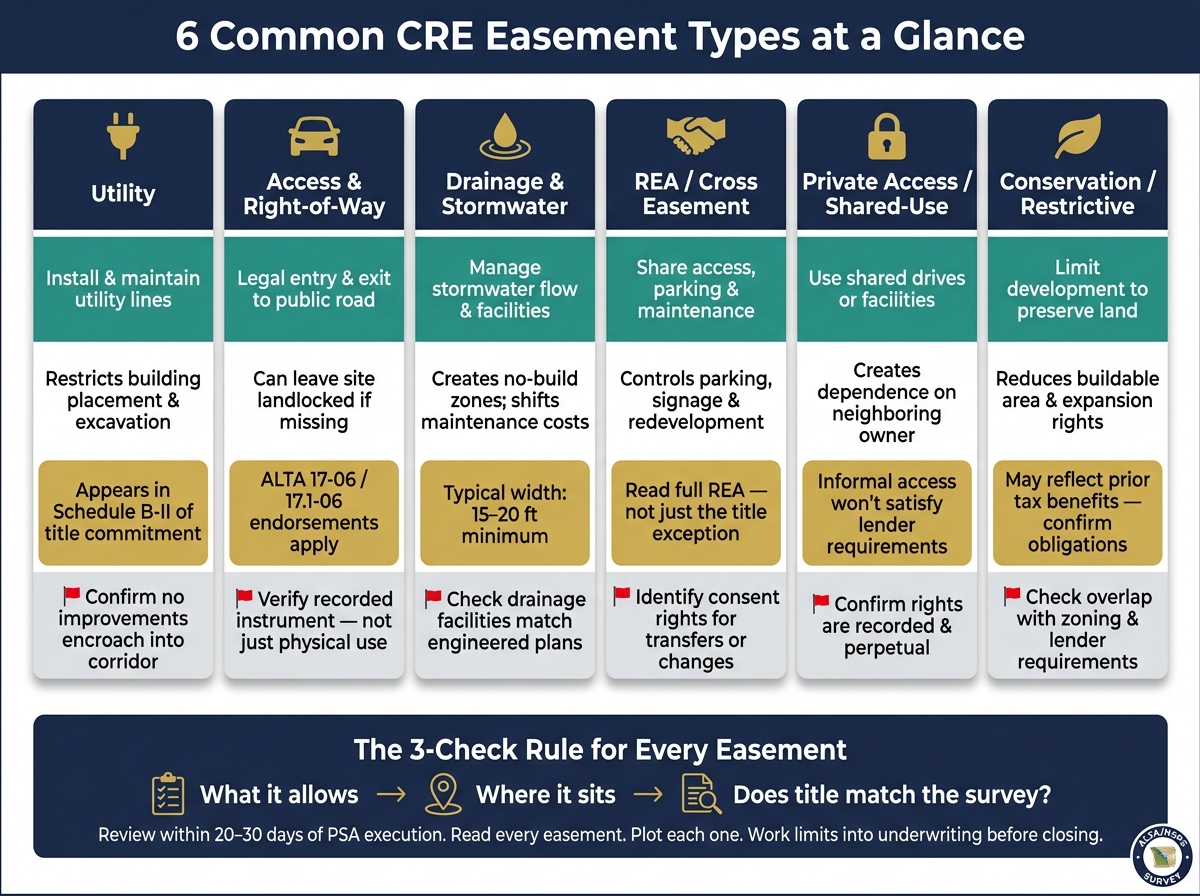
6 Common CRE Easement Types: Purpose, Impact & Review Checklist
The table below compares six common easement types by purpose, site impact, and review focus. Use it to sort easements by function and spot risk faster.
Comparison Table: Purpose, Site Impact, and Review Concern
| Easement Type | Purpose | Typical CRE Impact | Most Common Title/Survey Concern |
|---|---|---|---|
| Utility | Grants utility providers the right to install, access, and maintain infrastructure | Can limit building placement, paving, loading areas, and future expansion | Confirm exact location and width; verify no proposed improvements encroach into the easement corridor |
| Access & Right-of-Way | Legal access to a public road or shared circulation route | Critical to site value; affects driveways, truck routes, and internal traffic flow | Confirm legal access is supported by a recorded instrument, not just physical use; match to survey |
| Drainage & Stormwater | Allows stormwater conveyance, detention, or management across the property | May permanently restrict grading, building pads, paving, or outdoor storage in affected areas | Check whether drainage facilities and easement limits are correctly depicted and align with engineered plans |
| Reciprocal Easement Agreement / Cross Easement | Allocates shared access, parking, utilities, and maintenance rights among multiple parcels | Controls shared operations in retail and mixed-use projects; can limit use and redevelopment | Review full agreement for use restrictions, operating covenants, parking rights, cost-sharing, and amendment history |
| Private Access / Shared-Use | Grants specific private parties the right to use shared driveways, loading areas, or facilities | Creates dependence on another owner; affects parking counts and service access | Confirm rights are recorded and perpetual; verify maintenance obligations are clearly defined |
| Conservation / Restrictive | Limits development to preserve environmental, open-space, or other protected uses | Can reduce buildable area and limit grading, paving, signage, or expansion | Confirm exact restrictions, permitted uses, and holder; check for overlap with zoning and lender requirements |
Across all six types, underwriting usually comes down to three simple checks: what the easement allows, where it sits, and whether the title work matches the survey.[19][1][20] If the recorded documents say one thing and the site shows another, that gap needs to be cleared up before closing.[21][2]
That side-by-side view helps because not all easements hit a deal in the same way. Utility, access, and drainage easements affect how the site works day to day. REAs, private shared-use easements, and conservation or restrictive easements shape how the property can be used, shared, or changed later.
How Easements Affect Title, Survey, and Underwriting
Where Easements Show Up in Title Commitments and Recorded Exceptions
Once you've identified the easement type, check three things: the recorded right, the plotted location, and the impact on the deal.
On title, easements usually show up in Schedule B-II as recorded easements and title exceptions. In many cases, they appear under broad labels like "utility easement" or "ingress/egress easement." The problem is that those labels often don't spell out the exact rights, location, or term.
Every document listed in Schedule B-II should be pulled and read in full before closing. If the commitment uses broad "easements and restrictions of record" language instead of listing each instrument, ask for itemized exceptions. Blanket wording can hide limits that matter. It's better to replace that language with a complete list of recorded easements and copies of each document. If the exception list is vague, fix that before survey review.
What the ALTA/NSPS Survey Can Confirm or Flag
The survey shows the easement's location on the ground, its width, and its recorded reference. Under current ALTA/NSPS standards, surveyors must show plottable easements and rights-of-way that burden or benefit the property, using the title documents.
The survey can also flag encroachments, access conflicts, and gaps between recorded rights and actual site use. If the record says one thing and the site shows another, that conflict should be cleared up before closing. That record-to-ground check feeds straight into the underwriting review.
Key Underwriting Questions to Address Before Closing
Before closing, underwriting should answer three basic questions: Does the easement secure access? Does it reduce buildable area or parking? Does it create consent or cost risk?
- Legal access. Lenders want recorded ingress and egress rights, not just a path people have been using. The access route also needs to work for tenants and emergency vehicles.
- Buildable area and parking impact. Check whether the easement cuts into buildable area or lowers parking counts in a way that affects value or lender standards.
- Shared-use and REA consent exposure. With REAs and shared-use deals, find out whether any transfer, financing, leasing, or redevelopment needs third-party consent, and whether that step could delay or stop the deal.
Conclusion
Easements can change a deal in a hurry. They affect buildability, access, operating cost, and value. A utility easement, an access defect, or an unclear REA can shift the economics fast. That’s why the review should stay focused.
The rule is simple: check four things - recorded legal access, buildable area, ongoing obligations, and redevelopment rights. Just as important, do it early. Review easements within 20–30 days of PSA execution if you can, so problems show up before they turn into closing issues. Think of easement review as a title-and-survey checkpoint that feeds straight into underwriting.
Read every easement. Plot each one on the survey. Then work those limits and rights into underwriting before closing. The safest close happens when the recorded rights match what’s on the ground and what’s in the model.
FAQs
Can an easement stop future expansion?
Yes. An easement can limit future expansion, and in some cases block it altogether.
It can restrict where you’re allowed to build, change your parking layout, and make the whole project harder to pencil out.
For example, you usually can’t place permanent additions inside an easement area. If part of your plan crosses that line, those features may need to be moved. Conservation easements can go even further and prohibit future development entirely.
That’s why an early survey and title review matter. They can help you spot issues before permits are denied or you’re forced to remove work after the fact.
What if the survey and title don’t match?
If the survey and title commitment don’t match, you’ve got a gap that needs to be fixed before closing. Letting it slide can lead to delays, extra cost, or legal trouble.
Start by confirming the issue with a licensed surveyor and comparing the legal descriptions line by line. Small wording differences can turn into a big mess later.
You may need:
- An updated survey
- Curative legal agreements
- A title endorsement, such as the ALTA 25-06 Same as Survey endorsement
If the conflict still isn’t resolved, it may make sense to negotiate a price adjustment or set up an escrow holdback.
Can an easement affect financing or closing?
Yes. Easements can affect financing and closing because they may limit access or reduce the buildable area of a property. They can also show up as title exceptions that a lender won’t accept unless they’re properly documented or cleared up.
Most lenders want clear title and a legal description that matches the latest ALTA/NSPS survey. If an easement issue is still unresolved, it can slow down closing, throw the deal off track, or lead a lender to deny funding.