
Key Title Search Considerations for CRE
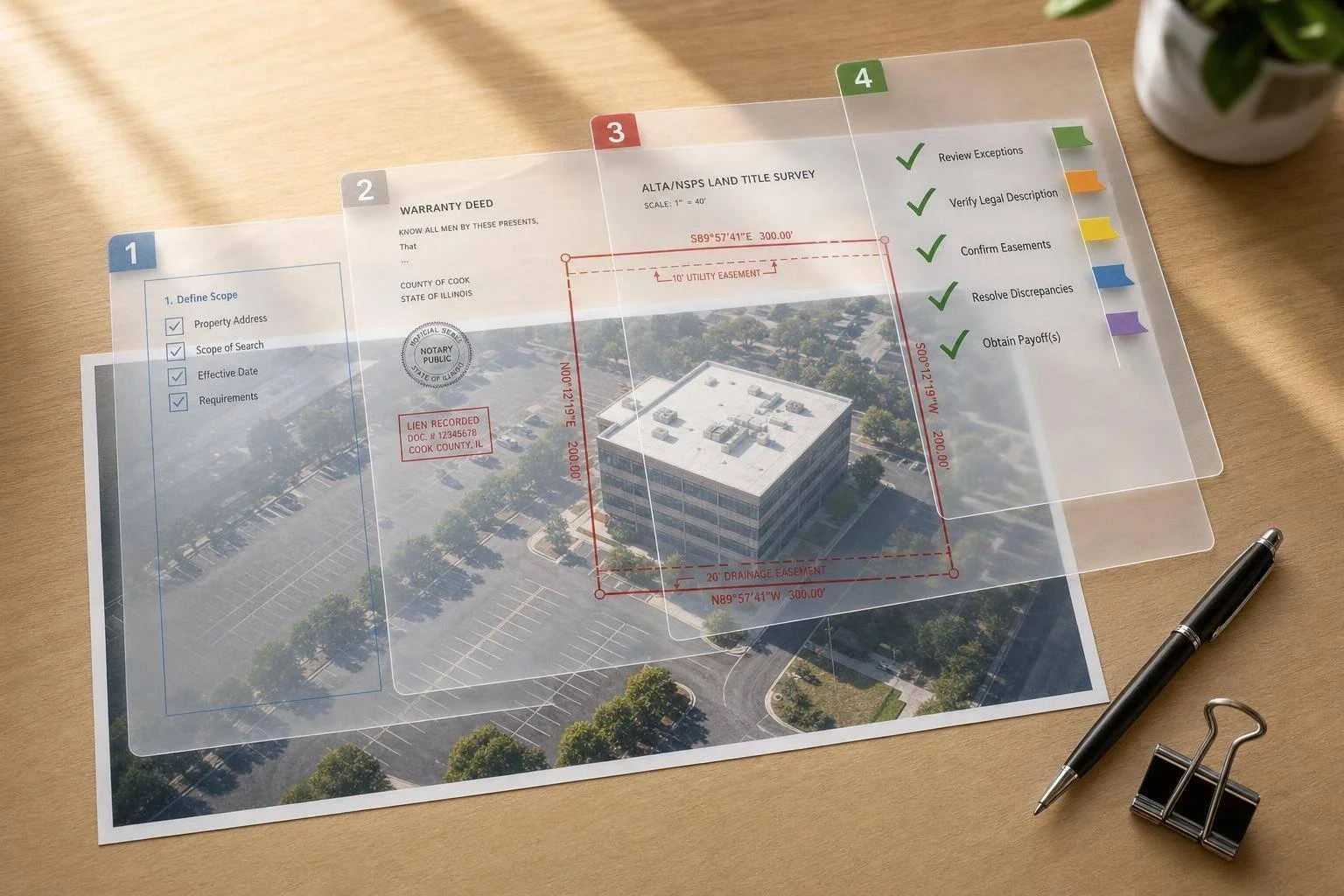
A CRE title search is not just about who owns the property. It is about whether you can close, finance, and use the site as planned.
If I had to boil this article down, I’d focus on 4 checks:
- Set the search scope early: confirm the legal description, parcel, seller name, buyer entity, and the right county or city offices
- Review ownership and claims: check chain of title, liens, taxes, judgments, and seller authority
- Match title to the survey: compare the commitment, legal description, easements, access, encroachments, and setbacks
- Clear closing items before funding: line up policies, endorsements, payoffs, releases, and final approval from the title company
In many commercial deals, the main problems are not just recorded mortgages. I also need to watch for municipal liens, bankruptcy filings, UCC issues, survey conflicts, access gaps, and use limits. And because lenders often ask for items like ALTA 17, ALTA 19, ALTA 25, ALTA 3, and ALTA 9, title review has to stay tied to survey, zoning, and legal work from the start.
A simple way to think about it: title tells me what the record says, the survey shows what is on the ground, and the closing checklist shows what still has to be fixed. If those 3 pieces do not match, the deal can stall.
| Area | What I check | Why it matters |
|---|---|---|
| Scope | Legal description, parcel, parties, offices | Stops search errors at the start |
| Ownership | Vesting, chain of title, authority | Confirms the seller can transfer title |
| Claims | Liens, taxes, judgments, city charges | Flags items that must be paid, released, or handled |
| Off-record risk | Bankruptcy, litigation, UCC, probate, divorce | Catches issues not shown in land records |
| Title + survey | Access, easements, boundaries, encroachments, setbacks | Shows whether the site matches the record |
| Closing | Endorsements, curative items, final policy | Gets the file ready for funding |
One practical stat to keep in mind: a single title file can involve dozens of Schedule B items, and even one missed release or bad legal description can delay closing. That is why I’d treat every open item as a closing condition, not a loose end.
Here’s the short version: define the property, verify the owner, find every claim, compare title to survey, and clear each issue before money moves.
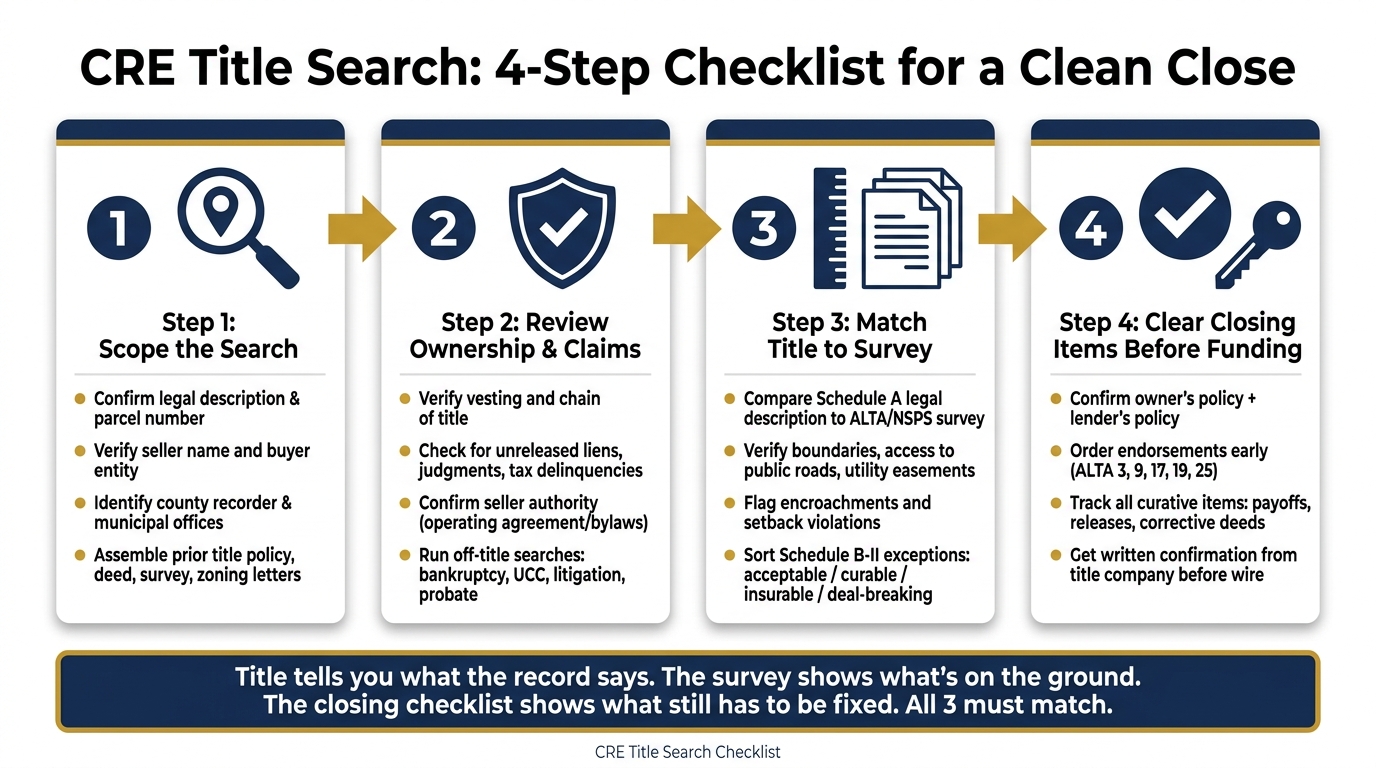
CRE Title Search: 4-Step Checklist for a Clean Close
CRE Legal Minute Episode 11 - Title and Survey Review
sbb-itb-df8a938
Checklist 1: Scope the Search and Collect Core Documents
Before you order title work, the deal team needs to pin down exactly what is being searched and gather the documents that will shape the whole review. If you miss something here, it usually comes back later as rework.
Start by locking the search scope and the document set.
Confirm Property, Parties, and Jurisdictions
Begin with the basics: the street address, legal description, parcel number, and the county recorder's office that holds the recorded documents. Title work follows the legal description, not the street address. Confirm both match the same parcel before ordering.
Next, confirm the seller's full legal name and make sure they have authority to transfer the deed. For entity-owned properties, that includes checking for undisclosed heirs or unresolved partnership claims that could show up during underwriting. On the buyer side, confirm the exact entity name that will take title. Searches run against specific names, and even a small variation can leave a coverage gap.
You also need to identify the county recorder and any municipal office that may call for a separate search. Some matters, like permit violations or municipal liens, may require a municipal search rather than a standard county title search. In some places, a separate municipal lien search is required.
Once the parties and parcel are locked in, collect the documents that will guide underwriting.
Assemble the Baseline Title File
After the property and parties are confirmed, gather the documents the title company needs to underwrite the deal. A prior title policy is one of the most useful items in the file. It gives you a starting point for existing exceptions and often speeds up underwriting. Add the current deed, any existing survey, tax parcel data, zoning letters, and loan payoff information if the property has debt in place.
| Document Category | Key Items to Collect |
|---|---|
| Title | Prior policies, recorded deed, prior commitment or title report |
| Survey | ALTA/NSPS survey, legal description, if already available |
| Zoning/Legal | Zoning letters, permits |
| Financial | Rent rolls, tax parcel data |
| Entity | Operating agreements |
Include leases and a current rent roll too. Those documents help identify tenant interests and occupancy.
Use this file to spot issues before the title commitment gets marked up.
Create the Closing Task List Early
Turn every gap into a closing task. Give each item an owner and a due date, whether it's a release, payoff letter, entity authorization, or survey deliverable.
Build this task list as early as you can. More lead time means more room to fix curative issues before they turn into closing blockers.
With the search scope set, move to ownership, lien, tax, and off-title risk.
Checklist 2: Review Ownership, Liens, Taxes, and Off-Title Risk
Next, make sure the seller can transfer title and spot any claims that could stop the deal from closing.
Verify Vesting and Chain of Title
Start with the vested owner. Pull the current deed and confirm the name on that document matches the person or entity signing the purchase agreement exactly. Then trace prior transfers far enough back to make sure the chain of title is clean, with no gaps, missing recordings, or deeds signed by someone who didn’t have legal authority.
Watch for undisclosed heirs, deeds that were signed the wrong way, and old liens that show as paid but were never recorded as released. A lien that was satisfied but never formally released can still cloud title.
If the property is owned by an entity, review the seller’s operating agreement or bylaws. You need to confirm that the person signing has clear authority to transfer the property.
Once vesting checks out, review every recorded claim that could affect title.
Identify Liens, Judgments, and Tax Issues
After ownership is confirmed, move to encumbrances. A solid search should surface all of the following:
| Encumbrance Type | What to Look For |
|---|---|
| Mortgage / Deed of Trust | Unreleased liens from prior financing |
| Mechanics' Liens | Contractor or subcontractor claims from recent work |
| Tax liens and delinquent property taxes | Unpaid taxes, delinquent installments, pending assessments, income tax liens |
| Judgment Liens | Court judgments recorded against prior or current owners |
| Assessments and municipal charges | Improvement district assessments and similar charges |
Each item needs a payoff, release, bond, or other cure before closing.
But recorded liens are only one part of the picture. Sometimes the land records look fine, and the transfer still gets blocked.
Run Off-Title Searches That Can Affect Marketability
Off-title risk matters because some problems won’t show up in the county records. Run searches tied to the seller for bankruptcies, litigation, UCC filings, and probate or divorce matters. A bankruptcy filing, for example, can limit or stop a seller’s ability to transfer the property.
Once ownership and off-title risk are clear, compare the commitment and survey line by line.
Checklist 3: Review the Title Commitment, Survey, and Exceptions
Once you've nailed down ownership and off-title risk, the next step is turning search results into actual closing calls. This is where the title commitment and ALTA/NSPS survey do the heavy lifting. They show what has to be fixed before closing, what stays on the policy, and what might limit the deal long after the ink dries.
Read Schedule A and Schedule B Line by Line
Schedule A is the base of the commitment. Check five items with care:
- The named insured matches the buyer or borrower exactly, including "LLC", "LP", or any other entity label
- The policy amount in U.S. dollars matches the purchase price or loan amount
- The insured interest fits the deal structure, such as fee simple or leasehold
- The effective date runs through the latest recorded documents
- The legal description matches the deed and survey
A mismatch in any of these can slow issuance or, worse, insure the wrong parcel.
Schedule B is where the file starts to get real. Schedule B-I lists requirements. These are the items that must be done before the title company will issue the policy. Think recorded deed, payoff of current liens, and entity authority documents. Schedule B-II lists exceptions. These are the matters the policy will not cover.
A simple way to stay on top of this: build a closing tracker tied to each Schedule B-I item, assign an owner, and get written confirmation from the title company that every requirement is cleared before wire instructions go out.
Match the ALTA/NSPS Survey to Title
Once the commitment looks clean, use the survey to test what can actually be insured and financed. The ALTA/NSPS survey is the standard commercial survey for this step, and many lenders want it so they can remove the general survey exception from Schedule B.
Start with the legal description. Compare the survey certification to Schedule A and the vesting deed. Parcel numbers, tracts, and boundary calls should line up exactly. No close-enough stuff here.
Then focus on the five survey points that have direct deal impact:
- Boundaries: Make sure they match the deed and support the site plan
- Access to public roads: Confirm recorded fee or easement access, not just a driveway that happens to exist
- Utility easements: Check location and width, since they can limit future building
- Encroachments: Look for structures crossing lot lines or easement areas
- Setbacks: Confirm current improvements comply, because non-conforming structures can make refinancing messy
Plot every recorded easement on the survey. If an easement can't be plotted, flag it right away. That's the kind of issue that can sit quietly in the file until it turns into a closing headache.
Sort Exceptions by Business and Financing Impact
Not every Schedule B-II exception deserves the same level of concern. Some are routine. Some are fixable. Some can be handled with endorsements. And some can wreck the deal.
| Category | Description | Common Examples |
|---|---|---|
| Acceptable | Routine items with low impact on use or value | Standard utility easements along street frontages |
| Curable | Defects that can be fixed before closing | Unreleased prior mortgages; minor boundary overlaps corrected by a lot line adjustment |
| Insurable by endorsement | Risks that stay in place but may be covered through specific ALTA endorsements | Access concerns (ALTA 17 series); zoning and setback risks (ALTA 3 series); survey description alignment (ALTA 25 series) |
| Deal-breaking | Restrictions that hurt the business plan or financeability | Use restrictions banning intended uses; REAs granting third parties broad approval rights over renovations; easements blocking planned development phases |
It also helps to separate standard exceptions from deal-specific exceptions. Standard exceptions, like rights of parties in possession, are common. Deal-specific exceptions are tied to the property itself. That includes recorded CC&Rs, reciprocal easement agreements, and mineral reservations. Those need a closer read of the source documents before you decide whether to accept them, cure them, or push for coverage.
Put the results into a Title & Survey Risk Memo for investment, asset management, and lender review. Any open items should move straight into the curative and endorsement checklist.
Checklist 4: Confirm Title Insurance, Curative Steps, and Closing Readiness
Confirm Policies and Endorsements Needed for the Deal
After you review the title commitment and survey, the next step is simple: confirm the title policy package needed to close.
In financed CRE deals, you usually need both an owner's policy and a lender's policy. The owner's policy covers title risk for the buyer. The lender's policy protects the lender's lien position.
It's smart to order endorsements early. A lot of them depend on the survey, zoning materials, or city and county review. That means title insurer discussions should start during due diligence, not at the last minute. Many endorsements rely on documents you're already gathering during that stage, so early ordering can save time and keep closing on track.
| Endorsement | Risk Addressed | Common Underwriting Conditions |
|---|---|---|
| ALTA 3 Series (Zoning) | Violations of zoning ordinances or unauthorized land use | Zoning letter, certificate of occupancy, or legal opinion |
| ALTA 17 Series (Access) | Lack of physical or legal access to a public right-of-way | Review of easement agreements and municipal road records |
| ALTA 25 Series (Survey) | Discrepancies between the legal description and physical boundaries | Current ALTA/NSPS survey matching the title's legal description |
| ALTA 19 Series (Contiguity) | Gaps or intervening parcels between multiple tracts of land | Survey confirming shared boundaries of adjacent parcels |
| ALTA 8.2-06 (Environmental) | Recorded environmental liens not listed as exceptions | Phase I Environmental Site Assessment (ESA) |
| ALTA 9 Series (restrictions, encroachments, and minerals) | Violations of restrictions, encroachments, or mineral rights issues | Survey and review of recorded Covenants, Conditions, and Restrictions (CC&Rs) |
Track Curative Items Until Final Policy Issuance
Clearing title isn't a one-and-done task. It runs from contract signing all the way through final policy issuance.
In CRE deals, the most common curative items include payoff letters, lien releases or satisfactions, subordination agreements, corrective deeds, and entity authority or probate documents.
Handle every unresolved item like a closing condition, not something you'll sort out after the ink dries. One missed release or missing authority document can hold up funding fast. The best move is to track each open item in a single closing checklist, so nothing slips through the cracks.
After closing, keep the final title policies, all endorsements, the ALTA/NSPS survey, and the full curative file in one central place. That file often becomes important later for refinancing and day-to-day asset management.
Conclusion: The Title Search Items That Matter Most in CRE
A CRE deal closes only when the required coverage is in place and all curative items are cleared. Use the title, survey, endorsement, and curative checklist to clear the file before funding.
FAQs
What can delay a CRE closing?
CRE closings often get pushed back by unresolved title defects. The usual culprits are liens, boundary disputes, ownership conflicts, and restrictive covenants.
Other problems show up all the time too: missing local documents, last-minute lender requests, and stale title commitments that fail to catch recent bankruptcies, tax changes, or recording gaps.
The fix is pretty simple in theory, even if it takes work in practice: start early. Coordinating with title insurers upfront and running date-down searches can help keep the deal on schedule.
Why does the survey matter for title?
The survey matters because it ties the title documents to the land itself.
A title commitment shows ownership and liens. A current ALTA/NSPS survey shows the property’s boundaries, visible features, and access rights on the ground.
When you compare the two, you can check that Schedule A matches the exact parcel being bought or financed. That side-by-side review can also reveal encroachments, boundary gaps, overlaps, or access problems that public records might miss.
Which title issues are deal breakers?
In commercial real estate, deal-breaking title issues are the ones that can make a property uninsurable, unusable, or legally compromised.
Some of the most common examples are forged deeds, unresolved ownership disputes, no legal access to public roads, conservation or agricultural easements that block development, and major defects a title insurer won’t cover.
Other issues, like utility easements or CC&Rs, can sometimes be worked through. But if a problem threatens the property’s basic viability or keeps the buyer from getting a clear title policy, it can stop the deal cold.