
Waterfall Distribution Models Explained

A waterfall tells you who gets paid first, when the GP starts sharing in profits, and how the split changes as returns go up. In most CRE deals, cash usually goes in this order: return LP capital, pay the pref - often around 8% - then handle any GP catch-up, and finally split the rest through promote tiers like 70/30, 60/40, or 50/50.
If I want to read a waterfall fast, I focus on four things:
- Is capital returned before profits are split?
- Is the pref simple or compounded?
- Is there a GP catch-up?
- Is the waterfall deal-by-deal or fund-level?
That matters because a small change in structure can shift returns by a lot. For example, on $4,500,000 of LP equity, an 8% pref equals $360,000 per year. And if a sale produces $7,000,000 in net proceeds, the timing and order of distributions can change both LP and GP outcomes.
A simple way to think about it: waterfalls are payout rules. They are not the same as ownership percentages. A GP may own less equity but still earn a larger share of profits after hurdles are met.
Here’s the quick view:
- Single-tier: one profit split after capital and pref
- Multi-tier: more tiers, with the GP share increasing at higher hurdles
- American-style: paid deal by deal
- European-style: LPs get all contributed capital and pref back across the fund before GP promote starts
If I’m underwriting a deal or checking an operating agreement, that is the short list I use first.
What a Waterfall Distribution Model Is and How It Works
A waterfall distribution model distributes cash flow in tiers. Each tier has to be paid in full before money moves to the next one. Cash goes first to the highest-priority tier, then the next, and so on. That step-by-step payout order is what sets a waterfall apart from a plain profit split. The next piece to understand is that payout order.
How the Tiered Payout Order Works
In a typical CRE waterfall, capital is returned first. Then the LP gets its preferred return. After that, the structure may include a catch-up, and any remaining profits are split through promote tiers. LPs earn a preferred return on their unreturned capital, usually around 8% to 10% annualized [9][10][6][11][7]. A catch-up can give the GP a larger share for a period until the agreed split is reached. Once that happens, profits move through promote tiers tied to negotiated performance hurdles.
Here’s what that can look like in practice:
- 75/25 at the first hurdle
- 65/35 at the next
- 50/50 above the top tier [4]
Each tier turns on only after the one before it has been fully paid.
One detail trips people up all the time: waterfall splits are not the same as ownership percentages [8][6]. A GP can hold a smaller equity stake and still earn a bigger share of profits once those hurdles are cleared. Those payout tiers come from a small set of core terms.
Why Sponsors and Investors Use Waterfalls
A flat split doesn’t account for timing, risk, or performance. A waterfall does. LPs get first claim on getting their capital back and on receiving preferred returns. GPs earn more only if the deal hits the agreed hurdles. That setup ties payout to results, not just ownership on paper. To read a waterfall the right way, you need to start with the terms that shape each tier.
sbb-itb-df8a938
Core Waterfall Terms You Need to Know
Most CRE waterfalls rely on the same set of terms. Once you know how to spot them in a waterfall schedule, the whole setup gets a lot easier to read. These are the terms that shape the payout order in the next section.
Return of Capital, Preferred Return, and Hurdle Rate
Return of capital is the payback of an investor's original equity before any profits get split. In models, you'll usually see it labeled as ROC. It tracks how much of each investor's original equity has been repaid.
Preferred return, often called the pref, is the first-priority return LPs receive on their unreturned capital before the GP shares in profits. In U.S. CRE, preferred returns are often around 8%.[12][13] It accrues only on unreturned capital.
A hurdle rate is the threshold that opens the next tier. In many deals, the preferred return acts as the first hurdle. Some deals add higher hurdles, which increase the GP's share as returns climb.
With those terms in place, the distribution sequence is much easier to follow.
Catch-Up, Promote, and LP/GP Roles
Once the preferred return has been paid, the catch-up gives the GP extra cash until it reaches the agreed share for that tier. It's a balancing tool, not a bonus.
Promote, also called carried interest, is the GP's share of profits above the hurdle.[5][12][14][15] That performance-based step-up is what gives the waterfall its economic punch for sponsors.
For LP and GP roles, the LP is the passive capital provider. The GP is the active manager handling deal sourcing, financing, and day-to-day operations. The GP also controls the distribution model and negotiates each tier.
Here’s the short version of how each term shows up in a deal model:
| Term | What It Means | Where It Appears |
|---|---|---|
| Return of Capital | Repayment of original equity before profit splits | Capital account schedules |
| Preferred Return | Priority annual return on unreturned capital | Preferred return accrual schedules |
| Hurdle Rate | Threshold that unlocks a new distribution tier | IRR tests, waterfall tier logic |
| Catch-Up | Optional tier that lets the GP reach the agreed profit share | Between the preferred return and the promote |
| Promote | GP's profit share above the hurdle | Final distribution tiers |
How a Waterfall Works Step by Step
Now that the core terms are clear, it helps to see how they play out with actual dollars. After expenses, debt service, reserves, and fees are paid, what’s left is distributable cash. That cash then moves through the waterfall based on a set order.
A Simple Distribution Sequence from First Dollar to Final Split
In this example, LPs contributed $4,500,000, and the deal produces $400,000 in distributable cash. From there, the money flows through the waterfall in a fixed sequence:
- Return capital
- Pay the preferred return
- Apply any catch-up
- Split the remainder by the promote tier
At 8% on $4,500,000, the preferred return comes to $360,000 per year.[1][2] If cash is left after that, it gets split based on the active tier. A common starting point is 70% to LPs and 30% to the GP, then shifting to 60/40 after a higher IRR hurdle is met.[1][2]
The same logic applies when the property sells. If net sale proceeds after debt payoff are $7,000,000, the waterfall first covers any unpaid capital and pref, then applies any catch-up, and only after that splits what remains across the promote tiers.[1] Sale and refinance proceeds follow the same tiers, with any unpaid capital and pref paid first before the rest is divided.[1][3]
How Timing Affects Cash Flow and Sale Proceeds
This same waterfall structure applies to periodic operating distributions during the hold period and again to net proceeds at sale or refinance.[1][3] That matters because IRR depends on when cash shows up, not just the total amount.
Here’s the key idea: if a deal returns part of LP capital during operations instead of waiting until the sale, LPs get their principal back sooner. That pushes IRR higher, even if total profit stays the same.[1]
Monthly modeling gives a closer view of timing and makes it easier to see how earlier distributions can increase IRR.
The exact order can change from one structure to another, which is why the next section looks at common waterfall types.
Common Waterfall Structures and Key Takeaways
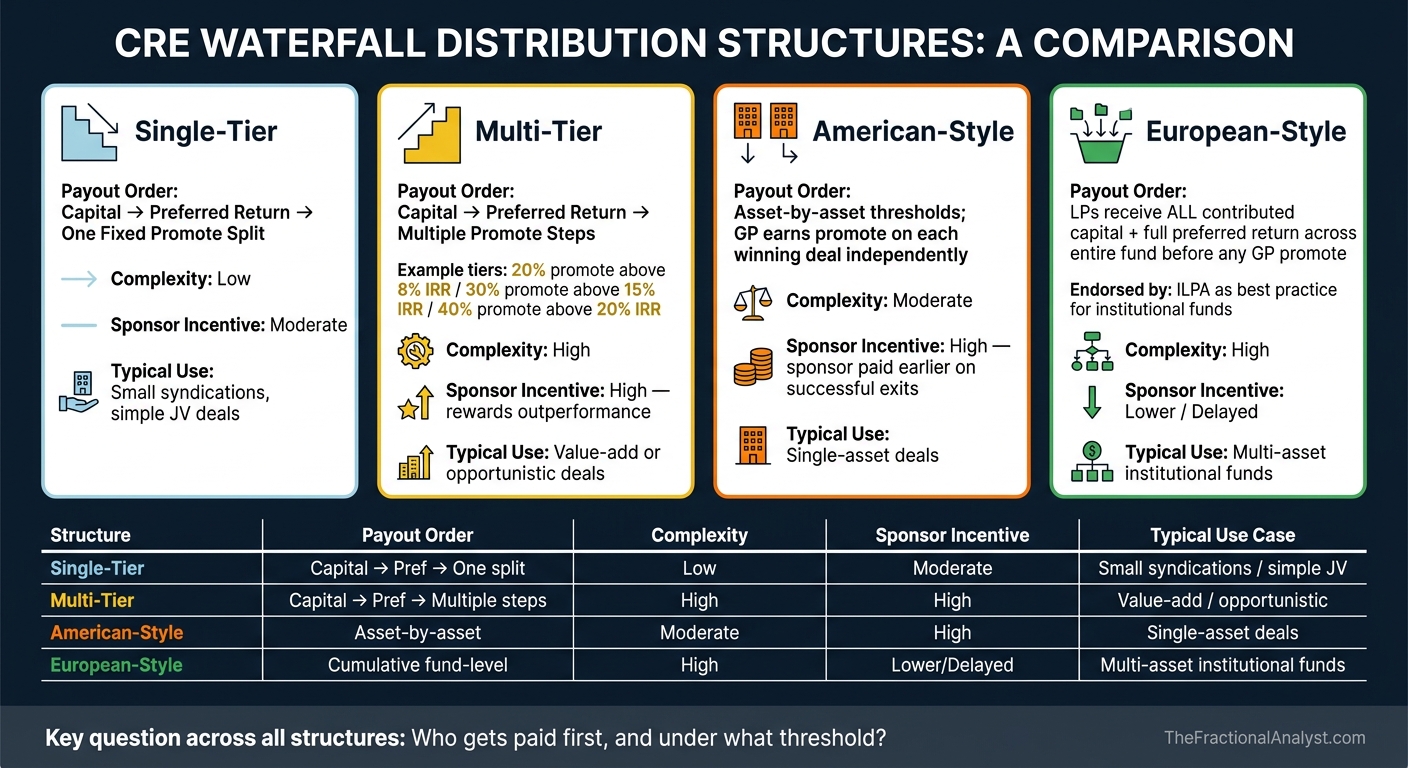
CRE Waterfall Distribution Structures: Side-by-Side Comparison
Single-Tier, Multi-Tier, and European-Style Waterfalls
The payout logic stays the same, but deal documents package it in different ways. At the core, every waterfall answers the same thing: who gets paid, when, and after which threshold is met. The main differences come down to how many hurdles the structure uses and whether it works at the deal level or the fund level.
After return of capital and the preferred return, a single-tier waterfall applies one fixed split to the profits that remain. It's common in small syndications and simple joint ventures because it's easier to model and explain.
A multi-tier waterfall adds more steps. As IRR clears each hurdle, the GP's promote increases. A common setup might look like this: 20% above an 8% hurdle, 30% above 15%, and 40% above 20%.[16][19][22] This type of waterfall is often used in value-add and opportunistic deals, where sponsors want more upside tied to stronger performance.
At the fund level, a European-style waterfall holds back all GP promote until LPs have received back their contributed capital and their full preferred return across the entire fund or portfolio.[17][18][23] The Institutional Limited Partners Association (ILPA) treats this as best practice for institutional funds and specifically recommends an "all-contributions-plus-preferred-return-back-first" structure.[23][24]
By comparison, an American-style (deal-by-deal) waterfall lets the GP collect promote on each winning asset on its own, even if another property in the same fund is still lagging.[17][20][21] That's a big difference. One structure waits for the whole pool to perform. The other pays out deal by deal.
| Structure | Payout Order | Complexity | Sponsor Incentive | Typical Use Case |
|---|---|---|---|---|
| Single-Tier | Capital → Pref → One promote split | Low | Moderate; easy to model and explain | Small syndications or simple JV deals |
| Multi-Tier | Capital → Pref → Multiple promote steps | High | High; rewards outperformance at higher IRR levels | Value-add or opportunistic deals |
| American-Style | Asset-by-asset thresholds | Moderate | High; sponsor is paid earlier on successful exits | Single-asset deals |
| European-Style | Cumulative fund-level thresholds | High | Lower/delayed; GP waits for the whole fund to perform | Multi-asset institutional funds |
The tradeoff is pretty clear. Simpler setups are easier to explain, underwrite, and track. More layered structures can line up incentives with more precision, but they also need careful modeling, clean drafting, and steady investor reporting.
Across all of them, the core question never changes: who gets paid first, and under what threshold?
Conclusion: What to Remember About Waterfall Models
Waterfalls decide who gets paid first, how profits are split, and when the GP earns promote. The right setup depends on the deal type, investor preferences, the number of assets involved, and how much complexity the group is ready to handle. What matters most is simple: everyone should understand the structure before capital is committed. Even a small shift in the preferred return or promote percentage can change distributions in a big way.
If you're underwriting a deal or reviewing an operating agreement, focus on a few practical checks:
- Confirm whether the waterfall is deal-by-deal or portfolio-level
- Verify whether the preferred return is simple or compounded
- Check whether distributions are based on cash flow, sale proceeds, or both
- Stress-test the model under conservative scenarios so the impact of holding period, exit timing, and cash flow timing is clear
The Fractional Analyst offers underwriting support, investor reporting, and financial modeling tools for commercial real estate professionals.
FAQs
How do I read a waterfall quickly?
Start by identifying the four core tiers: return of capital, preferred return, catch-up provision, and residual profit splits. Review the operating agreement first, since it’s the final source for the distribution rules.
Then, in the financial model, make sure all cash is accounted for. Check the IRR hurdles and promote percentages to see how the profit split changes between limited partners and general partners.
When does the GP start earning promote?
The General Partner (GP) usually starts earning a promote after Limited Partners (LPs) have received their initial capital back, along with the agreed preferred return on their unreturned capital.
When that happens comes down to the waterfall structure.
In an American model, the GP may start earning promote as soon as one asset clears its hurdle. In a European model, the GP usually has to wait until those same requirements are met across the entire portfolio.
Which waterfall structure is best for my deal?
The best waterfall structure depends on the deal.
For single-asset deals, American (deal-by-deal) is common. It lets the GP receive promote distributions once that investment clears its return hurdles.
For multi-asset funds, European (whole-of-fund) is often the better fit. In that setup, LPs must first receive their contributed capital and preferred returns across the full portfolio.
You also need to stress-test the hurdles, promote splits, and hold periods together. Looking at each one on its own can miss the bigger picture. A small change in one term can shift investor returns more than you'd expect.