
How to Allocate Closing Costs in CRE
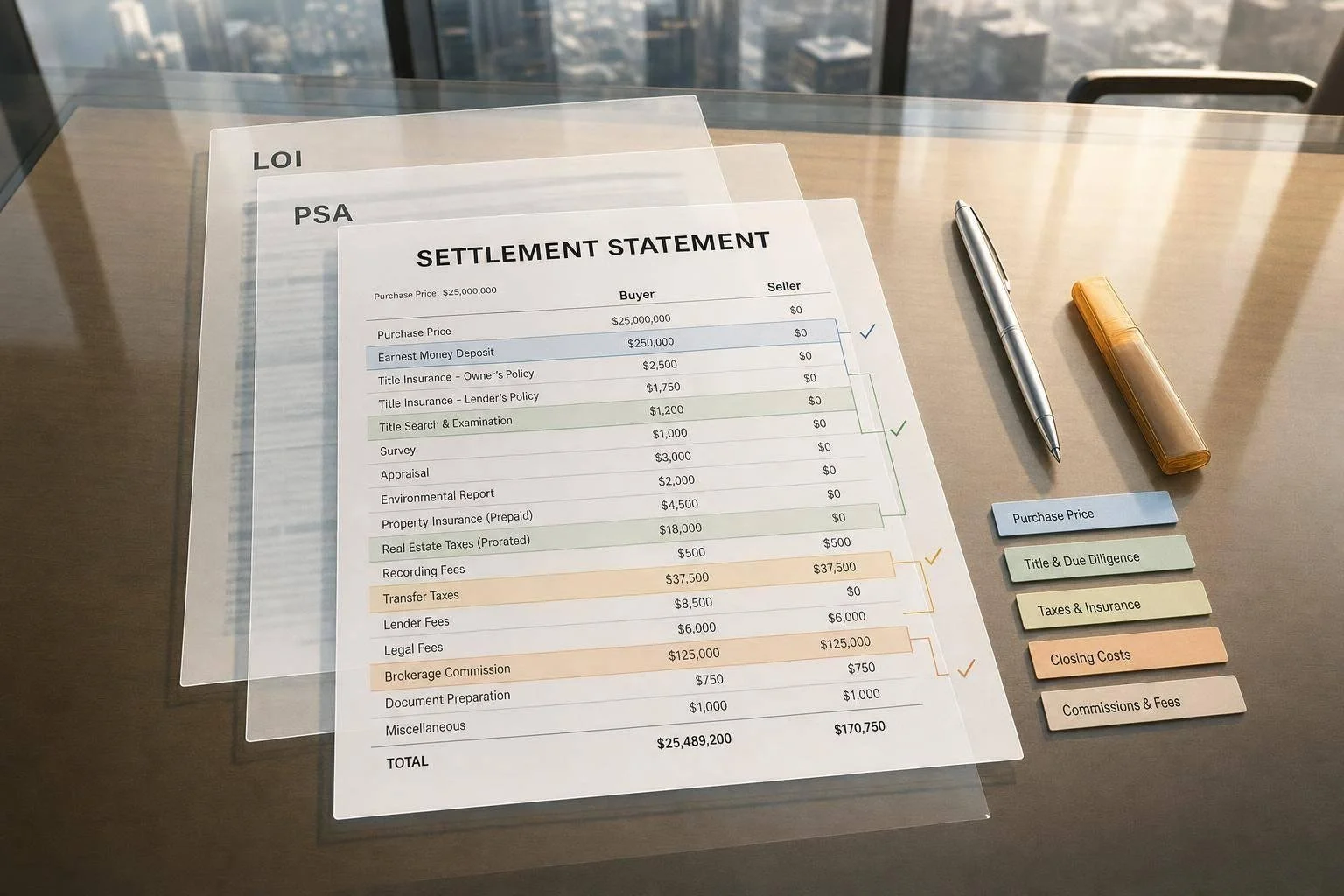
Closing costs in U.S. CRE often run about 2% to 5% of the purchase price, so one wrong assumption can change cash to close by a lot.
If I want to keep a deal on track, I need to do four things early:
- List every closing cost
- Assign each cost to buyer, seller, or both
- Write that split into the LOI and PSA
- Match the final settlement statement to the contract before signing
Here’s the short version: buyers usually cover loan and due diligence costs, sellers often cover broker fees and many transfer taxes, and shared items often include escrow fees. But local rules can change the default, especially for transfer taxes, owner’s title insurance, and some recording charges.
The biggest mistakes are simple:
- underwriting the deal with the wrong payer
- leaving cost splits vague in the LOI
- letting the PSA, escrow instructions, and closing statement say different things
- missing prorations, post-closing true-ups, or tax filing rules
If I were handling the deal, I’d treat closing costs as part of the full economics - not random line items. A fee shift can change basis, equity needs, seller net proceeds, and IRR, even if the purchase price stays the same.
| Item | Usual first check |
|---|---|
| Transfer taxes | Local law and market custom |
| Title costs | Which policy, which endorsements, who asked for them |
| Escrow fees | Whether split 50/50 or assigned another way |
| Prorations | Cutoff date, estimate method, true-up window |
| Surprise charges | Catch-all PSA language |
In plain English: set the split early, put it in writing, and audit the draft closing statement line by line. That is how I’d cut down on last-minute disputes and keep the closing numbers in line with the deal model.
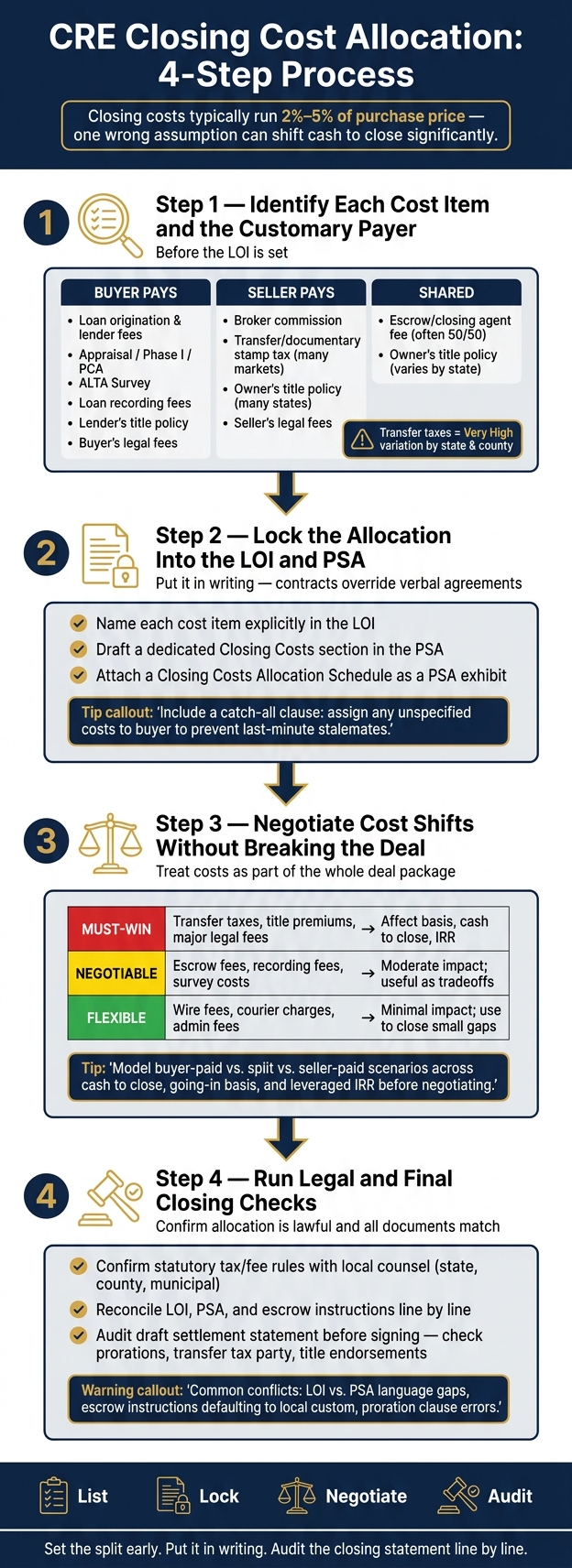
CRE Closing Cost Allocation: 4-Step Process Guide
Navigating Your First CRE Closing: A Step-by-Step Guide
sbb-itb-df8a938
Step 1: Identify Each Cost Item and the Customary Payer
List every expected closing cost and assign a default payer before LOI terms are set. Start with the items that hit net proceeds and equity needs first, because those are the numbers that can move a deal in a big way.
Separate Buyer Costs, Seller Costs, and Shared Costs
The default payer usually tracks the party that gets the main use from the item or carries the duty tied to it.
Buyers usually pay lender and due diligence costs, such as loan fees, appraisals, Phase I reports, property condition reports, and ALTA surveys. These costs shape financing and due diligence assumptions, so they usually sit on the buyer's side. [8][10][12]
Sellers usually pay broker commissions, their own legal fees, and transfer or documentary taxes when local practice puts those charges on the seller. Those costs need to show up early in the seller's net-proceeds model. [5][8]
Shared costs often include escrow or closing agent fees. The lender's title policy usually goes to the buyer, while the owner's policy depends on local custom. [5][11]
Account for State and Local Market Differences
Transfer taxes can swing a lot by state and county. In some places, the seller pays. In others, the buyer pays, or both sides split the bill. That means you should confirm the local default with local counsel and the title or escrow company before you write it into the LOI. [5][7][9]
Buyer vs. Seller Allocation Table
Use the table below as a starting point. Any item marked with high variation should be checked locally before it goes into the LOI.
| Cost Item | Customary Payer | Commonly Split? | Variation Risk |
|---|---|---|---|
| Loan origination & lender fees | Buyer | Usually no | Low |
| Appraisal, Phase I environmental, PCA | Buyer | Rarely | Low |
| Survey / ALTA update | Buyer | Sometimes | Medium |
| Loan recording fees | Buyer | Sometimes | Medium |
| Lender's title policy | Buyer | Usually no | Medium |
| Owner's title policy | Seller in many states; buyer in others | Sometimes | High |
| Escrow / closing agent fee | Shared | Yes - often 50/50 | High |
| Transfer / documentary stamp tax | Seller in many markets | Sometimes | Very High |
| Broker commission | Seller | Usually no | Medium to High |
| Buyer's legal fees | Buyer | Usually no | Low |
| Seller's legal fees | Seller | Usually no | Low |
Use this table as the default split unless local custom or the PSA says otherwise. [5][6][7] Once the usual split is clear, lock any exceptions into the LOI and PSA.
Step 2: Lock the Allocation Into the LOI and PSA
Once you've mapped out who pays what, put those assumptions into the LOI and PSA. Start with the payer defaults from Step 1, then spell out any exceptions in the deal documents. A spreadsheet can drift. A verbal agreement can get fuzzy. The contract is what counts.
Address Major Cost Allocations in the LOI
Use a short, itemized LOI clause for the costs that matter most. At a minimum, call out transfer taxes, recording fees, owner's title insurance, lender's title insurance, escrow fees, survey costs, environmental reports, and post-closing prorations.[19][15]
A clean LOI clause assigns each item by name. For example: seller pays transfer taxes, buyer pays title premiums and lender-related fees, escrow fees are split 50/50, and real estate taxes, rents, CAM, and operating expenses are prorated as of the Closing Date.[19][15] That kind of plain wording cuts down on later fights.
Draft a Dedicated Closing Costs Section in the PSA
Put all closing cost allocations in one PSA section, with separate buyer and seller subsections. That gives the escrow officer one clear place to check when preparing the settlement statement.[1][13][16][17]
Prorations need their own subsection. List exactly what gets prorated - property taxes, rents, CAM, utilities, and service contracts - and set a firm cutoff, such as 11:59 p.m. on the day before the Closing Date.[1][13][20] If any amount will be estimated at closing, like a tax bill that hasn't been issued yet, say how the post-closing true-up will work. Include the time window and whether a de minimis threshold applies.[1][13][20] The PSA should also say who controls and pays for any post-closing reconciliation costs.[1][13][20]
Many deal teams attach a Closing Costs Allocation Schedule as a PSA exhibit. It's usually a one-page table that lists each cost item, the party who pays it, and the PSA section that governs it. That gives the escrow officer a single go-to document and clears up gray areas around items like title endorsements or recording charges.[19][20][21]
| Cost Item | Responsible Party | PSA Reference |
|---|---|---|
| Transfer taxes | Seller | Closing Costs section |
| Lender's title insurance | Buyer | Buyer costs subsection |
| Escrow fees | Split 50/50 | Shared costs subsection |
Reconcile the PSA With the Closing Statement Before Signing
Before the escrow draft goes out, compare the closing statement to the PSA line by line. Ask for a draft settlement statement a few days before closing, not on the day of closing. Then check each line against the PSA's closing costs section and the escrow instructions.[14][18]
The charges most often assigned the wrong way are:
- title endorsements added late in the process
- transfer taxes charged to the wrong party
- proration timing mistakes[19][20]
Also watch for silent charges. These are fees that show up on the statement but were never clearly assigned in the PSA, such as courier fees, HOA or condo association charges, or odd recording surcharges.[19][21] When one appears, tie it to a PSA provision or get written agreement from both sides on who pays it before closing.[19][21] If you catch a mismatch here, fix it in writing before anyone signs.
One useful backstop is a catch-all clause in the PSA that assigns any unspecified costs. A common version makes the buyer responsible for all other closing costs not expressly assigned to the seller.[19][21] That one line can stop a last-minute stalemate over a surprise fee.
If a cost still needs to move, price that tradeoff explicitly in Step 3.
Step 3: Negotiate Cost Shifts Without Breaking the Deal
Once the PSA sets the baseline split, use the negotiation stage to move the few items that still change the economics. The main idea is simple: treat closing costs as part of the whole deal package - price, timing, and certainty of close - not as a series of isolated fights over each fee.
That changes the conversation. Instead of arguing over one line item at a time, ask what mix of purchase price and cost allocation gets both sides to the same net result. A buyer may accept a slightly higher price if the seller covers transfer taxes and the owner’s title policy. A seller may stay firm on price but agree to split escrow fees or cap its share at the base owner’s title policy, especially if the buyer offers a faster close or a non-refundable earnest money deposit.
Speed and deal certainty matter here. Parties will often eat a closing cost rather than risk losing the transaction over a fee that makes up only a small slice of the total deal. [25]
Rank Cost Items by Impact on Underwriting
Not every closing cost is worth the same amount of time at the table. Before final talks, sort each item by how much it changes your underwriting.
Transfer taxes usually deserve the most attention. In some places, they’re small. In others, they run above 2% of value and can make up 10–30% of total closing costs. [24] That’s why they’re often a top buyer focus. Title insurance premiums also matter. When the owner’s and lender’s policies are bundled, the total cost often lands around 0.5%–1% of the purchase price. [22] Those are worth pushing on too. Lower-dollar items can do a different job: they help bridge gaps.
| Priority | Cost Items | Why It Matters |
|---|---|---|
| Must-win | Transfer taxes, title premiums, major legal fees | Directly affect basis, cash to close, and IRR |
| Negotiable | Escrow fees, recording fees, survey costs | Moderate impact; useful as tradeoffs |
| Flexible | Wire fees, courier charges, admin fees | Minimal impact; use to close small gaps |
After you rank the costs, check the final split against counsel and the escrow instructions in Step 4.
Model the Effect of Different Cost Allocations
Before you give up any item, measure what it does to cash to close and returns. Model the shift first, then negotiate. Run a sensitivity analysis with at least three scenarios:
- buyer-paid
- split
- seller-paid
Compare each one across cash to close, going-in basis, and early return metrics like leveraged IRR or equity multiple. Every concession should connect to a number you can point to.
Once the economics are set, make sure the final split lines up with the PSA, escrow instructions, and local law.
Step 4: Run Legal and Final Closing Checks
Once the economics are set, the next job is simple in theory and messy in practice: make sure the allocation is lawful and matches every closing document.
Confirm Statutory Tax and Fee Rules With Counsel
One of the most common mistakes is treating the PSA like the only rulebook. It isn't. State and local law often decides who is legally responsible for transfer taxes and recording fees, even when the contract shifts the economic burden in a different way [29][32]. So the contract has to line up with the governing statute, not just the deal the parties shook hands on.
State transfer-tax rules often place the filing and remittance duty on a named party, even if the PSA pushes the cost to someone else. That split can still work if the PSA moves the cost through a closing statement debit and the documents also include an indemnity provision for any post-closing tax claim [1][29][32].
Counsel should confirm two things for each item: who pays, and who files or remits. That review should cover state, county, and municipal transfer taxes, plus recording fees. From there, the PSA needs to line up with both the legal rule and the deal economics the parties agreed to [26][29].
Check for Conflicts Across the LOI, PSA, and Escrow Instructions
After legal responsibility is nailed down, check that every document says the same thing. This is where a lot of last-minute closing problems show up.
The usual trouble spots are familiar:
- LOI language that sounds clear at first but never gets pinned down in the PSA
- Escrow instructions that fall back on local custom instead of the negotiated terms
- proration clauses that miss known tax reassessments or rent abatements (often tracked in a multifamily model) [2][35][36]
The PSA should serve as the master allocation document. Once the LOI and PSA set the split, the escrow instructions should follow the PSA. So if the LOI assigns transfer taxes based on county custom but the PSA assigns them another way, the escrow instructions should track the PSA [4][31].
Before anyone signs, run a line-by-line reconciliation of the PSA, escrow instructions, and draft settlement statement with counsel, the title or escrow company, and your internal deal team [27][30][33]. This is the kind of review that feels tedious right up until it saves a closing.
Pay close attention to prorations. Confirm the proration date, the calculation method, and whether any reassessments or special assessments are included [1][30][34]. Also mark up any boilerplate carried over from prior deals if it conflicts with the current allocation [3][28][31].
Conclusion: A Clear Process for Accurate Closing Cost Allocation
Closing cost allocation starts with the LOI and ends with the final settlement statement. Order matters. Define each cost item early, map the customary payer, negotiate the economics as part of the full deal, lock the allocation into the LOI and PSA, and then check the final settlement statement against those documents with counsel and the title or escrow team [2][23][35][36].
When that process is followed, the closing package lines up with the negotiated economics, the legal rules, and the final settlement statement.
FAQs
Who usually pays title insurance in a CRE closing?
In commercial real estate deals, who pays for title insurance usually comes down to negotiation between the buyer and seller. That detail is typically spelled out in the purchase agreement.
If the deal includes financing, the lender will require a lender’s title insurance policy. That cost is a required closing expense, so it should be built into the transaction budget from the start.
How should prorations be handled at closing?
In commercial real estate deals, the escrow agent usually handles prorations so recurring property costs are split fairly between the buyer and the seller.
That often includes real estate taxes, rent, utilities, and interest. The agent checks the amounts, figures out the right credits or debits based on each party’s period of ownership or responsibility, and then adds the final numbers to the settlement statement after both sides provide written instructions.
What if the PSA and settlement statement conflict?
If the PSA and settlement statement don’t match, follow the terms in the signed purchase agreement. That’s the deal the parties agreed to. A lawyer should review the closing terms before signing so the documents line up and any gray areas get fixed early.
If the fight over the funds doesn’t go away, the escrow agent may stay neutral and file an interpleader action. In that case, the agent deposits the funds with the court and lets the court decide who gets what.