
How Lease Expirations Affect NOI Stability

If too much rent expires in one year, you can get hit by vacancy, lower re-leasing rent, and upfront costs like tenant improvements, commissions, and free rent. Even a short gap in occupancy can pressure NOI, DSCR, and value.
Here’s the short version:
- NOI is income left after property expenses.
- Lease rollover risk starts when a tenant can renew, leave, or renegotiate.
- The biggest problem is concentration: too many leases ending at the same time.
- A tenant move-out can cut rent to $0 for that space while costs like taxes, insurance, and maintenance still keep going.
- Even when space gets leased again, the new rent may come in below the old rate.
- Re-leasing costs can pile up fast, especially when multiple leases roll in the same year.
- Lenders watch this closely because lower NOI can weaken DSCR and make refinancing harder.
- To judge risk, I would map expirations by rent and square footage, review WALT, and stress-test renewal odds, downtime, rent changes, TI costs, commissions, and free rent.
- To keep income steadier, I would start renewal work 6 to 12 months before expiration, spread lease end dates out, and track tenant health early.
A simple way to think about it: lease expiration risk is not just about whether space goes dark. It’s about how much cash flow changes before the property gets back to normal.
| Issue | What it can do to NOI |
|---|---|
| Vacancy after move-out | Cuts rent while property costs stay in place |
| Rent reset | Lowers income if the new lease is below in-place rent |
| TI, commissions, free rent | Reduces near-term cash flow |
| Clustered expirations | Makes income swings larger in one period |
| Weak renewal planning | Increases downtime and leasing friction |
If I want steadier property income, I need to treat lease expirations as a cash-flow timing issue, not just a lease admin task.
How Lease Expirations Create NOI Volatility
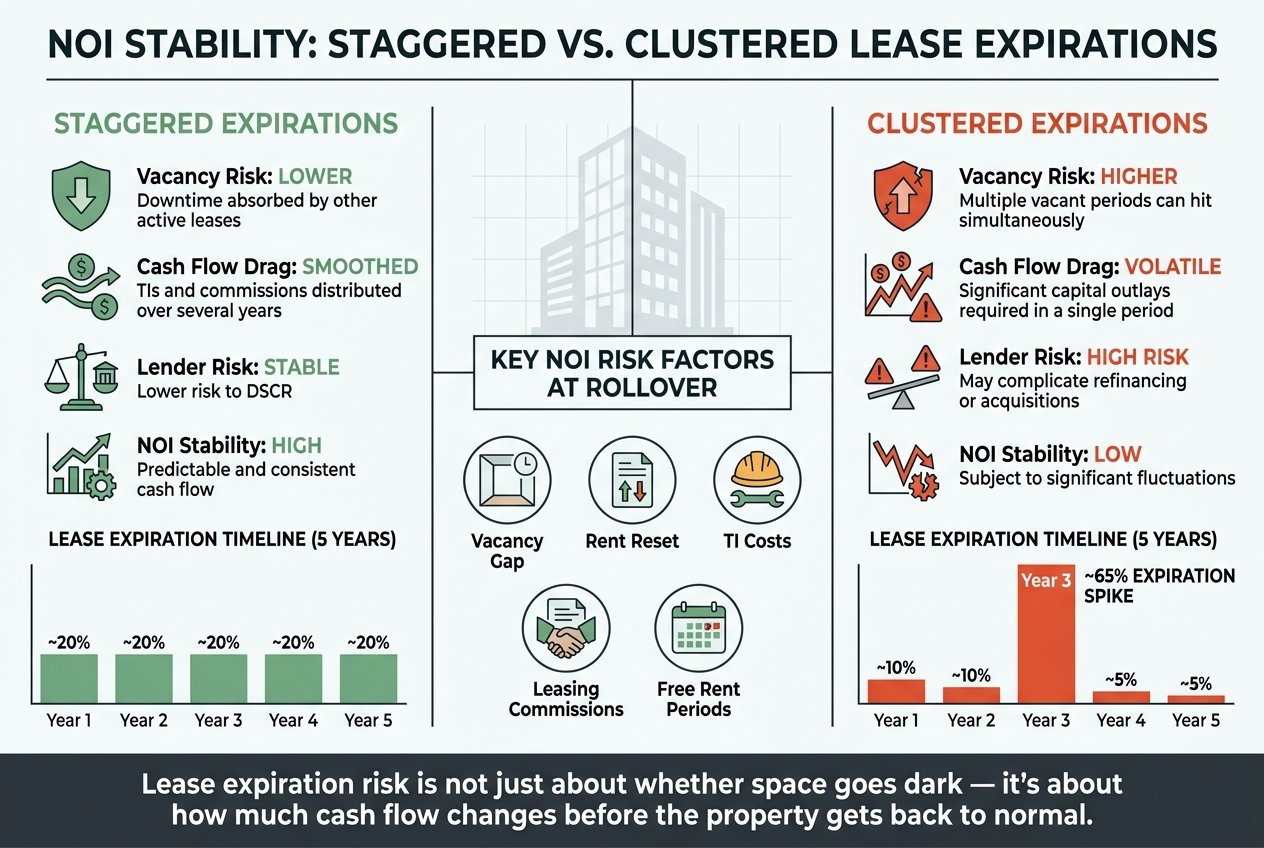
Staggered vs. Clustered Lease Expirations: NOI Impact Comparison
Lease expirations can hit income fast, while property costs keep coming. The big issue is concentration: how much rent expires at the same time.
Vacancy, Downtime, and Rent Resets During Tenant Transitions
When a tenant moves out, rent stops, but operating expenses do not. Taxes, insurance, maintenance, and utilities can still keep running in the background.
And even if the space gets leased again without much delay, NOI can still drop. Why? Because the new lease may come in at a lower rent than the prior one. So the damage doesn't only come from vacancy. It can also come from a rent reset below the old rate or from downtime that pushes back collections.
Re-Leasing Costs That Reduce Near-Term Cash Flow
A re-lease may look like a win on paper and still hurt near-term cash flow.
Tenant improvements, leasing commissions, and free rent all eat into income during the transition period. If a lot of leases roll at once, those costs can stack up in a hurry. That's when DSCR can move fast.
High Rollover Concentration and Lender Risk
Lenders pay close attention when a large share of a property's revenue expires in one year. If rollover is packed into a short window, DSCR can come under pressure because NOI may fall before new leases have time to stabilize income.
That point matters: a weaker DSCR comes from weaker NOI, not from the lease expiration by itself. But if DSCR drops far enough, the borrower may run into covenant pressure or have a harder time refinancing.
Staggered expirations usually lead to better lender terms than clustered expirations because the risk is spread out instead of landing all at once.
| Metric | Staggered Expirations | Clustered Expirations |
|---|---|---|
| Vacancy Risk | Lower; downtime is absorbed by other active leases. | Higher; multiple vacant periods can hit simultaneously. |
| Cash Flow Drag | Smoothed; TIs and commissions are distributed over several years. | Volatile; significant capital outlays required in a single period. |
| Lender Risk | Viewed as stable; lower risk to DSCR. | Viewed as high risk; may complicate refinancing or acquisitions. |
| NOI Stability | High; predictable and consistent cash flow. | Low; subject to significant fluctuations based on renewal success. |
The next step is to measure that exposure before it hits NOI.
sbb-itb-df8a938
How to Measure Lease Expiration Risk Before It Affects Cash Flow
Once you've spotted clustered expirations, the next step is to size the risk. The goal is simple: put numbers on rollover exposure before it shows up in NOI.
Map Expirations by Revenue and Square Footage
Start with a lease expiration schedule that shows, for each calendar year, the share of your total gross leasable area (GLA) and total annual base rent set to expire.
Look at both. A big block of square footage matters, but rent concentration can hit harder. A smaller tenant paying above-market rent can create more pressure than a larger tenant paying less. That's why expirations should be weighted by both GLA and annual base rent.
Use WALT and Annual Rollover Concentration
Weighted average lease term (WALT) gives you a quick read on average lease timing. But on its own, it won't tell you where the pressure lands.
That's where the maturity schedule comes in. It shows when the cash-flow hit is likely to arrive.
Use WALT alongside yearly rollover concentration and tenant concentration. Together, they show whether expirations are spread across several years or packed into a short window.
Stress-Test NOI, DSCR, and Value Under Renewal Scenarios
A maturity schedule tells you when risk shows up. A stress test shows what happens if renewals don't go as planned.
Model the main drivers at rollover:
- renewal probability
- downtime between leases
- market rent changes
- tenant improvement costs
- leasing commissions
- free rent periods tied to vacancy, downtime, and rent resets
Then run a base case and a downside case. That gives you a clearer view of how rollover can affect NOI, DSCR, and value.
| Variable | Base Case Assumption | Downside Stress Scenario | Impact on Metrics |
|---|---|---|---|
| Renewal probability | Expected renewal outcome | Lower renewal likelihood | NOI, DSCR, and value may decline |
| Downtime between leases | Typical downtime | Longer vacancy period | Lower NOI and weaker DSCR |
| Market rent vs. in-place rent | Current market level | Lower re-leasing rent | Reduced cash flow and value |
| Tenant improvement costs | Normal re-leasing costs | Higher TI burden | Near-term NOI pressure |
| Leasing commissions | Standard commissions | Higher commission expense | Lower cash flow |
| Free rent periods | Limited concessions | More free rent | Delayed revenue recovery |
That output helps you see which leases need attention first. Start with the exposures that create the biggest downside and move those renewals to the front of the line.
Steps to Stabilize Revenue During Lease Rollover
Knowing where rollover risk sits is only part of the job. What protects NOI is acting early. Once you identify the leases with the most risk, move them to the top of the renewal pipeline.
Start Renewal Planning 6 to 12 Months Before Expiration
Start renewal talks 6 to 12 months before expiration to cut downtime and protect NOI from vacancy and rent resets. Early outreach also gives both sides time to negotiate without rushing.
Reduce Clustering Through Staggered Lease Terms and Portfolio Mix
When several leases expire in the same year, revenue risk stacks up fast. Extensions and early renewals can help spread those dates out, which lowers concentration in one calendar year.
When you're working on new leases, try not to pack too many expirations into the same window. A better mix of lease terms helps spread maturities over time. On the tenant side, less reliance on one tenant, one industry, or one anchor revenue source can help protect NOI if a single segment starts to weaken.
Track Tenant Health and Prioritize the Largest NOI Exposures
Not every expiring lease brings the same level of risk. The goal is to spot likely non-renewals before the tenant makes that call, so you still have room to act.
A few signals are worth watching closely:
- For retail tenants, monitor the sales-to-rent ratio. A declining ratio is a main warning sign for non-renewal.
- For office and industrial tenants, occupancy data like badge-in records can show space that's being underused and may be given up at expiration.
- Across all property types, late payments and weakening credit are early warning signs that should be tracked on a steady basis.
Once you've identified at-risk tenants, rank them by NOI exposure. Put retention work first on the leases that would do the most damage if they were lost. Reactive management tends to increase downtime, re-leasing costs, and vacancy exposure. Early action helps cut all three.
Centralizing lease dates and renewal status makes it much easier to keep those priorities straight.
Using The Fractional Analyst and CoreCast to Manage Rollover Risk

Once you've ranked at-risk leases, the next step is action. That means using underwriting and lease data management to stay ahead of rollover issues instead of reacting after cash flow takes a hit.
Model Lease Expirations With Tailored Underwriting and Scenario Analysis
After expirations are mapped, model how each rollover affects NOI, DSCR, and asset value.
The Fractional Analyst supports commercial real estate teams with lease-level underwriting built around lease abstracts. These abstracts boil long lease documents down to the dates and financial obligations that matter most.
From there, teams can model renewal options, terminations, and contraction rights, then see how those changes affect vacancy, downtime, and rent resets. You can also stress-test renewal rates, downtime, and re-leasing economics to find the NOI and DSCR break-even point. Add exit cap rates alongside rollover schedules, and the value impact becomes much clearer.
That kind of work only holds up if the lease data is clean and stored in one place.
Use CoreCast to Centralize Lease Data and Monitor Upcoming Expirations
CoreCast centralizes lease abstracts, expiration dates, renewal deadlines, and rollover concentration in one workflow.
Track these fields in CoreCast:
| Data Category | Key Fields to Track | NOI Effect |
|---|---|---|
| Dates | Expiration, renewal deadlines, notice periods | Shows rollover timing and helps prevent unnoticed vacancies |
| Financials | Base rent, CPI escalations, CAM reimbursements | Helps forecast revenue growth and expense recovery accuracy |
| Tenant Rights | Termination options, contraction rights | Flags downside cash flow scenarios |
| Dependencies | Co-tenancy, exclusive use clauses | Shows risks where one tenant's exit can trigger others |
| Operations | Expansion rights, right of first refusal (ROFR) | Changes how easily space can be re-leased or floor plans can be consolidated |
Conclusion: Stable NOI Requires Disciplined Lease Rollover Management
Lease expirations affect NOI through vacancy, rent resets, and re-leasing costs. Centralized data, early renewals, and scenario-based underwriting can cut rollover risk before it shows up in cash flow.
FAQs
How much lease rollover in one year is too much?
There’s no single cutoff point here, but the risk goes up fast when a large share of leases expires at the same time. For example, 40% of leases expiring in one year is far riskier than having those expirations spread out over several years.
If 60% of leases expire within two years, the property faces a high risk of more vacancies. That can lead to uneven cash flow and pressure on revenue while tenants move out and new ones are signed. Managing these expiration clusters matters if you want steadier income during tenant transitions.
Can NOI fall even if vacant space is re-leased quickly?
Yes. NOI can still drop even if the space is re-leased fast.
Why? Because the handoff between tenants often costs money.
You can lose rent during the gap, even if that gap is short. And landlords often offer concessions to get the new tenant signed, which cuts into revenue.
On top of that, turnover comes with extra costs, such as:
- Tenant improvements
- Leasing commissions
- Legal fees
- Marketing
Even when some of those costs don't flow through NOI, they can still put short-term pressure on the property's finances.
What lease data should I track to reduce rollover risk?
Keep a detailed rent roll that includes tenant names, suite numbers, square footage, rent per square foot, and lease start and end dates. It should also track renewal options, expiration clusters, and escalation schedules so you can spot periods when income may swing.
Just as important, watch payment history, creditworthiness, and occupancy records. Then compare that information with local market trends and renewal probabilities. That gives you a clearer view of upcoming lease transitions, helps you plan ahead, and can cut down on downtime.