
Hurdle Rate Tiers in Real Estate Waterfalls

If you want to know who gets paid first in a real estate deal, look at the waterfall. In most CRE waterfalls, cash moves through four main steps: return of capital, preferred return, GP catch-up, and promote. The trigger is often IRR, sometimes equity multiple, and that choice can change payout timing by a lot.
Here’s the short version:
- LPs usually get paid first
- Preferred return often falls between 6% and 10% per year
- Catch-up gives the GP a larger share for a period
- Promote tiers often step from 80/20 to 70/30 to 60/40
- IRR measures timing and return
- MOIC/equity multiple measures total dollars returned
- A deal can hit an IRR hurdle and still owe unpaid pref
I’d boil it down like this: the waterfall does two jobs. First, it sets the order of payments. Second, it sets the test that moves cash into the next tier. If you miss either part, you can misread the whole deal.
A few points matter most:
- Return of capital: LP money comes back before profit sharing ramps up
- Preferred return: usually an accrual on unreturned capital, not the same as an IRR test
- Hard vs. soft hurdle: hard hurdles limit GP promote below the threshold; soft hurdles let catch-up shift more cash to the GP after the test is met
- IRR vs. MOIC: IRR rewards earlier cash back; MOIC ignores timing and looks only at total cash returned
- Modeling: dated cash flows should use
XIRR, not plainIRR
Bottom line: I’d read hurdle tiers as a map of who gets cash, when they get it, and how the upside gets split. Even a small change - like moving the pref from 8% to 10%, or adding a second promote tier - can change GP carry and LP payout in a big way.
| Topic | What it tells you |
|---|---|
| Preferred return | Base LP return on unreturned capital |
| IRR hurdle | When a higher promote tier turns on |
| Equity multiple / MOIC | Whether total dollars returned are high enough |
| Catch-up | How the GP gets to its agreed share |
| Promote split | How profits are shared after hurdles are met |
If I were reviewing a deal on August 17, 2026, these are the first terms I’d check before trusting the sponsor’s return math.
IRR Hurdle Waterfall Template with GP Catch-up Provision
sbb-itb-df8a938
How Hurdle Rate Tiers Work in a Standard CRE Waterfall
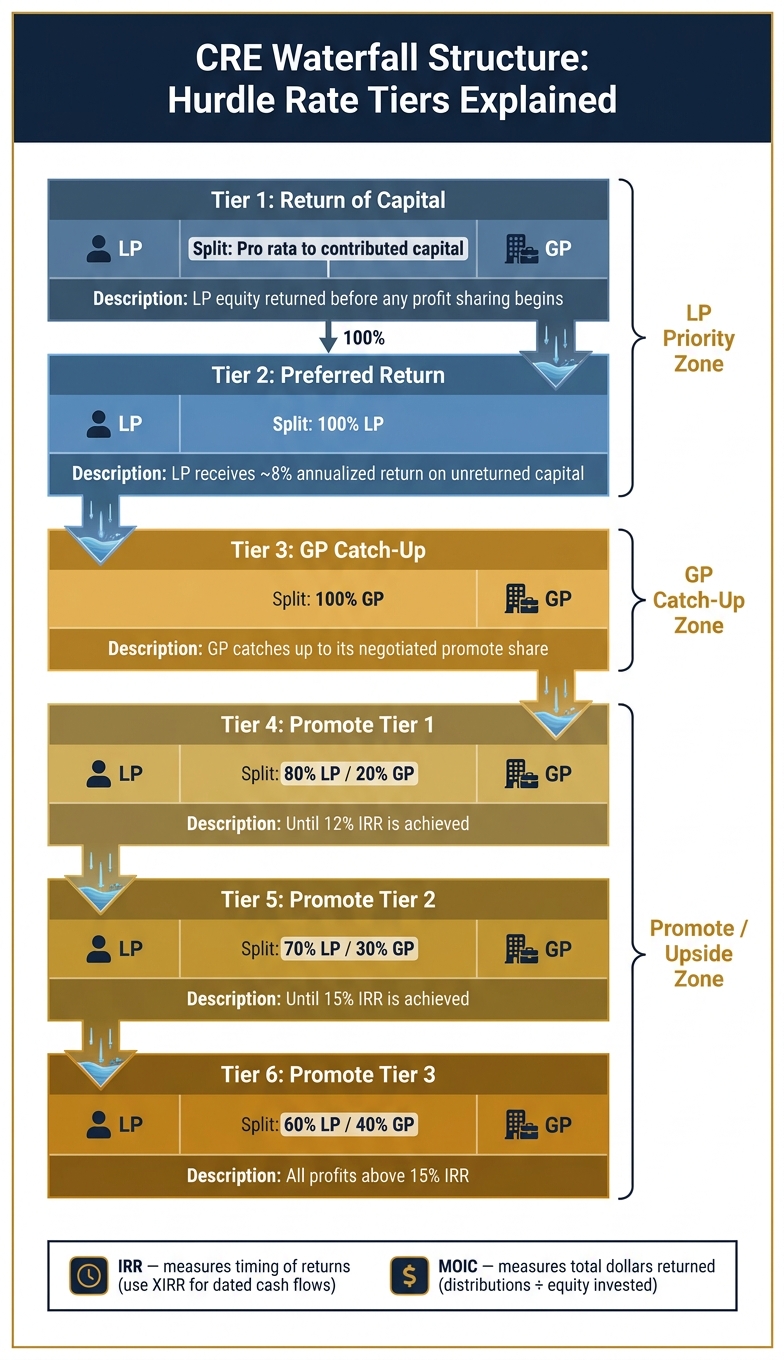
CRE Waterfall Structure: Hurdle Rate Tiers Explained
The main point here isn’t the order of the tiers. It’s how cash moves from one gate to the next, and what metric flips that switch.
Tiers 1 Through 4: Capital Return, Preferred Return, Catch-Up, and Promote
In Tier 1, capital goes back to LPs pro rata based on contributed capital. In Tier 2, LPs get a preferred return on unreturned capital. That part is pretty standard. The economics start to shift after that.
A GP catch-up directs most, or sometimes all, cash to the GP until the GP reaches the agreed promote share. Put simply, catch-up helps the GP get back to its target economics after the LP pref has been paid. Once that catch-up is done, the waterfall moves into the promote tiers.
From there, the split often changes as returns improve. A deal might move from 80/20 to 70/30, then to 60/40. Those step-ups are just post-hurdle economics. They’re not some separate waterfall structure.
| Tier | Phase | Typical Split (LP/GP) |
|---|---|---|
| 1 | Return of Capital | Pro rata to contributed capital until initial equity is recovered |
| 2 | Preferred Return | 100% LP until an 8% annualized return is met |
| 3 | GP Catch-Up | 100% to GP until catch-up is complete |
| 4 | Promote Tier 1 | 80% LP / 20% GP until 12% IRR is achieved |
| 5 | Promote Tier 2 | 70% LP / 30% GP until 15% IRR is achieved |
| 6 | Promote Tier 3 | 60% LP / 40% GP for all profits above 15% IRR |
Soft Hurdles vs. Hard Hurdles
A hard hurdle means the GP earns promote only on profits above the threshold. The GP does not catch up through the LP’s pref dollars. For LPs, that usually means cleaner downside protection.
A soft hurdle works differently. Once the preferred return threshold is met, a catch-up provision lets the GP take a larger share of the next dollars distributed until the GP has received its full percentage of all profits paid out to that point. That gives the sponsor more upside when the deal performs well. [1]
Neither setup is automatically the right one. It comes down to how the parties want to divide risk and reward. In many deals, the trigger is IRR. In others, the switch can be tied to equity multiple thresholds.
With the tier sequence in place, the trigger metric decides when each promote band turns on.
The Return Metrics That Trigger Hurdle Tiers
Tiers set the structure. The trigger metric sets the timing.
That metric decides when each gate opens. Pick the wrong one, or define it too loosely, and the economics can shift in a big way between LPs and GPs. Once the tiers are in place, the metric determines when each one turns on.
IRR Hurdles and Why They Are Common in U.S. Real Estate Waterfalls
Tiers define the split. The trigger metric decides when that split changes.
In U.S. CRE waterfalls, IRR is the most common trigger metric because it measures both return size and return timing. That matters a lot in practice. A deal can move into a higher tier just because cash came back earlier, even if total profit stayed the same. That's why exact cash-flow dates matter so much in underwriting [1][4]
For dated cash flows, use XIRR. Plain IRR can misstate when tiers are hit if distributions don't land on regular intervals [1][4]
Equity Multiple and Dual-Test Hurdles
Equity multiple, often called MOIC or multiple on invested capital, answers a simpler question: for every $1 invested, how many dollars came back?
The formula is straightforward: MOIC = total cash distributed ÷ total equity invested. So a 2.0x equity multiple means investors got back double their money, no matter how long it took [1][3]
Because it ignores timing, equity multiple helps guard against early-exit promotes. In that setup, a GP might earn a promote from a strong IRR even though the LP ends up with less total cash than a longer hold could have produced.
Some sponsors use both tests at the same time so one metric doesn't overstate deal performance. These dual tests require both a timing hurdle and a profit hurdle before the next promote tier opens. For example, the structure might require a 12% IRR and a 1.5x equity multiple before the split moves up [3]
IRR vs. Equity Multiple: A Side-by-Side Comparison
| Feature | IRR | Equity Multiple (MOIC) |
|---|---|---|
| Definition | Annualized return on invested capital that makes the NPV of all cash flows equal to zero | Total cash distributions divided by total equity invested |
| Sensitivity to Timing | High - earlier distributions can increase the result a lot | None - only total dollars matter |
| Sensitivity to Total Dollars | Moderate - focuses on capital efficiency over time | High - measures absolute wealth created |
| Typical Use Case | Gating performance-based promote tiers | Ensuring a minimum absolute profit before higher promotes |
| GP Incentive | Pushes toward faster exits and faster return of capital | Pushes toward maximizing total project profit |
| Modeling Implication | Requires XIRR and exact cash flow dates |
Simple division: total distributions ÷ total equity |
IRR tends to fit value-add and opportunistic deals, where speed of return is part of the pitch. Equity multiple fits long-hold core-plus or stabilized deals better, where total wealth creation matters more than speed.
Use IRR for timing. Use equity multiple for absolute profit.
How to Structure and Model Hurdle Tiers in Practice
Matching Hurdle Levels to Strategy, Risk, and Hold Period
Once you’ve picked the trigger metric, the next job is setting hurdle levels that fit the deal economics. Those tiers should line up with the deal’s risk, the sponsor’s economics, and the expected hold period. Higher-risk deals often use stepped IRR tiers so the GP split rises as returns go up [2][1].
A hold-period sensitivity table helps you pressure-test those bands before you lock them in. Put simply, it shows where returns are most likely to land across different exit timing cases, which makes it easier to place hurdle tiers in spots that match how the deal may actually perform [4].
Catch-Up Design and Promote Alignment
After the hurdle bands are set, the catch-up tier needs to work so the GP only reaches its target promote after the LP’s priority return has been paid. That’s the point of the structure: LPs get paid first, then the GP can catch up under the agreed terms.
A catch-up tier can allow the GP to catch up until its share equals the negotiated promote split [2].
Building the Waterfall Model and Using Institutional Templates
Once the tier rules are clear, the model needs to turn them into actual cash flow order and split math. The cleanest way to do that is to build the waterfall step by step:
- Enter equity contributions and actual cash flow dates
- Test each tier with
XIRR - Cap each distribution with
MIN()at the amount still available - Reconcile total cash in to total cash out [1]
If you’re building a monthly model, convert the annual preferred return to a monthly rate with =(1 + Annual Rate)^(1/12) - 1 [1]. That keeps the timing math lined up with the model’s cash flow frequency.
Conclusion: The Key Decisions That Drive Waterfall Economics
Once the tiers and trigger metric are set, the waterfall economics are mostly locked in. Tier levels, catch-up, promote splits, and trigger metrics decide who gets paid, when they get paid, and how much they get paid. And even a small shift in the promote structure can change how the upside ends up being divided between LPs and GPs [3].
The biggest choice isn't only the tier itself. It's also the test used to open that tier. IRR measures speed. Equity multiple measures total payout. That difference matters a lot. A short hold can post a strong IRR while still returning less total cash than a longer hold with a lower IRR and a higher multiple. Preferred return works differently. It's a dollar balance on unreturned capital, not a timing test. So a deal can pass an IRR hurdle and still owe the LP pref [3].
Modeling puts those economics on the page. IRR matrices show which exit year turns on each tier and where promote timing starts to shift. In plain terms, the model should show exactly when each tier activates across the exit dates that are most likely. In practice, the best waterfall is the one whose tiers line up with the deal's risk, hold period, and target split [4].
FAQs
How do I know if a hurdle is hard or soft?
Check whether the waterfall includes a cumulative catch-up for the preferred return.
A hard hurdle usually changes the profit split once the threshold is hit, without first making up any unpaid preferred return from earlier periods.
A soft hurdle usually means the investor must receive the full cumulative preferred return before the sponsor’s promote starts.
Confirm the exact terms in your partnership agreement.
Can a deal clear an IRR hurdle but still underpay the LP?
Yes. A deal can clear an IRR hurdle and still leave the LP with less than they expected.
Here’s why: waterfall tiers pay out cash based on timing-sensitive IRR triggers, preferred return status, and catch-up or upper-tier promote splits.
A simple example helps. If capital comes back earlier, the deal may hit the next IRR tier even when total profit barely changes. That can move more of the upside to the GP.
Also, IRR and preferred return are not the same thing. They’re separate gates.
When should a waterfall use both IRR and MOIC hurdles?
Use both IRR and MOIC hurdles when you want to balance speed of return with total profit.
IRR rewards getting capital back fast, which makes it a good fit for value-add or opportunistic deals. The catch is that timing events like refinancings can make IRR look better than the full economics might suggest.
That’s where MOIC helps. It sets a floor for total return before the sponsor earns a promote. Put the two together, and you get a more balanced setup that works well across different strategies and market cycles.