
Real Estate APIs: 7 Features to Look For

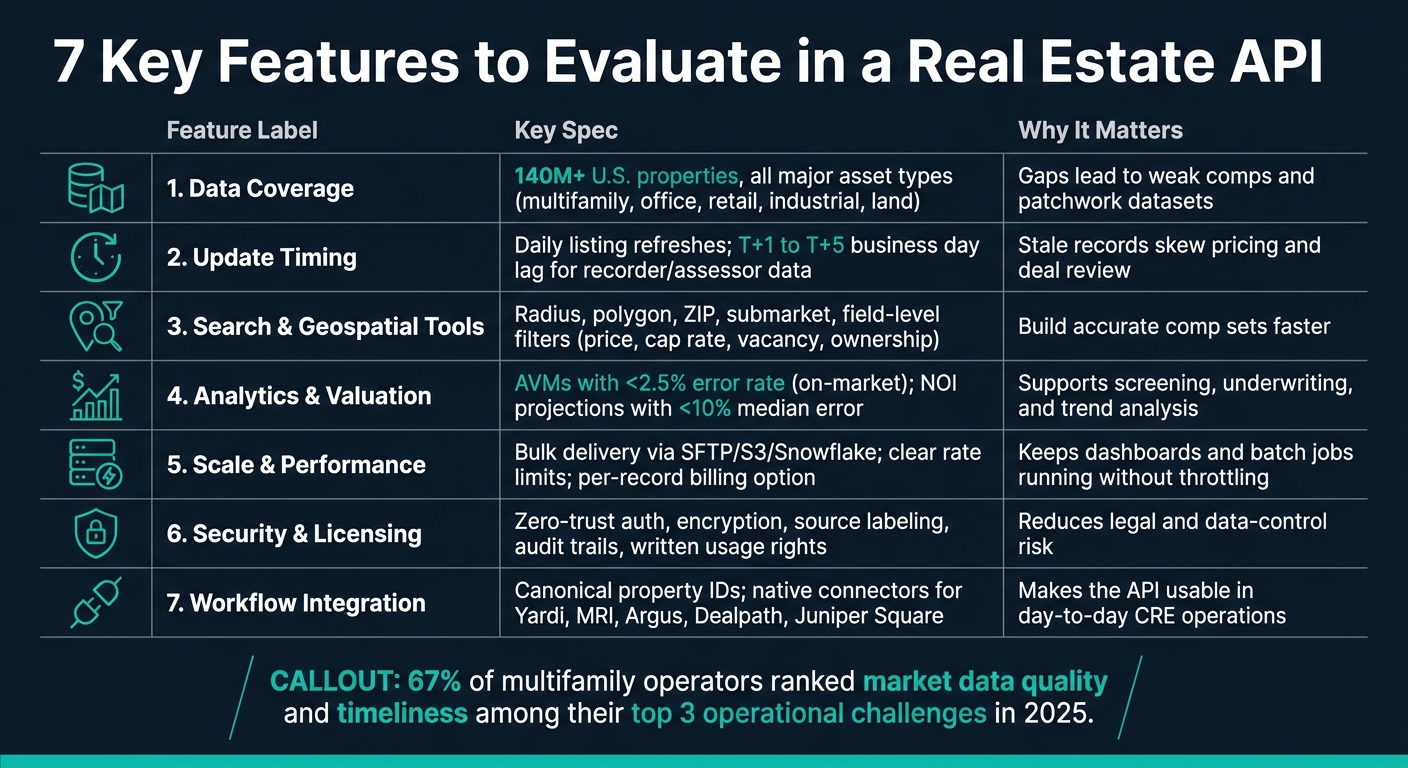
If I were picking a real estate API today, I’d judge it on seven things: data coverage, update speed, search tools, analytics, scale, security, and workflow fit. If one of those is weak, underwriting, comps, and reporting can break down fast.
Here’s the short version:
- I need data that covers major U.S. property types and markets
- I want update timing that matches the job, with daily listing updates as a baseline for active deal work
- I look for search tools like radius, polygon, and field-level filters
- I check whether the API includes AVMs, rent forecasts, and market signals
- I test rate limits, bulk access, and uptime before I trust it at scale
- I review licensing, source labeling, and audit trails before I build on it
- I make sure it fits the systems my team already uses
A few numbers stand out. Some APIs cover 140 million+ U.S. properties. Recorder and assessor data can still lag by T+1 to T+5 business days. And some valuation models report error rates below 2.5% for on-market properties.
7 Key Features to Evaluate in a Real Estate API
The Best API for Prop-Tech: RealEstateAPI | SourceForge Podcast, ep. #36
sbb-itb-df8a938
Quick Comparison
| Feature | What I look for | Why it matters |
|---|---|---|
| Data coverage | Major asset types, national reach, populated fields | Gaps lead to weak comps and patchwork datasets |
| Update timing | Daily listing updates, clear timestamps, change history | Old records can skew pricing and deal review |
| Search tools | Radius, polygon, ZIP, submarket, financial filters | Helps me build comp sets faster |
| Analytics | AVMs, rent forecasts, NOI and market signals | Helps with screening and trend review |
| Scale | Rate-limit clarity, bulk delivery, load handling | Keeps dashboards and batch jobs running |
| Security and licensing | Auth, encryption, usage rights, source labels | Cuts legal and data-control risk |
| Workflow fit | Canonical IDs, exports, CRM/warehouse support | Makes the API usable in day-to-day work |
The main point is simple: I would not choose an API by field count alone. I’d test whether the data is populated, time-stamped, allowed for my use case, and easy to move into my team’s workflow.
Why API Feature Quality Matters in Commercial Real Estate
Raw listing data isn't enough. A listing may show an asking rent that looks competitive, but the effective rent can be lower once you factor in concessions like a free month. In soft markets, listing agents are often slow to cut prices, so asking rents can overstate where deals are actually getting done [4]. If your API only pulls asking prices, your rent comps and underwriting models start with the wrong baseline.
Historical depth matters just as much. A single snapshot from today doesn't tell you much about rent movement across past cycles or how a submarket changed over time. Industry guidance says you need at least five years of historical data to support dependable underwriting and trend analysis [6][7]. Without that history, forecasting models are far less dependable. And depth by itself still doesn't solve the whole problem.
Field completeness is another weak spot people often miss. An API may advertise hundreds of data fields, but that doesn't mean those fields are well populated. If the data is sparse, the day-to-day use drops fast [7]. Put simply: field availability and field population are not the same thing. A long list of fields doesn't help much if half of them are empty.
Freshness comes next. Update quality shapes decision quality in a direct way. Call-center-based data collection can create 30- to 60-day lags in reported figures [6], and that's a problem if you're trying to read a market that's moving fast. APIs that pull straight from county assessors and recorder offices give you a much stronger base for risk review and valuation work [7].
That's why the seven features below matter most.
1. Comprehensive Property and Market Data Coverage
Start with coverage. If an API misses asset classes or key fields, every model built on top of it gets weaker. Coverage is the baseline. An API that handles multifamily well but comes up short on industrial, retail, office, or land pushes you into stitching together multiple sources. That means more cost, more mess, and more room for mistakes. A strong API should cover all major property types: multifamily, office, retail, industrial, and land [1][3].
Geographic reach matters just as much. Institutional portfolios don’t stop at major metros. They span primary, secondary, and tertiary U.S. markets, so national coverage cuts down the hassle of juggling regional contracts [3]. Some enterprise APIs cover 140 million+ U.S. properties, which gives teams room to analyze at scale without patching together fragmented datasets [2].
Breadth alone isn’t enough, though. The fields an API returns determine whether the data is useful for underwriting and rent comps or just looks good in a sales deck. For underwriting, look for fields like:
- Square footage
- Year built
- Zoning
- Sale price
- Recording date
- Buyer and seller details
- Ownership chain
- Mortgage data [1][3]
For rent comps, the API should return active listing data, effective rents, vacancy rates, absorption figures, and Days on Market (DOM) [4].
Before you buy, test a sample dataset. A big field count can sound great, but it doesn’t mean much if those fields are thinly populated [7]. An API may advertise 300+ fields, but if square footage, year built, or last sale price are missing across a meaningful share of records, the dataset won’t stand up when an underwriting team leans on it.
It’s also worth checking how the API handles missing data. Good datasets flag missing values as null instead of defaulting them to zero. That detail sounds small, but it isn’t. Missing values need to stay null. Zero values can throw off downstream models fast.
Coverage only helps if the data stays current, which is where freshness comes in next.
2. Real-Time Updates and Data Freshness
In commercial real estate, data age becomes a problem the moment a listing changes status or the asking price drops, but your API still serves the old record.
Update frequency and data freshness are not the same thing. Update frequency is how often the system refreshes. Data freshness is how old the record is when you pull it. That depends on both the refresh schedule and how much time has passed since the last refresh finished [1][9]. So even a steady refresh cadence can still leave you looking at stale information.
For active listings and price changes, a 24-hour refresh cycle is the practical minimum [1]. That schedule helps surface new inventory, status changes like a property moving to "Under Contract", and price cuts before they go stale. Sales comps and transaction records have a different kind of delay. Recorder and assessor offices often post data on a T+1 to T+5 business day lag, which means even a fast API cannot fully remove that gap [9].
Off-market data and ownership records usually do not need daily refreshes. For prospecting and historical work, updating every few weeks is often enough [1].
When you review an API, pay close attention to timestamp transparency. Good providers return priceHistory arrays with exact timestamps for each price drop, withdrawal, or sale, instead of only showing one "last updated" field [9]. That makes it much easier to check how current a record is and what changed over time.
It also helps to see whether the API offers run-on-demand queries, which return the record’s current state at request time [9]. If your team is underwriting active deals, that can make a big difference.
A simple schedule often works best:
- Daily for acquisitions
- Weekly or monthly for tax data
- Weekly or monthly for ownership data [7]
Fresh data matters, but teams also need to find and compare records without digging around, which brings search and geospatial tools into the picture next.
3. Flexible Search, Filtering, and Geospatial Querying
Once the data is current, the next step is simple: can analysts find the right records fast? Fresh data doesn't do much if it takes forever to sort through it.
A strong CRE API should let analysts set their own geographic boundaries instead of forcing them into preset regions. Radius searches can pull properties within a set distance of a target asset using latitude and longitude coordinates. Polygon filtering goes a step further. It lets you draw custom boundaries around a submarket or site and return only the records inside it [1]. For local market analysis, that level of control makes it much easier to isolate the right comps.
Location is only part of the job. Field-level filtering is what separates a useful API from a plain data dump. You should be able to filter by property type, building class, square footage, year built, cap rate, asking rent, TI allowances, vacancy status, and owner or management identity. For lease comp work, filters for concessions, escalation structures, and effective rent matter a lot. And those filters should work across location, property, financial, and ownership data.
Before you commit to a provider, test the API yourself. Does each filter return enough records to build a sound comp set? That's the part that tells you whether the search system is built for actual analysis or just looks good in a demo. Good search tools turn large datasets into usable comp sets, underwriting inputs, and market snapshots.
| Search Category | Key Filtering Options |
|---|---|
| Geospatial | Radius (lat/long), polygon, ZIP code, submarket |
| Physical | Asset type, building class (A/B/C), square footage, year built |
| Financial | Sale price, cap rate, asking/effective rent, TI allowances, concessions |
| Market | Vacancy rate, absorption, construction pipeline, historical occupancy |
| Ownership | Ultimate owner, buyer/seller name, debt/lien status |
4. Automated Valuation and Predictive Market Analytics
After analysts find the right comps, the next job is figuring out value and where the market may move next. That’s where rent forecasts, appreciation signals, and anomaly detection come in. Search tools help you find the comps. Valuation and analytics tools help you judge what those comps mean.
AVMs use live sales and market data to estimate value. They work well for screening, but not for final pricing. Some AVMs post error rates below 2.5% for on-market properties [2].
It also helps to look for rent forecasting and NOI benchmarking. Predictive endpoints review rental demand, concession terms, and unit-level availability to estimate future income and rental yields. Some models report sub-10% NOI error. And some comp engines line up with appraiser selections at high rates [10].
You’ll also want market momentum signals. Good APIs track appreciation forecasts, economic indicators, and micro-trends at the ZIP code or block level. That gives teams more support for acquisitions, underwriting, and portfolio monitoring. Anomaly detection can spot unusual cap rates or rent growth patterns before a deal gets overstated.
Ask vendors for published accuracy metrics and a clear methodology. Then use a 7-day or 30-day trial to back-test results against closed deals or internal appraisals [2][10].
These tools only help if they can run fast and stay reliable at scale.
5. Scalability, Performance, and Reliability
Valuation tools only matter if the API can keep up.
When several underwriting models run at once, or an alert goes out across a big portfolio, the API has to handle the load without slowing down or dropping requests. For CRE teams, this is about throughput, not just the quality of the analytics.
Rate limits catch most teams off guard. A lot of plans cap requests per second or per minute. That can break dashboards, delay alerts, and create headaches during peak usage.
And rate limits don't just create a technical issue. They turn into engineering work. Teams end up throttling requests, retrying failures, and queuing jobs just to keep things moving.
For large portfolio workflows, on-demand calls aren't always the best setup. Some providers offer bulk delivery through SFTP, Amazon S3, or data warehouse connectors like Snowflake for nightly reconciliations and model refreshes [3].
It also helps to look closely at the pricing model structure. Per-request billing can get messy at scale because some providers charge for failed or empty queries. A per-record credit model charges only for delivered data, and it often removes rate limits altogether while shifting the infrastructure load to the provider [3].
Before you commit to any provider, run a load test during the trial period. Simulate the kind of traffic your system would create at peak usage:
- multiple concurrent users
- automated alerts firing
- a full portfolio refresh
Then watch how the API responds. If it slows down or starts throwing errors under that pressure, reliability may turn into a repeat issue in production. Once performance looks solid, the next thing to check is access, governance, and licensing.
6. Security, Governance, and Licensing Controls
After throughput, the next gate is access control and legal use. A fast API can still fall apart if data access is weak or the license shuts down your use case.
Authentication is the first line of defense. API-related security threats rose sharply in 2025 [2]. That helps explain why many providers now rely on zero-trust access. In plain English, every request gets authenticated, encrypted, and checked before any data comes back.
But don’t stop at the login screen. Check the license too.
MLS-sourced data often comes with strict licensing terms, display rules, and geographic limits tied to membership boundaries [3]. Public record APIs tend to allow more freedom for national-scale analytics. Some institutional data sources go even further and ban automated or programmatic access.
Before you build on top of any data source, get written confirmation that your planned use is allowed. That step can save a lot of pain later. Some agreements limit data use to:
- Internal use
- Client-facing outputs
- Model training
Those rights need to be verified before you build [3] [2].
Access rights are only part of the picture. Strong governance also depends on source transparency. Good providers mark which fields are direct, inferred, or modeled, instead of treating everything as if it came straight from county assessors or recorders [7].
Audit trails matter here too. They show where each field came from and how it was derived, which helps defend the model.
7. Integration with CRE Workflows and Internal Data Pipelines
Security and licensing set the boundaries. Integration is what decides whether people will use the API at all. That’s why workflow fit is the last screen before you compare vendors side by side.
A solid real estate API should plug into the systems your team already uses every day. That includes native integrations with Yardi, MRI, Argus, Dealpath, and Juniper Square, plus clean JSON for internal workflows.
You should also look for a canonical property ID that connects listings, transactions, ownership records, and activity records across datasets [5]. Without that link, teams get stuck piecing together records by hand. And at that point, automation starts to lose its value.
It’s also worth testing whether the API can feed underwriting models with market rent assumptions, comp data, and demographic inputs [8]. On top of that, it should be able to append external property data to internal CRM records by address.
For internal pipelines, check that the API supports scheduled exports to your warehouse or BI dashboard and lines up with your refresh cadence. Streaming only makes sense when the cost of a one-hour delay is higher than the overhead of running always-on infrastructure.
Before adoption, review the SDKs, integration guides, and pre-built recipes. Weak documentation often leads to implementation mistakes, including duplicate fields [11]. Use those checks to narrow the field before you compare providers directly.
How to Compare API Providers
Compare providers using the same seven criteria, not a slick demo. A feature only matters if it holds up in your actual workflow. Use the scorecard below to find the provider that best supports underwriting, comp analysis, and portfolio monitoring.
Stale data and shallow history are hard to fix later.
| Factor | What to check |
|---|---|
| Data freshness | Daily or near-real-time refreshes are ideal. Weekly updates are the minimum for most active workflows. Monthly or quarterly may work for lower-frequency use. |
| Historical depth | Enough history to support cycle analysis and underwriting. |
| Search and geospatial tools | Map-based search, custom polygon drawing, and stacked filters for CRE workflows. |
| Analytics endpoints | AVMs, predictive scoring, and rental yield analysis to streamline underwriting and market research. |
| Access and scale | Bulk delivery, self-serve access, enterprise support, and workable rate limits all matter. |
| Licensing and compliance | Usage rights should fit your internal and reporting needs. |
| Documentation quality | Clear docs, examples, and schemas reduce implementation friction. |
Pricing can vary a lot. Some providers sell through annual enterprise contracts. Others offer monthly plans or pay-per-call pricing. That sounds simple on paper, but cost means little if the data falls apart once you put it to work.
So don't just count fields. Check how often those fields are actually populated. Pull a sample export on properties you already know, then cross-check the results against county records. That kind of spot check gives you a much better read on whether the API can support near-real-time CRE analysis.
How These Features Support Real-Time CRE Analysis
Taken together, these features show whether an API can support live underwriting or if it’s better suited to static reporting.
Broad coverage and daily refreshes keep comp sets current enough for active deal review. That matters because 67% of multifamily operators said market data quality and timeliness ranked among their top three operational challenges in 2025 [10]. The most direct way to deal with that problem is simple: keep refresh cycles consistent.
Once coverage and freshness are in place, valuation models can work from current market signals instead of stale inputs. AVMs and predictive analytics endpoints can post error rates below 2.5% for on-market properties [2], while median NOI projection errors can stay under 10% [10]. In practice, that kind of precision helps teams move faster through underwriting, especially when they’re working from live market conditions instead of lagged survey data.
Of course, accuracy alone isn’t enough. The data also needs to be controlled and traceable. Tight authentication and source-level governance make auditability possible in lender and investor reporting, where every figure needs a clear origin. That traceability is what turns API outputs into underwriting inputs and reporting deliverables that people can stand behind.
Those are the signals to look for when comparing providers.
Conclusion
These seven features decide whether an API can support live CRE decisions or just static reporting. The best real estate API brings coverage, freshness, search, analytics, scale, governance, and workflow fit into one reliable system.
For underwriting, focus on unit-level detail, accurate AVMs, and expense data that help you build dependable NOI forecasts. For market research and forecasting, look for deep historical data, frequent refreshes, and analytics that help spot market shifts early.
In day-to-day work, the best API is the one that keeps market data current, usable, and trustworthy inside your existing workflow.
If your team needs help turning API data into decisions, The Fractional Analyst supports CRE analysis, reporting, and CoreCast-based workflows.
FAQs
How fresh should CRE API data be?
CRE API data should be refreshed as close to real time as the source allows so dashboards stay current, especially for events like lease renewals, rent payments, and changes in operating expenses.
For time-sensitive market monitoring, use live-at-request data or set update schedules often enough to catch meaningful changes. In most cases, that means hourly or daily updates instead of weekly ones for slower feeds.
What data fields matter most for underwriting?
The most important underwriting data fields start with property characteristics such as square footage and lot size. They also include transaction and ownership history, tax assessments, deed and mortgage records, and foreclosure data.
On top of that, underwriters look at current market trends, rental estimates, automated valuation models, zoning, and risk factors tied to the property and its surroundings. Those data points help them validate the collateral, project performance, and judge long-term viability.
How can I test a real estate API before buying?
Before you buy a real estate API, compare a few providers side by side. You want to make sure their data and technical setup match your use case, not just look good on a sales page.
Start with the basics:
- Check the quality of the documentation
- Look at how easy the API is to implement
- Review the level of technical support
- Gauge the learning curve for your team
That early review can save a lot of friction later.
It also helps to audit your own data before you integrate anything new. If your internal data has gaps, duplicates, or quality problems, plugging in an API won't magically fix them. It can actually make a messy system messier.
The Fractional Analyst also offers resources to support data-driven workflows, including free financial models and CoreCast.