
How to Verify Rent Rolls in CRE Due Diligence
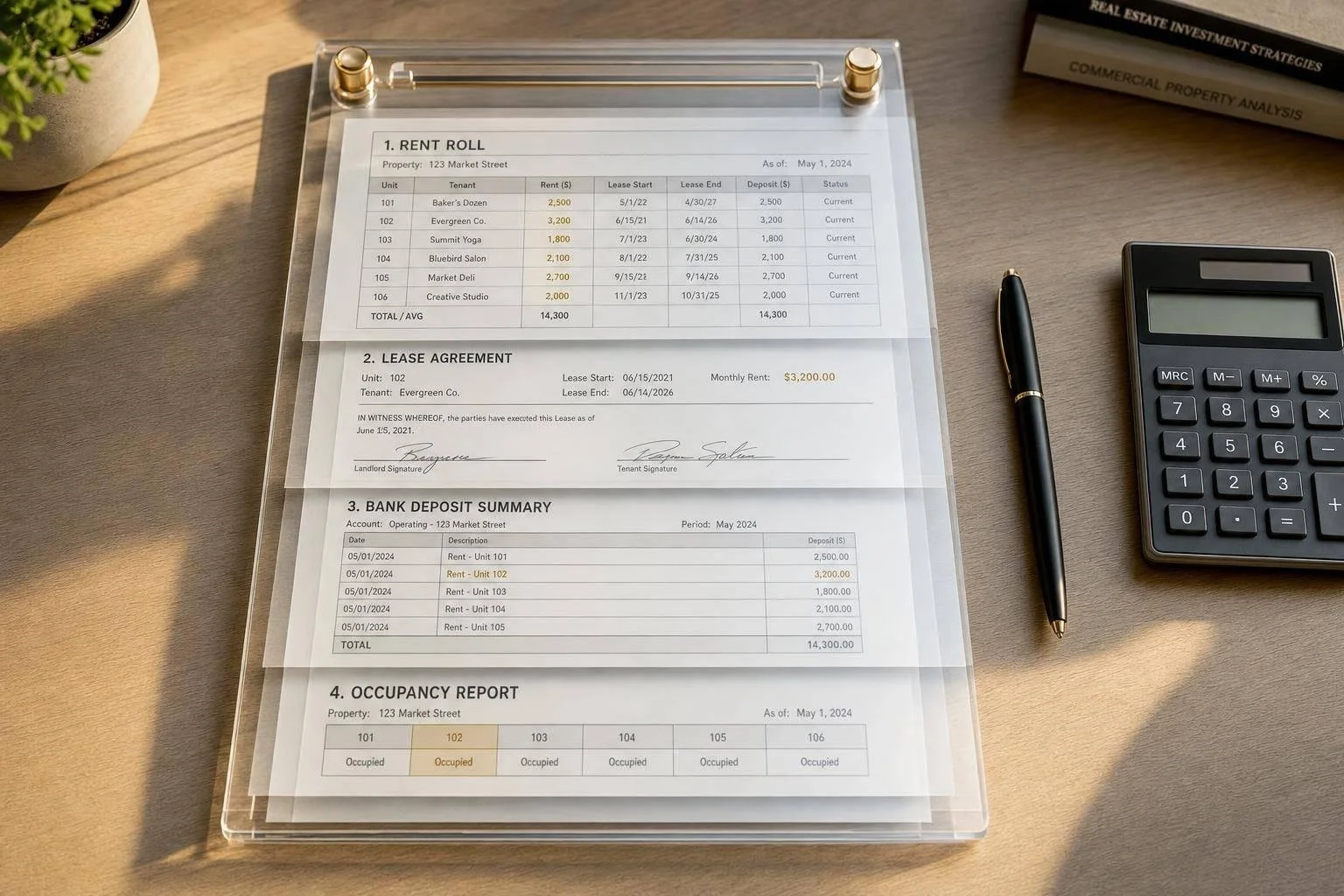
I treat every rent roll as unproven until it matches the leases, T-12, bank deposits, and occupancy records. That one rule can stop bad underwriting, weak loan sizing, and value errors before they spread through the deal.
If I had to boil this process down, it’s this:
- I get a certified rent roll dated within the last 30 days
- I collect all leases, amendments, side letters, estoppels, T-12s, receivables, and 12 months of bank statements
- I check each tenant line for name, suite, RSF, rent, dates, rent steps, free rent, deposits, and reimbursements
- I compare contract rent vs. collected rent
- I confirm whether occupied space is actually occupied
- I log every mismatch by NOI and value impact
That matters because even a small rent error can hit valuation fast. For example, $75,000 less NOI at a 6.25% cap rate cuts value by about $1.2 million.
Here’s the short version: the lease is the control document, the bank shows what got paid, and the property tells you whether the tenant is there at all. If those three don’t line up, the rent roll is wrong, incomplete, or both.
Before I underwrite, I want one clean workbook that shows what matches, what needs review, and what changes the deal.
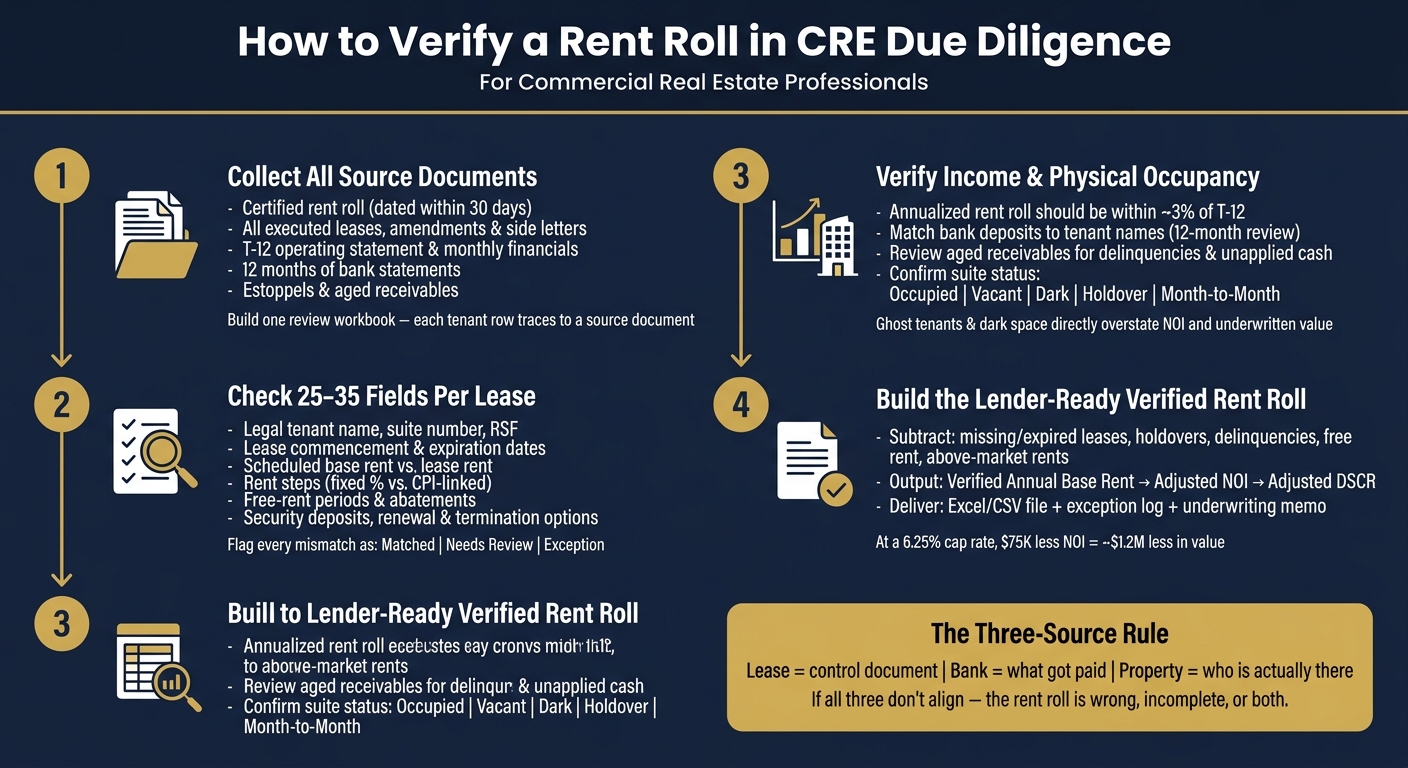
Rent Roll Verification Process: 4-Step CRE Due Diligence Framework
5 AI Workflows for Real Estate Asset Management | Rent Roll, Budget & Lease Analysis
sbb-itb-df8a938
Step 1: Gather Source Documents Before You Reconcile
Start with the source documents before you reconcile any line item. Pull the full source set together and place it in one review workbook. If you're still hunting for leases, amendments, or bank statements while reconciling, the job drags out and it's a lot easier to miss something material.
The first document to request is a certified current rent roll with a clear as-of date in MM/DD/YYYY format. Best case, it's no more than 30 days old when your review starts. The seller's certification should cover tenant names, suites, rent amounts, lease dates, deposits, delinquencies, and any abatements or concessions.
Documents Needed for a Full Review
Check the rent roll against three document groups: lease documents, financial records, and verification documents.
| Document Category | Specific Items to Collect | Purpose in Rent Roll Verification |
|---|---|---|
| Lease Documents | Executed leases, amendments, side letters, option notices | Verify rent, escalations, and expirations |
| Financial Records | T-12 operating statement, monthly financials, aged receivables, collections reports | Compare reported income to collections |
| Verification Docs | Bank statements, certified rent roll, estoppels | Match deposits to the rent roll |
Estoppels can back up lease terms straight from the tenant and bring disputes to light before closing. Bank statements should cover the most recent 12 months so you can trace scheduled rent to actual deposits. Missing amendments and side letters are a common reason rent rolls don't match, so make sure you have the full file for every tenant before you begin.
With the full source set in place, move to tenant-by-tenant reconciliation.
Create a Tenant-by-Tenant Review Workbook
Once the documents are in hand, build one workbook where each row stands for one tenant or suite. Every rent roll field should trace back to a source document.
At a minimum, each row should include:
- Legal tenant name
- Suite number
- Lease commencement date
- Rent commencement date
- Expiration date
- Current base rent
- Scheduled rent steps
- Free-rent periods
- Security deposit
- Additional rent/expense reimbursements
- Renewal and expansion options
Add reference columns that point back to the source, such as Amendment 2, p. 3 or Bank statement 08/2026. That way, if something looks off, you can trace it fast without rereading the whole file. Use one status flag per row: matched, needs review, or exception. It's a simple move, but it makes filtering open items much easier than scanning the full workbook over and over.
Once the workbook is built, reconcile each tenant line by line against the executed lease.
Step 2: Check the Rent Roll Line by Line Against Leases
Review each tenant against the executed lease, one field at a time. A full pass can involve 25 to 35 fields per lease, so move in a steady, organized way [1]. Treat the lease as the control document. Then log every mismatch in your workbook before you move on to the financials.
Check Tenant Names, Space, Dates, and Base Rent
Start with the core fields: legal tenant name, suite number, rentable square footage (RSF), lease commencement date, lease expiration date, and scheduled base rent. These numbers feed NOI and value, so small errors here can ripple through the whole model.
Legal name mismatches happen all the time. A rent roll may say "ABC Corp, LLC" while the executed lease says "ABC Corp, Inc." That may look minor at first glance, but you still need to flag it and sort it by materiality. Suite number errors can be a bigger deal. If a tenant occupies suites 400 and 410, but the rent roll lists only suite 400, your model is leaving out leased space [1].
RSF gaps need a close check. Compare the rent roll's RSF to the lease exhibit, the stacking plan, and the broker marketing package. If those sources clash, use the executed lease as the controlling source.
For scheduled base rent, compare the current rent schedule with the lease and every amendment in the file. Missing amendments are a common reason rent rolls don't match. If the scheduled rent looks off, check whether an amendment is missing from the file before you assume the rent roll is wrong [1].
Check Rent Steps, Free Rent, Deposits, and Options
Next, test the lease economics that change NOI. Scheduled rent steps, whether they are fixed percentage bumps or CPI-linked escalations, need to match the lease exactly. If the rent roll shows a 3% fixed annual step, but the lease ties increases to CPI, that is a material gap. It changes the cash flow picture.
Free-rent periods and abatements are often left off rent rolls altogether. That can make income look higher than it is. Check the rent commencement date against the lease commencement date, and confirm whether any concession is still in effect.
Security deposits should line up with the lease and any amendments. Renewal options and termination rights can matter even more. Check whether any option notices have already been exercised and whether any termination windows are coming up. Miss a notice deadline, and you could end up with an automatic renewal or an unexpected vacancy.
Expired leases and missing concessions are common errors. The simplest way to catch them is to compare dates and concession schedules directly against the lease.
Log Discrepancies by Materiality
As soon as you find an exception, log it. Every mismatch should go into your workbook with a materiality classification: none, minor, or material. Base that call on the effect on NOI and value, not on how obvious the error looks. Use the same materiality label your underwriting model will use.
| Key Field | Rent Roll Value | Lease Value | Discrepancy Type |
|---|---|---|---|
| Tenant Legal Name | ABC Corp, LLC | ABC Corp, Inc. | Minor (Legal Entity) |
| Suite Number | 400 | 400 & 410 | Material (Missing Space) |
| Rentable Sq. Ft. | 5,000 SF | 4,850 SF | Material (Overstated RSF) |
| Lease Expiration | 12/31/2028 | 12/31/2026 | Material (Rollover Risk) |
| Current Base Rent | $12,500/mo | $11,000/mo | Material (NOI Impact) |
| Rent Escalation | 3% Fixed | CPI-Linked | Material (Value Impact) |
| Security Deposit | $25,000 | $15,000 | Minor (Accounting) |
Cite each finding with a specific reference, such as Rent Roll Row 14 or Lease Amendment 2, p. 3, so your audit trail is easy to defend.
Once the lease-by-lease review is done, test the verified rent roll against financials, deposits, and occupancy.
Step 3: Match the Rent Roll to Financials, Collections, and Occupancy
Use the verified rent roll to reconcile income to the T-12, general ledger, and cash receipts. The same tenant-by-tenant workbook should connect contract rent to actual cash flow and occupancy. If the lease says one thing but the books show another, that gap needs an answer.
Compare Rent Roll Income to the T-12 and Bank Deposits
After you verify lease terms, the next step is simple: check whether that income shows up in the accounting records and in the bank.
Start by annualizing in-place monthly base rent and comparing it to T-12 rental income. Then explain any gap with vacancy, concessions, free rent, bad debt, and non-revenue units. As a rule of thumb, annualized rent roll totals should usually land within about 3% of the T-12. If the difference is larger and you can't explain it, treat it as a finding, not rounding noise.[3]
Not every variance means something is wrong. Some are just timing differences. So before calling it a miss, separate timing issues from true discrepancies. Review at least 12 months of bank statements and match deposits to tenant names or sources using property management ledgers or payment histories. Then review the aged receivables report for:
- Delinquent balances
- Disputed charges
- Unapplied cash
- Tenants marked "current" on the rent roll even though open receivables keep rising
That last one matters more than it may seem. A tenant can look fine on the rent roll while the receivables report tells a very different story.
Confirm Occupancy and Tenant Status
Once rent and collections tie out, make sure the space status on paper matches what's happening at the property.
Occupancy verification is not just a paperwork task. Cross-check the rent roll against site inspection notes, occupancy reports, and utility or access data. Confirm which suites are:
- Occupied
- Vacant but marketed
- Dark but paying
- Holdover
- Month-to-month
This is where hidden problems tend to show up. Ghost tenants, dark space, holdovers, and month-to-month occupancy can all distort cash flow. A suite may appear occupied and rent-paying on the rent roll, but if utilities are shut off and no activity shows up during a site visit, that's a red flag and needs immediate follow-up. False occupancy directly overstates NOI and, in turn, the property's underwritten value.
Review Lease Risks by Property Type
The main risk changes by asset class, so the review should change too. What hurts a multifamily deal is often not the same thing that hurts office, retail, or industrial cash flow.
| Asset Type | Key Verification Focus | Typical Issues |
|---|---|---|
| Multifamily | Month-to-month concentration; delinquency trends | Fast turnover risk; unstable revenue from high month-to-month share |
| Office | Tenant concentration; termination rights; go-dark provisions | Large NOI share from one or two tenants; early exit options that weaken projected income |
| Retail | Co-tenancy clauses; percentage rent; anchor tenant status | Rent reductions triggered by anchor departure; percentage rent shortfalls if sales thresholds are not met |
| Industrial | Warehouse vs. office rent splits; reimbursement structure | Misclassified rent components; incorrect expense recovery assumptions |
In plain terms, the goal is to test the lease points that have the biggest effect on income. A retail center can look fine until an anchor issue triggers co-tenancy cuts. An office building can seem stable until one tenant controls too much of NOI. An industrial asset can get messy when rent pieces or reimbursements are booked the wrong way.
Step 4: Record Adjustments, Review Risk, and Finish the Verified Rent Roll
After you’ve matched the rent roll against leases, financials, and occupancy, the job shifts from checking to packaging the findings in a way lenders can use right away.
That means turning your work into:
- an adjusted rent roll file
- an exception log
- a short underwriting memo
A solid final package clearly separates base rent, recoveries, and adjustments tied to vacancy, holdovers, and delinquency. It should be delivered as an Excel or CSV file, plus a summary memo and exception log. The goal isn’t just to hand over a list of issues. It’s to produce a lender-ready file built from verified tenant-level findings.
Summarize Verified Rent and Underwriting Adjustments
The income bridge is the direct output of the lease, financial, and occupancy reconciliation from the prior steps. Start with the seller’s stated annual rent roll income, then walk it down to your verified number.
Subtract rent tied to:
- missing or expired leases
- holdovers
- delinquent tenants
- free-rent periods
- concessions
- vacancy
- above-market rents expected to reset at renewal
What’s left is your verified annual base rent.
From there, connect each adjustment straight to NOI, DSCR, and value. This is where the numbers start to hit home. At a 6.25% cap rate, $75,000 less NOI cuts value by about $1.2 million.[2][6] Put that math in a simple table and the impact becomes hard to miss.
| Summary Line Item | Monthly (USD) | Annual (USD) | Notes |
|---|---|---|---|
| Seller-stated base rent | - | - | From the offering memo or initial rent roll |
| Add: recoveries | - | - | CAM, tax, and insurance recoveries verified against leases and the T-12 |
| Less: unverified / at-risk rent | - | - | Missing leases, unsigned amendments, holdovers |
| Less: vacancy / unleased space | - | - | Confirmed through occupancy review and physical inspection |
| Less: delinquencies and bad debt | - | - | 30/60/90+ day arrears, payment plan tenants |
| Less: concessions and abatements | - | - | Free rent, tenant improvement reimbursements, rent waivers |
| Less: scheduled rent resets | - | - | Above-market rents expected to normalize at renewal |
| Verified base rent | - | - | Confirmed against leases and bank deposits |
| Adjusted NOI | - | - | Verified rent minus operating expenses |
| Adjusted DSCR | - | - | Adjusted NOI ÷ annual debt service |
In the summary tab, include an expiration schedule by year or quarter, plus tenant concentration metrics. That gives lenders and investors a fast read on rollover timing and how stable the income stream looks.
Once the income bridge is done, split minor cleanup items from risks that can change the deal.
Flag the Red Flags That Change Deal Risk
Not every mismatch matters in the same way. Some are small cleanup items. Others can hit pricing, loan sizing, or even the go/no-go call. The final memo should have a Key Risk Flags section that pulls those issues to the surface.
The biggest ones to call out are missing or unsigned leases, expired leases still listed as active, and side agreements that never made it into the rent roll. You should also flag above-market rents expected to reset at renewal, a weighted average lease term (WALT) under three years, and heavy revenue concentration in just a few tenants.[4][5]
For each risk flag, quantify the impact in monthly rent and as a share of total income. That’s what makes the memo useful. Saying expired or missing leases account for $X,XXX per month and Y% of total income gives the reader something they can underwrite. Saying “some leases are missing” doesn’t.
Conclusion: A Simple Process for Better CRE Due Diligence
The process is pretty direct: gather the source documents, check each lease field line by line, match the rent roll to the T-12 and bank deposits, confirm physical occupancy, and record every adjustment based on materiality.
When this is done well, the verified rent roll becomes the underwriting baseline. The Fractional Analyst can support rent roll verification, underwriting, and lender reporting.
FAQs
What is a certified rent roll?
A certified rent roll is the official rent roll for a property that has been checked and signed by the owner or an authorized representative.
That signature confirms that key details are accurate and complete, including tenant names, suite numbers, lease terms, rental rates, and occupancy status. For lenders and investors, that matters a lot during due diligence because it gives them more confidence in the numbers they’re reviewing.
How do I explain a rent roll and T-12 mismatch?
Start by reconciling rental income so both documents cover the same 12-month period. A lot of gaps come down to timing. Recent move-ins, move-outs, or rent concessions may show up in one report but not the other.
If the numbers still don’t match, check that lease terms, rent amounts, and occupancy line up. Then cross-check bank deposits and lease agreements to confirm that reported income matches actual collections.
What are the biggest rent roll red flags?
Key red flags include:
- Lease expiration clusters among major tenants
- Rent far above market averages
- Rising arrears or tenants behind on payments
- Mismatches between the rent roll, bank deposits, P&L statements, or lease agreements
Also watch for undisclosed concessions, misrecorded security deposits, and unusual turnover. Those issues can point to tenant dissatisfaction or occupancy problems.