
ALTA 17.0 vs. 17.1: Choosing the Right Access Endorsement
Need help deciding between ALTA 17.0 and 17.1 endorsements for your property? Here’s a quick breakdown:
- ALTA 17.0: Best for properties with direct access to a public street. Covers vehicular and pedestrian access, as well as curb cuts along the property’s frontage.
- ALTA 17.1: Designed for properties relying on an easement to connect to a public road. Includes protections for access easements and curb cuts where the easement meets the public street.
Both endorsements ensure the road is publicly maintained and physically open. While the cost is typically the same (e.g., $50 in New Jersey), ALTA 17.1 requires more due diligence, which can delay the process.
Key takeaway: If your property has direct street frontage, go with ALTA 17.0. If access depends on an easement, opt for ALTA 17.1. Always consult your title professional to confirm the right choice.
Quick Comparison:
| Feature | ALTA 17.0 | ALTA 17.1 |
|---|---|---|
| Access Type | Direct frontage on public road | Easement-based access |
| Curb Cut Coverage | Along property frontage | Where easement meets street |
| Due Diligence Required | Minimal | Detailed easement review |
| Cost | Typically $50 | Typically $50 |
Choose the right endorsement to protect your property’s access rights and avoid future disputes.
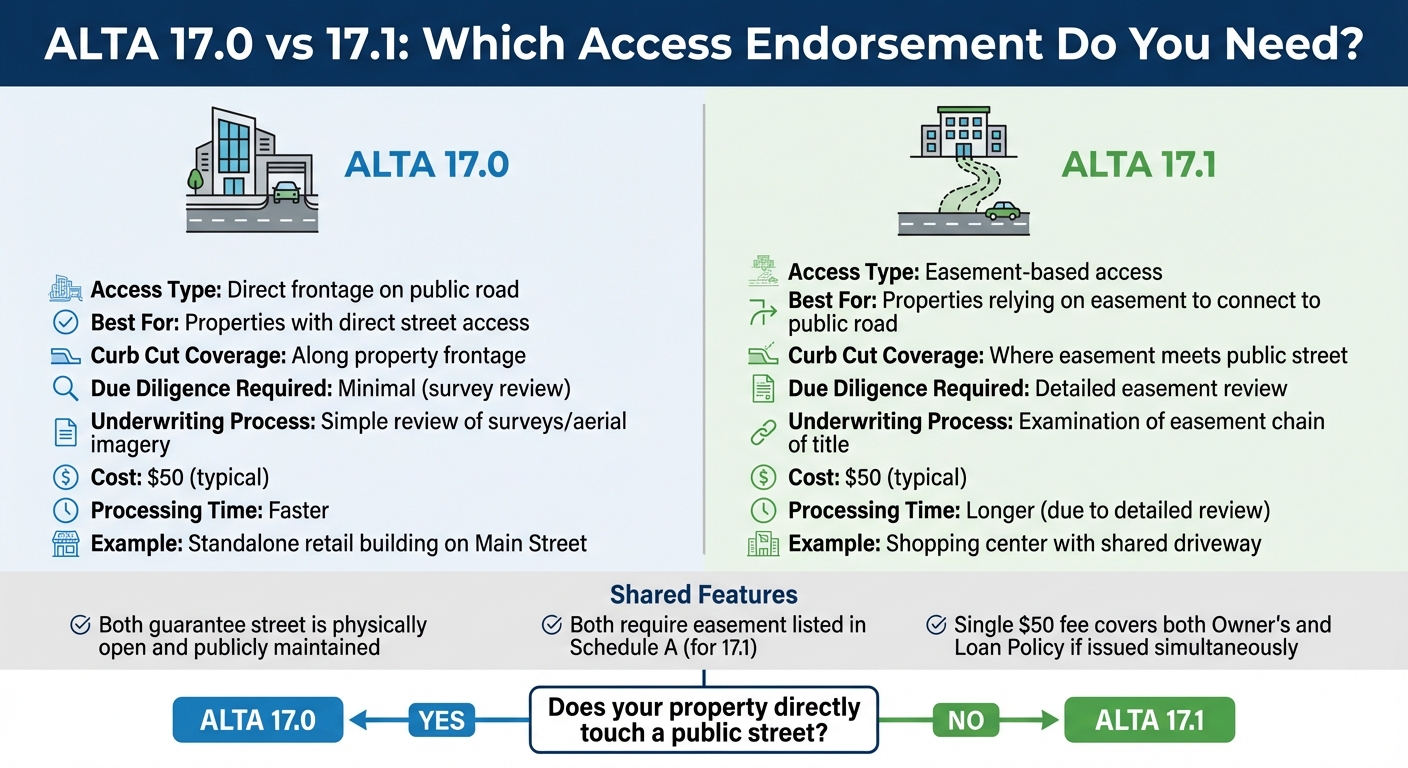
ALTA 17.0 vs 17.1 Access Endorsement Comparison Chart
Main Differences Between ALTA 17.0 and 17.1
Coverage Comparison
The key difference between ALTA 17.0 and ALTA 17.1 lies in the type of property access they cover. ALTA 17.0 applies to properties that directly border a public street, while ALTA 17.1 is designed for properties that rely on an insured easement to connect to public roads. This distinction plays a big role in deciding which endorsement suits a property's specific access needs.
Both endorsements guarantee that the designated street is physically open and publicly maintained. They also provide protection for existing curb cuts: ALTA 17.0 covers curb cuts along the property's frontage, while ALTA 17.1 applies to curb cuts at the point where the easement meets the public street.
The underwriting process for ALTA 17.1 is more detailed. Title professionals must examine the easement's chain of title to identify any potential use restrictions or maintenance obligations. On the other hand, ALTA 17.0 typically requires a simpler review of surveys or aerial imagery to confirm direct street access and ensure there are no physical barriers.
When to Use Each Endorsement
Choosing the right endorsement is essential for protecting property access and ensuring smooth operations. Here's a quick guide:
- ALTA 17.0: Best for properties with direct frontage on a public street. This is a common scenario for standalone commercial buildings with entrances that face the street.
- ALTA 17.1: Ideal for properties that do not directly connect to a public street but instead rely on an easement for access. This endorsement is particularly useful in complex commercial setups where shared driveways or easements are essential. Keep in mind that the easement must be listed in Schedule A of the title policy.
Cost Differences
In most cases, the cost of these endorsements is the same. For instance, in New Jersey, both ALTA 17.0 and ALTA 17.1 are priced at $50.00 each[2]. If both an Owner's Policy and a Loan Policy are issued at the same time, a single $50.00 fee covers the endorsement for both policies. However, it's worth noting that ALTA 17.1 requires more extensive due diligence, which could lead to delays in issuance even though the pricing remains consistent.
sbb-itb-df8a938
How to Choose the Right Endorsement
Evaluating Property Access Requirements
Start by reviewing your property survey to determine if the property directly touches a public right-of-way. If there’s direct contact, ALTA 17.0 is the endorsement you’ll need. However, if there’s a gap requiring access through another property, ALTA 17.1 is the better fit.
Be mindful of elevation differences between your property and the street, which could create obstacles for vehicles or pedestrians. Additionally, check for curb cut rights - sometimes, even if a property borders a road, physical barriers or missing legal access points can restrict actual entry. As CATIC Title points out:
Attention should be paid to any barriers to access including the possibility of the street and property being at different elevations [2].
For ALTA 17.1 situations, confirm that the easement providing access complies with policy standards. Once you’ve gathered this information, consult your title professional to review the legal documents and easement history in detail.
Working with Legal and Title Professionals
Engaging a title professional early in the process is essential. They’ll review your survey and investigate the easement’s chain of title for any restrictions or maintenance responsibilities that could impact your access rights. This step is especially critical for ALTA 17.1 endorsements, as shared driveways or easements often come with obligations that aren’t immediately apparent. The easement must also be explicitly included in Schedule A of your title policy.
Title underwriters rely on surveys, filed maps, and even overhead imagery to confirm access. They also ensure compliance with state-specific regulations, since some jurisdictions may adapt standard ALTA forms. Emily from Zwiren Title Agency explains it clearly:
If there is no separate access easement and the Land directly abuts the street, then the ALTA 17-06 is the proper endorsement [4].
For more complex situations - like shopping centers, multi-building developments, or landlocked parcels - your title professional’s expertise becomes even more critical. These scenarios often involve multiple parcels and shared access routes, which require thorough documentation. As CATIC Title notes:
The endorsement is most requested for commercial transactions where client, customer, or employee access are critical issues or for shopping center or multi-building complexes where access is by common driveways crossing numerous parcels before reaching the insured property [2].
In addition to verifying access, it’s important to consider how the due diligence process might affect your closing timeline.
Weighing Coverage Against Cost
Don’t let cost dictate your decision - both endorsements come with the same fee. If you’re issuing both an Owner’s Policy and a Loan Policy at the same time, you’ll typically pay a single $50.00 charge for both.
The real cost is time. ALTA 17.1 requires a detailed easement review, which can extend your closing schedule. While it might be tempting to skip this step to save a few days, choosing the wrong endorsement could leave you without the protection you need if access problems arise in the future.
The priority should always be securing the right coverage for your property’s specific access situation. While the price difference is negligible, the consequences of selecting the wrong endorsement could be far-reaching if access issues come to light later.
Case Examples
Case Study: ALTA 17.0
A standalone retail building with direct street frontage often qualifies for ALTA 17.0. Take, for instance, a single-story office building located on Main Street with its own curb cut. In this setup, the property line directly touches the public right-of-way, allowing immediate access for both vehicles and pedestrians.
Here’s how it works: the title company verifies that the property borders a publicly maintained street. The endorsement then protects the buyer if it turns out that the street isn’t actually public or if the curb cut rights were never properly established. Since no easements are involved in this example, the underwriting process is straightforward. Typically, it only requires an updated ALTA survey and confirmation from municipal records.
On the other hand, properties needing easement-based access present a different set of challenges.
Case Study: ALTA 17.1
The Prose v. Old Republic National Title Insurance Company case from March 2025 illustrates how ALTA 17.1 functions. Mr. Prose acquired several lots on Michigan’s "Treasure Island" peninsula, which relied on access via Edgewater Drive and a bridge to connect to the nearest public road. When Edgewater Drive became unusable and legal disputes arose over bridge access, Old Republic stepped in under the access endorsement. The insurer funded the bridge replacement and secured a legal easement from the State of Michigan, ensuring the property retained both legal and physical access to the public road [6].
However, the court clarified a critical limitation. When Mr. Prose argued that the endorsement should also cover internal access between various improvements on his property, the court ruled against him. As expert witness Bushnell Nielsen explained:
"The only indemnification that addresses the connection from the public road to the insured parcel is the assurance that the Land 'abuts' the street... this assurance stops at the line between the street and the insured Land" [6].
In simpler terms, the endorsement guarantees access to the property boundary but doesn’t extend to internal circulation within the property.
What These Cases Show
These examples highlight the practical application of these endorsements. The main takeaway: ALTA 17.0 applies to direct access, while ALTA 17.1 addresses easement-based access. The Prose case emphasizes that access coverage ends at the property line - it doesn’t ensure you can navigate between different buildings or areas within the property. For shopping centers or multi-building complexes, ALTA 17.1 is essential because they often rely on shared driveways that cross multiple parcels before reaching public roads [2]. While the endorsement secures access to the property boundary, internal circulation requires separate coverage.
Conclusion
Core Differences Recap
Choosing between ALTA 17.0 and 17.1 depends on how your property connects to a public road. If your land directly borders a publicly maintained street, ALTA 17.0 provides coverage for direct access, including vehicular and pedestrian use, as well as curb cuts [4][3]. On the other hand, if your property relies on an easement across another's land to reach the public road, ALTA 17.1 is the appropriate endorsement [1][4]. Both ensure the road is physically open and maintained by public authorities, but they differ in the specific access path they protect. This distinction is key when securing the right coverage.
Making the Right Choice
To determine the correct endorsement, start by reviewing a survey to confirm whether your property has direct street frontage or relies on an easement for access [2]. If access depends on an easement, ensure it’s listed in Schedule A of your title policy [4][5]. This verification is critical for ALTA 17.1 coverage to apply.
It’s also important to work with your title underwriter to confirm the street’s legal status and check for any physical barriers, such as steep elevation changes, that might obstruct access [2]. For easement-based access, review the easement’s title for restrictions or maintenance responsibilities [2].
Final Thoughts
Careful evaluation and expert guidance are essential to match your property's access needs with the right endorsement. These endorsements protect a fundamental property right - the ability to reach it via a public road. Whether you're purchasing a standalone building with direct street access or a shopping center that relies on an easement, selecting the correct endorsement ensures your investment remains accessible. By thoroughly assessing your property's access situation and consulting title professionals, you can avoid future disputes and secure peace of mind. Access endorsements are a key step in safeguarding your property’s value and usability over time.
Common Endorsements in Commercial Transactions
FAQs
Can I get ALTA 17.0 if my property also uses a driveway easement?
Yes, you can get ALTA 17.0 coverage if your driveway easement provides both vehicular and pedestrian access to a public street. However, the easement must also meet specific conditions: it should be physically open, properly maintained, and allow for the use of any existing curb cuts.
What documents does the title company need to issue ALTA 17.1?
To issue ALTA 17.1, the title company needs to ensure several conditions are met. First, they must confirm that the easement granting access to a public street is correctly titled and directly connects to the street. Additionally, they need to verify that the street is open and maintained by public authorities.
On top of that, the company must check that curb cuts are in place to allow actual physical access. Finally, they need to confirm that the property already has improvements that are in use.
Do these endorsements cover access inside the property, like between buildings?
The ALTA 17.0 and 17.1 endorsements address access to a property through public streets or easements, ensuring both vehicular and pedestrian entry. These endorsements confirm that the land connects to a specific named street or easement. However, they don't cover access within the property itself or between buildings unless it directly ties to the insured street or easement.